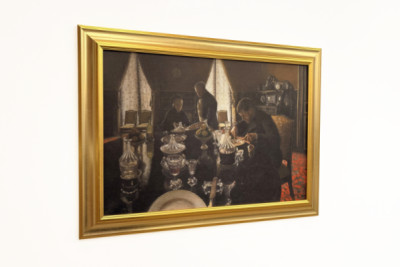
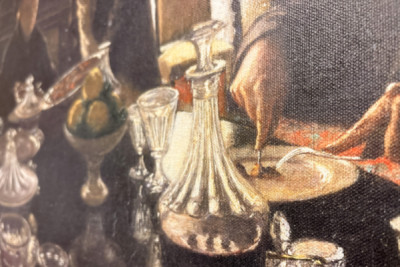
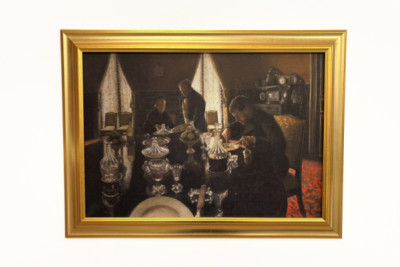
A faint glimmer of light lingers on the cut glass. All around, the room is bathed in deep browns and blacks. Gustave Caillebotte depicts his mother and his brother René having dinner in the family’s Paris flat on Rue Miromesnil. The two are not speaking to one another; each is going about their own business, whilst a servant stands behind the laid table. Carafes, bowls and cutlery form a dense still life in the foreground, their reflections adding texture to the dark background. Two light-coloured curtains open up the room towards the rear and set the rhythm of the composition, whilst on the right the red carpet provides a striking accent. Caillebotte painted the scene in 1876. He belonged to the Impressionist circle, but often sought a stricter spatial arrangement than many of his contemporaries. Here, he is not interested in a social occasion; he is observing middle-class everyday life within his own home. It is precisely the absence of any plot that captivates me: it is merely a shared meal, and yet it gives the impression of a brief glimpse into a private life that is scarcely aware of being observed.
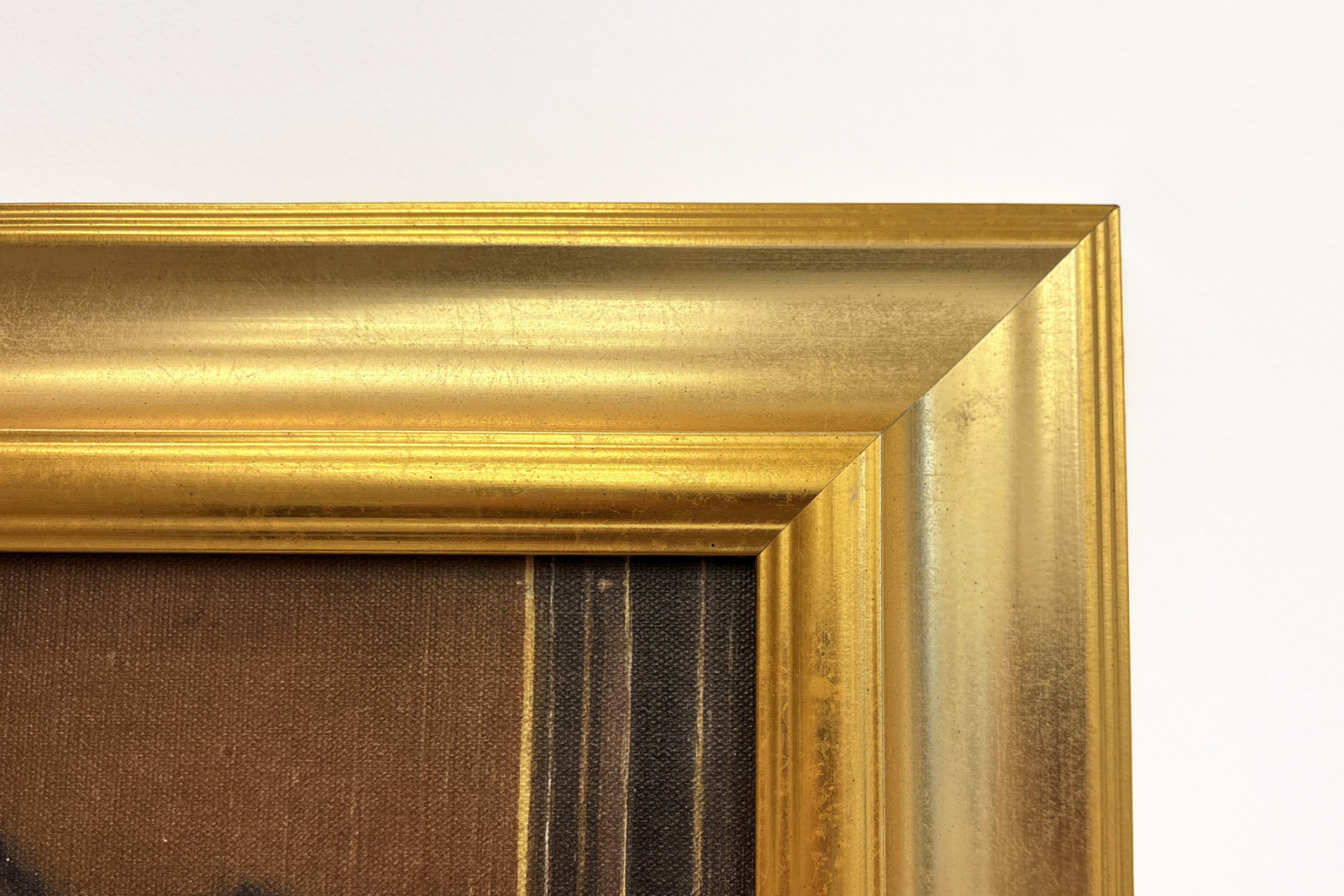
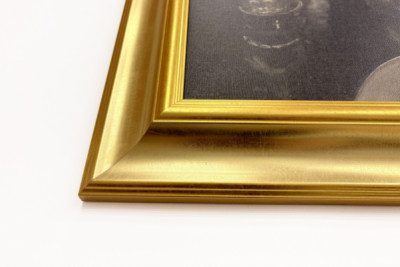
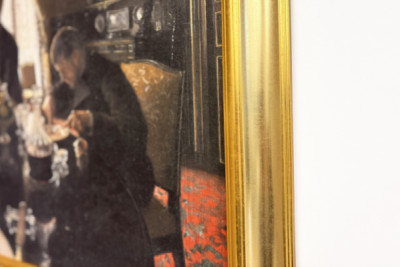
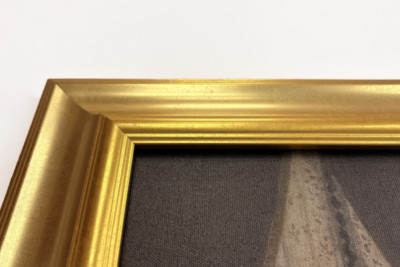
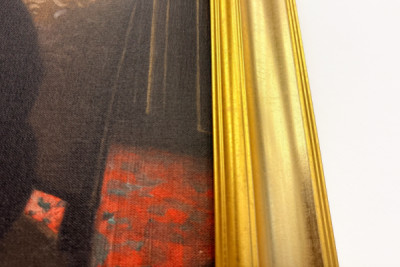
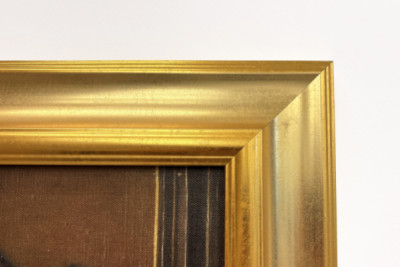
This work measures 69 x 48 cm and is painted on Leonardo canvas with a satin finish. The subtle sheen plays a surprisingly important role in this dark motif. Above the large carafe next to René’s hand lies a broad reflection that remains soft, allowing the printed contours beneath to be discerned. Nor does any harsh patch of light appear on the black tablecloth; instead, a subdued sheen spreads across the glasses and plates. This is in keeping with Caillebotte’s own treatment of light, without obscuring it with an additional pane of glass. Depending on the viewing angle, individual sections briefly stand out before receding once more into the deep darkness - it is precisely this alternation that brings the otherwise very tranquil scene to life. Ava frames the canvas directly, without a passe-partout. The wide gold moulding is divided into several levels: light accumulates more strongly on the curved surfaces, whilst it is refracted in the narrow recesses. Viewed up close, the frame therefore appears less smooth than the frontal view might initially suggest. The visible gold edge at the inner rim delineates a clear boundary around the picture.
Above the red carpet, the satin-finished surface remains almost reflection-free; it is only around the carafes in the centre of the table that the light condenses once more into a bright veil. In the end, what really sticks in the mind is precisely what defines the picture: a perfectly ordinary dinner that one finds oneself watching for longer than one really ought to.
 ×
×





 +43 4257 29415
 support@meisterdrucke.com
 Mo-Do: 7:00 - 16:00 | Fr: 7:00 - 13:00