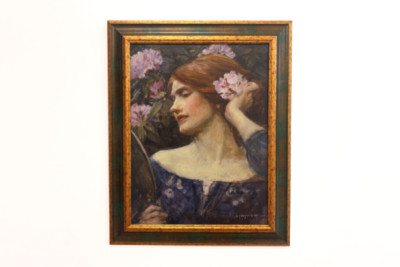
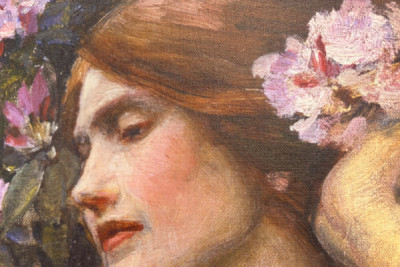
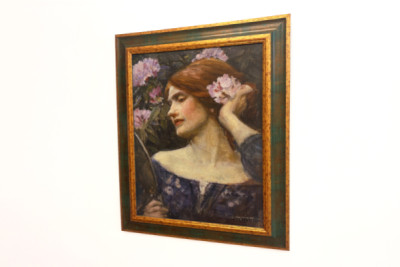
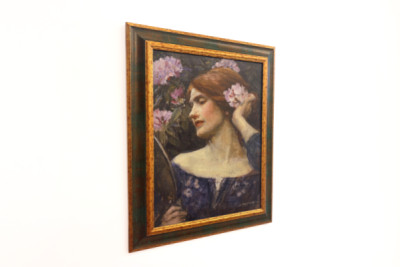
A young woman tucks a pink flower into her reddish-brown hair, a hand mirror in her left hand, her gaze lowered and completely lost in her own thoughts. Rhododendron branches encircle her like a dark arbour, from which the pale blossoms glow - pink and violet against the deep green of the foliage. The blue dress has slipped from her shoulder, and it is precisely this contrast that defines the picture: the warm flesh tones of her face and décolletage against the cool blue and the almost black background. John William Waterhouse painted this ‘Vanity’ in 1900, at the height of his career, straddling Victorian painting and the legacy of the Pre-Raphaelites. Unlike his grand mythological scenes, this motif requires no narrative - no Ophelia-style drama, no nymphs, just a private moment before the mirror. The title alludes to the ancient vanitas tradition, yet there is no trace of moralising; rather, one observes a gesture that has existed for centuries and is captured here without the slightest affectation.
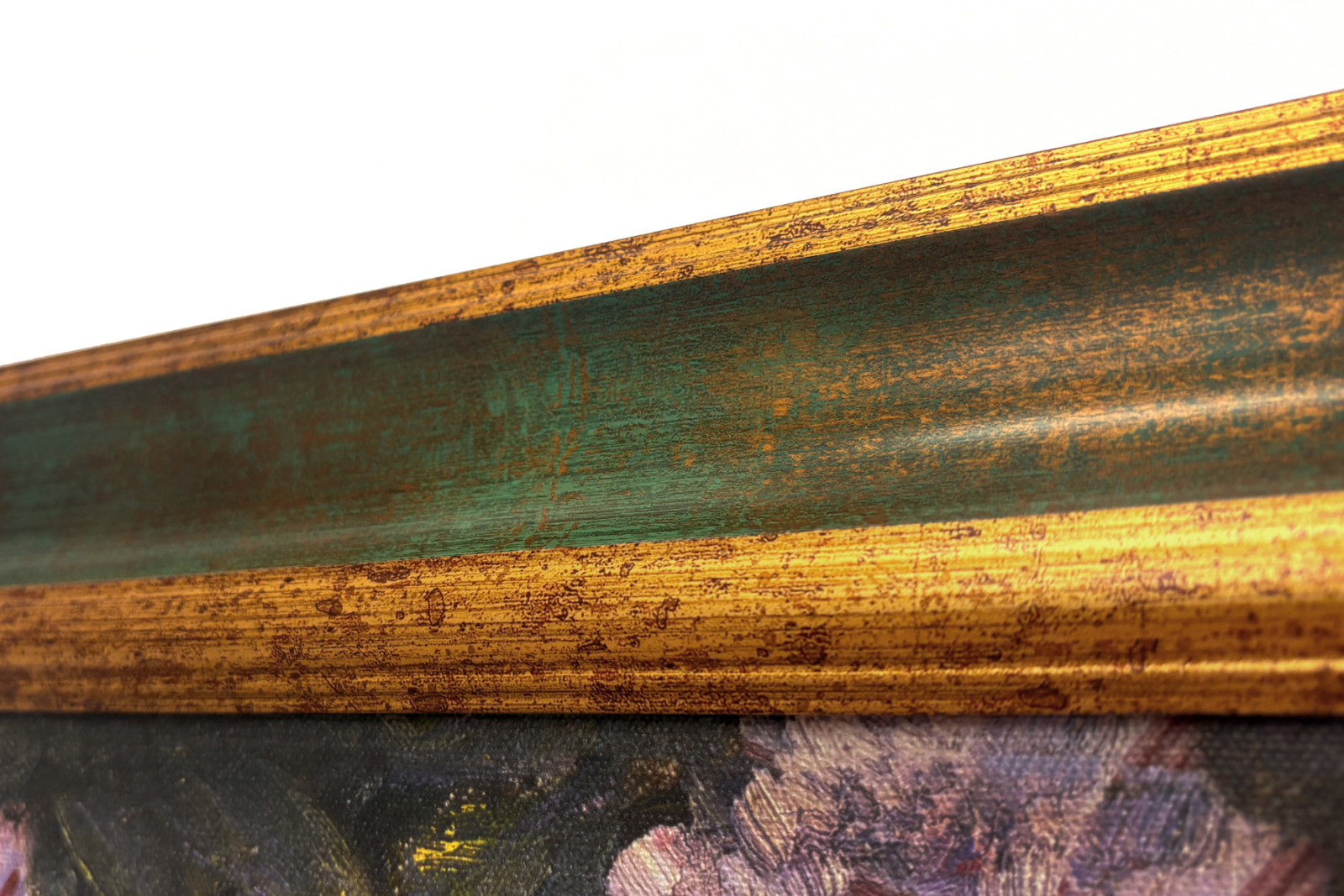
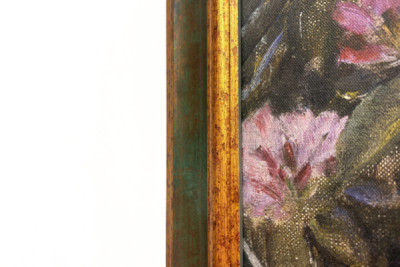
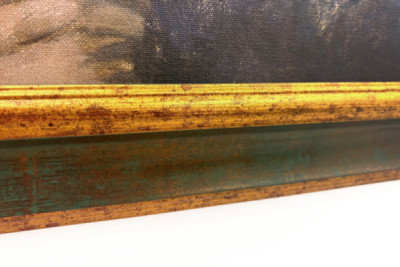
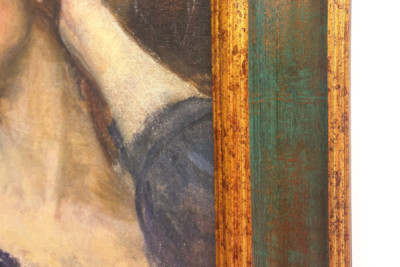
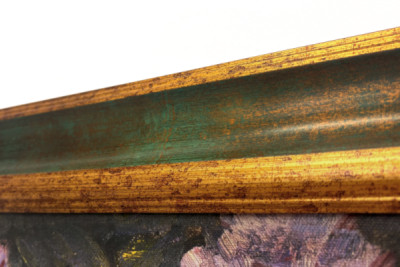
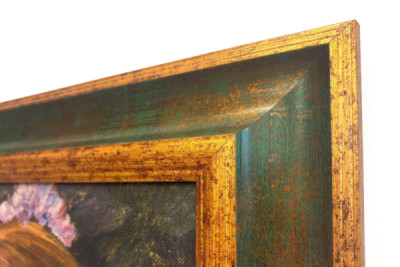
This piece left the studio as a canvas print without glass, and that is precisely what suits the motif: nothing stands between the eye and the surface. If you let your gaze wander over the blossoms at the top edge, you can see how the impasto white and pink tones of the original run across Leonardo’s canvas - the satin-finished canvas has a fine grain that lends the brushstrokes their own subtle relief. This is particularly noticeable in the dark areas of the foliage: where Waterhouse has applied the paint thinly, the structure of the canvas shines through, whilst the thickly applied highlights above stand out almost three-dimensionally. As a result, the surface appears less like a print and more like a painted surface that one feels like running a finger over. Framed, the whole piece hangs in ‘Lydia’, a wooden frame whose green central strip is interlaced with a gold grain; the rubbed gold on the inner edge meets the canvas directly, without a passe-partout or any gap. The fact that the green of the frame and the foliage in the painting are so close cannot be a coincidence - you only notice it at second glance, and once you do, you always see it. It is precisely such details that determine whether a reproduction works.
 ×
×





 +43 4257 29415
 support@meisterdrucke.com
 Mo-Do: 7:00 - 16:00 | Fr: 7:00 - 13:00