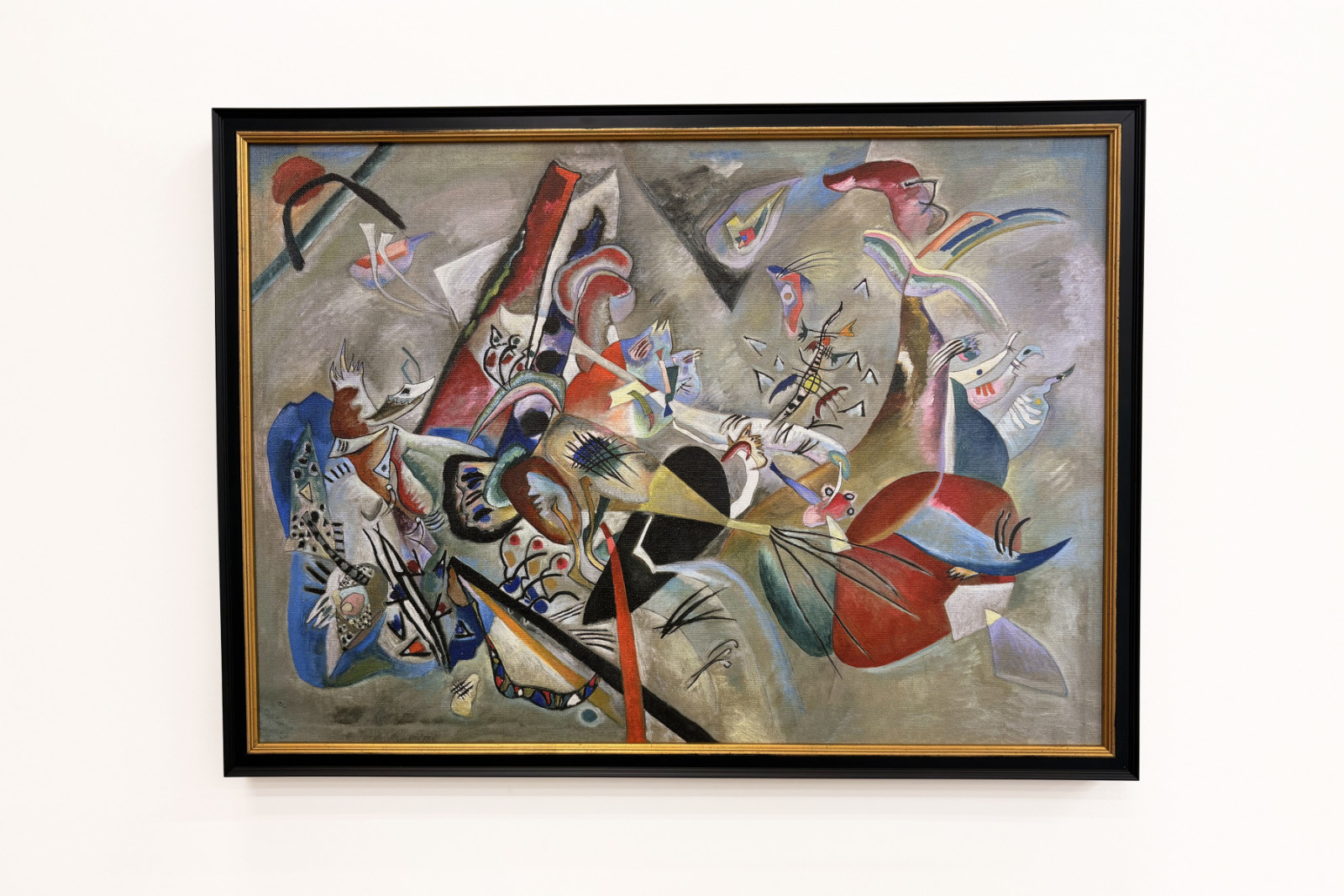
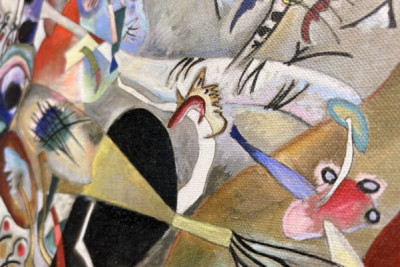
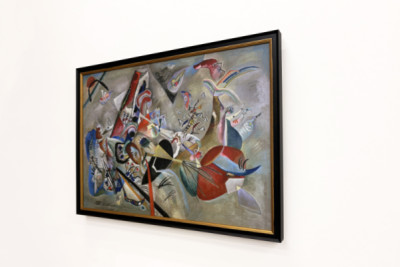
Here, the grey is not merely a background colour. It is the actual pictorial space. Kandinsky allows forms to float within it: red segments, blue crescents, black arcs, interspersed with fine lines like musical notes. Nothing is representational; everything is movement. Despite the title, the painting does not appear colourless - quite the contrary. Precisely because the background remains so subdued, the individual patches of colour stand out all the more. Measuring 49 x 35 cm, it is a compact landscape format, and the condensed composition works well within these dimensions. ‘In Grey’ was created in 1919, during a transitional phase. Kandinsky had moved beyond representational painting and was working on rhythm, tension and the independent life of forms. The painting marks a point at which early expressive abstraction gives way to something more orderly.
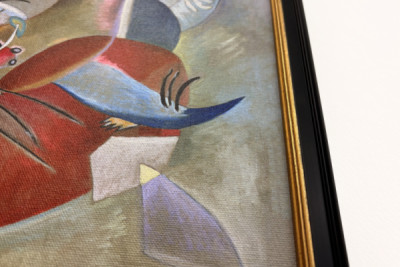
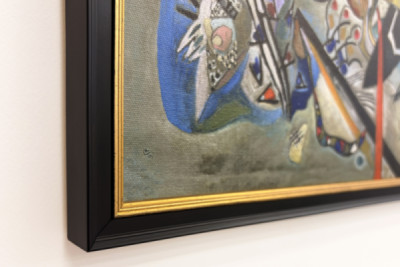
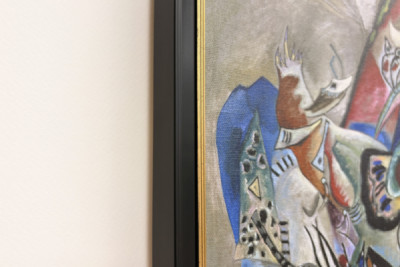
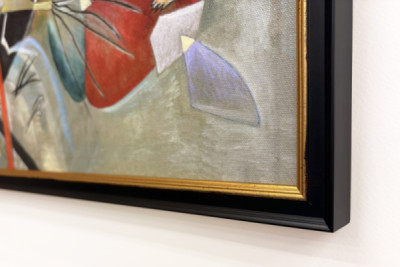
The ‘Amelie’ frame does exactly the right thing: it responds to the painting’s colours rather than overpowering them. Matt black on the outside, a narrow gold strip on the inside - both colours that appear in the painting itself. The black wedge shapes and clusters of lines find their counterpart in the dark outline, whilst the gold corresponds to the ochre and sandy areas in the centre of the picture. What catches my eye is the inner edge: there, a reddish patina shimmers through the gold leaf in places, complete with small dark speckles. This warm undertone links the gold strip with the large red shapes in the picture - this is clearly visible at the lower edge of the frame, where the worn gold sits right next to a red segment. The black-and-gold contrast also gives the open, abstract composition a clear outer boundary; a classic outline around a modern visual language, and it works. The whole piece is printed on Leonardo, a satin-finished canvas whose subtle sheen does not overwhelm the delicate grey gradations. The graphic lines remain sharp, right down to the small hooks and cross-hatching.
In the end, everything comes back to grey. It holds the composition together like a serene space from which the colours emerge - and the black frame extends this serenity outwards, whilst the golden edge sits precisely on the threshold between the two.
 ×
× 





 +43 4257 29415
 support@meisterdrucke.com
 Mo-Do: 7:00 - 16:00 | Fr: 7:00 - 13:00