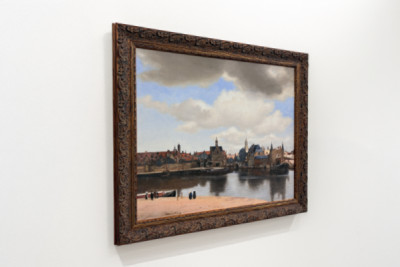
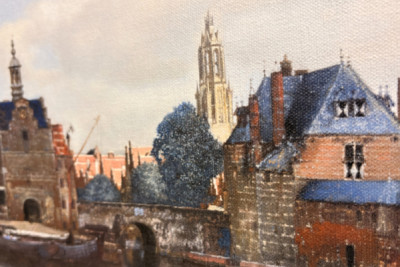
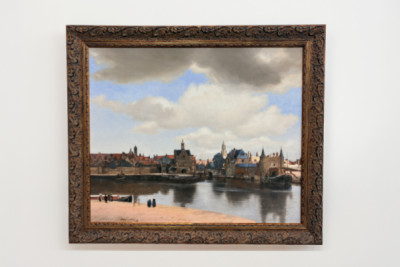
Large grey clouds drift across the blue sky, and beneath them the city lies as if frozen in time: Delft in the early morning, seen from the southern bank of the Schie, with gates, towers and tiled roofs reflected in the almost still water. Johannes Vermeer painted this view around 1660; it is one of only two known cityscapes by the Delft master, and perhaps his most tranquil work of all - no narrative, no event, just light wandering across the façades and illuminating individual roofs, whilst others remain in the shadow of the clouds. In the sandy foreground, a few figures stand together, small and incidental, as if they belonged more to the landscape than to the scene; far in the background, the tower of the Nieuwe Kerk catches the sunlight and stands out brightly against the cloudy sky. Measuring 58 x 48 cm, this tranquillity unfolds with astonishing completeness, printed on Leonardo satin-finished canvas, whose fine weave complements the soft transitions in the sky: subdued ochre and brick tones, dark, greenish water, all in that understated colour palette that has made the painting so special for three and a half centuries. Marcel Proust called it the most beautiful painting in the world, and anyone who stands before it for a while can at least begin to understand what he meant.
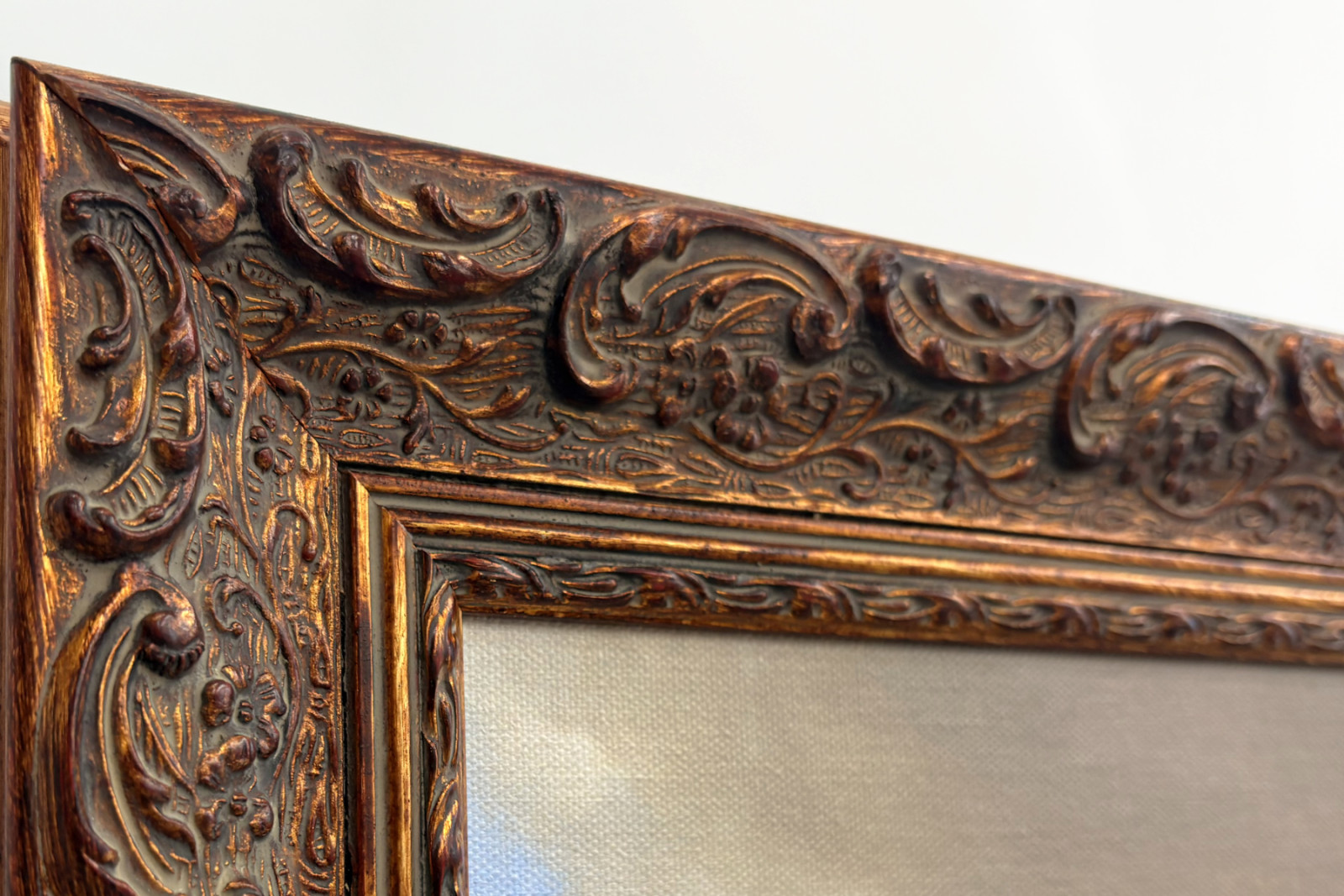
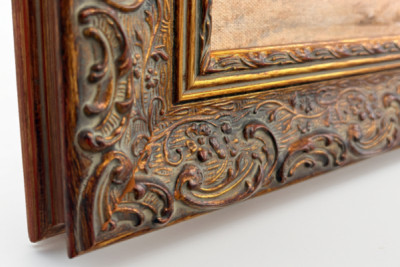
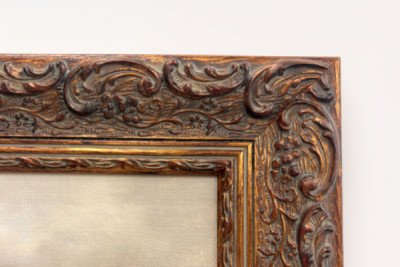
Framed, the scene hangs in ‘Lily’, a wide, ornate solid wood frame whose bronze hue forms a surprisingly precise connection with the painting. In terms of colour, the coppery blossoms and leafy tendrils lie exactly between the red brick roofs and the dark ship’s hulls at the quay; between the ornaments there is also a grey-green background that echoes the water and the shaded sections of the wall. This dialogue between the painting and its frame is only noticeable at second glance, but once spotted, it cannot be overlooked. One might object that such a richly carved profile is almost too opulent for Vermeer’s restraint - yet it is precisely this contrast that works: The city remains still, the frame takes on the task of representing it, and the narrow gold border on the inside mediates between the two. In the end, the gaze lingers anyway where the painting has always led it: on the water, the reflections of the towers, the light that will have moved on in the next moment - only here it remains still.
 ×
×






 +43 4257 29415
 support@meisterdrucke.com
 Mo-Do: 7:00 - 16:00 | Fr: 7:00 - 13:00