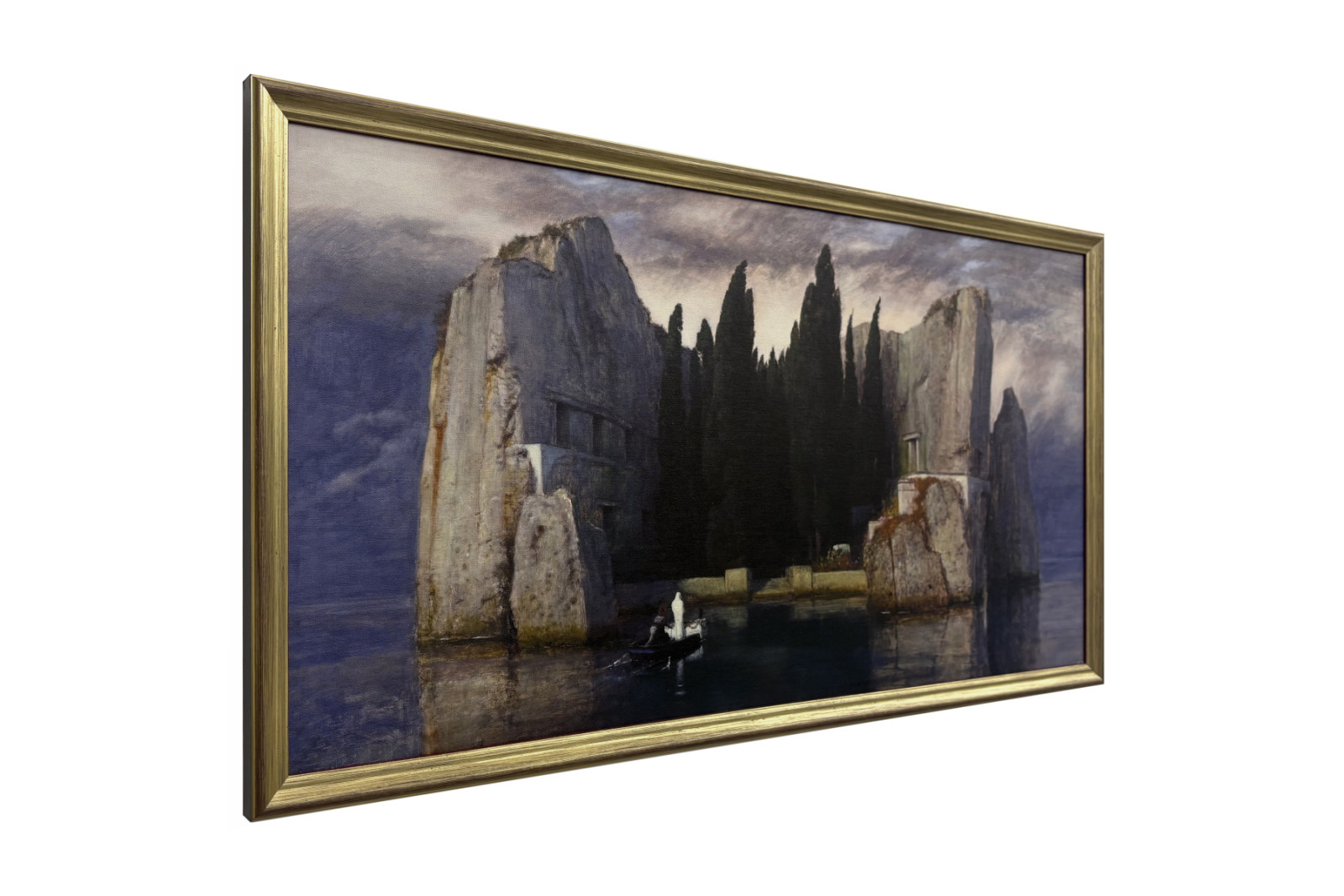
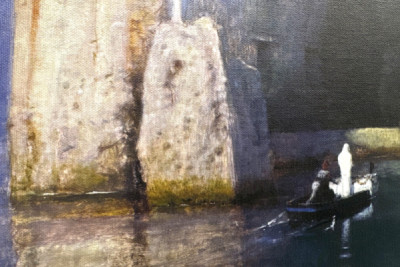
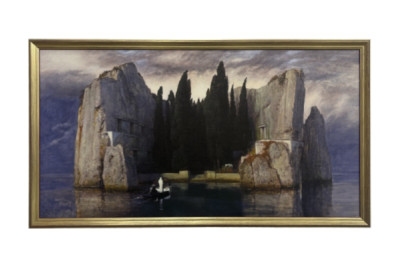
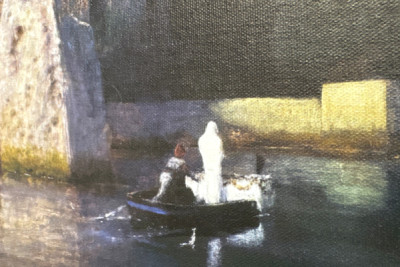
Amidst the darkness of the cypress trees lies a bright streak that Böcklin never painted: a reflection from a window that rests on the satin surface and shifts as soon as you take a step to the side. Only then does one look back at what remains beneath it - the island. In 1883, Arnold Böcklin painted a rock formation in the midst of still water, broken up into a semicircle of light-coloured rock, with burial chambers and dark doorways within it. In the centre, the cypresses crowd together into an almost black mass; above them, the sky breaks into streaks of pink and grey. In front of the quay wall, a boat, a rower, a white figure, and before him a coffin. No one speaks here, not even the water; only the reflections of the rocks ripple slightly. Böcklin, born in Basel and long at home in Italy, is counted amongst the forefathers of Symbolism, and he painted this motif on several occasions - the version shown here was created for the Berlin art dealer Gurlitt, from whom the title also derives. Böcklin himself preferred to speak of a painting for dreaming.
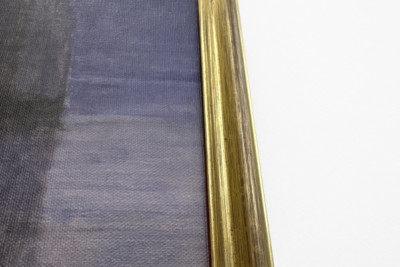
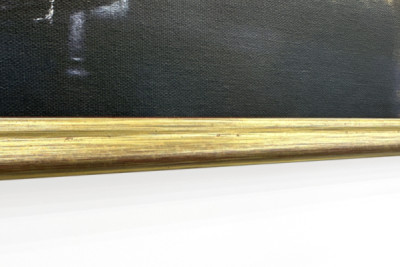
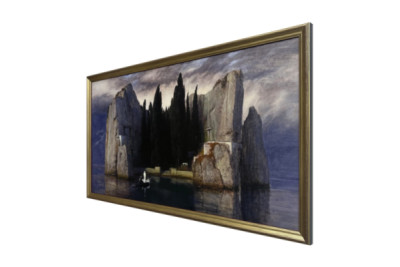
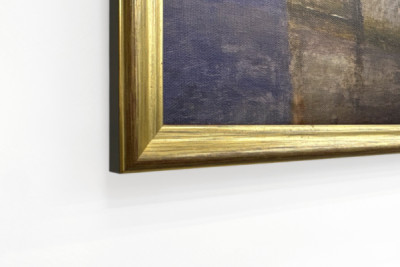
In Leonardo’s terminology, ‘satin’ means: not high-gloss, but not a dull matt finish either. The light glides over the fabric, catches in the dark green of the treetops and traces soft paths there, which are barely noticeable against the lighter sky. If you stand directly in front of it, the surface closes in again; then the blue-grey streaks of the water remain, and you can see that Böcklin’s glazes do not smudge in the print - to be honest, I would have expected them to on a 68 x 36 cm print. Nessa, a narrow gold moulding with a rounded profile, frames the picture without a passe-partout or glass, directly against the edge of the painting. Fine brushstrokes run through the gold, and a reddish base shimmers through at the curve - it is worn gold, not polished. It is precisely this that harmonises with the island: the warm border brings out the few light patches on the rock, whilst the boat appears all the smaller and more lost in the darkness. A wider frame would probably have overwhelmed this tranquillity; as it is, the eye lingers on the coffin, not on the plinth.
 ×






 +43 4257 29415
 support@meisterdrucke.com
 Mo-Do: 7:00 - 16:00 | Fr: 7:00 - 13:00