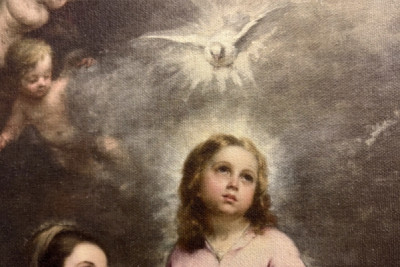
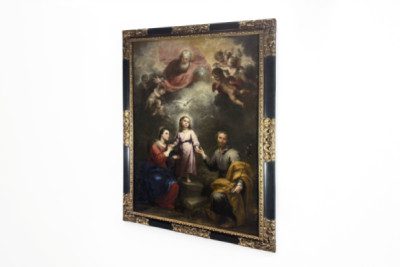
The child is standing on a rock, and both parents are each holding one of its hands, as if they wanted to support it and let it go at the same time. It looks upwards, towards where the dove descends from a bright patch in the clouds and God the Father, in a pink cloak, spreads his arms over the scene. Two lines thus intersect: the vertical line of the Father, the Holy Spirit and the Son, and the horizontal line of Mary, the Child and Joseph, both with the infant Jesus as their point of intersection. Murillo, a 17th-century Sevillian and one of the great storytellers of the Spanish Baroque, depicts theology here as a family scene: Mary in red and blue, Joseph with a lily staff in ochre, and between them the Child in pale pink, the only one not looking towards his parents. All around, cherubs and clouds dissolve into brown and grey; the light is concentrated almost exclusively on the faces. One believes this painting’s depiction of a child on a stone as the centre of the world because no one in it is posing solemnly - and I prefer that to many a more melodramatic heaven.
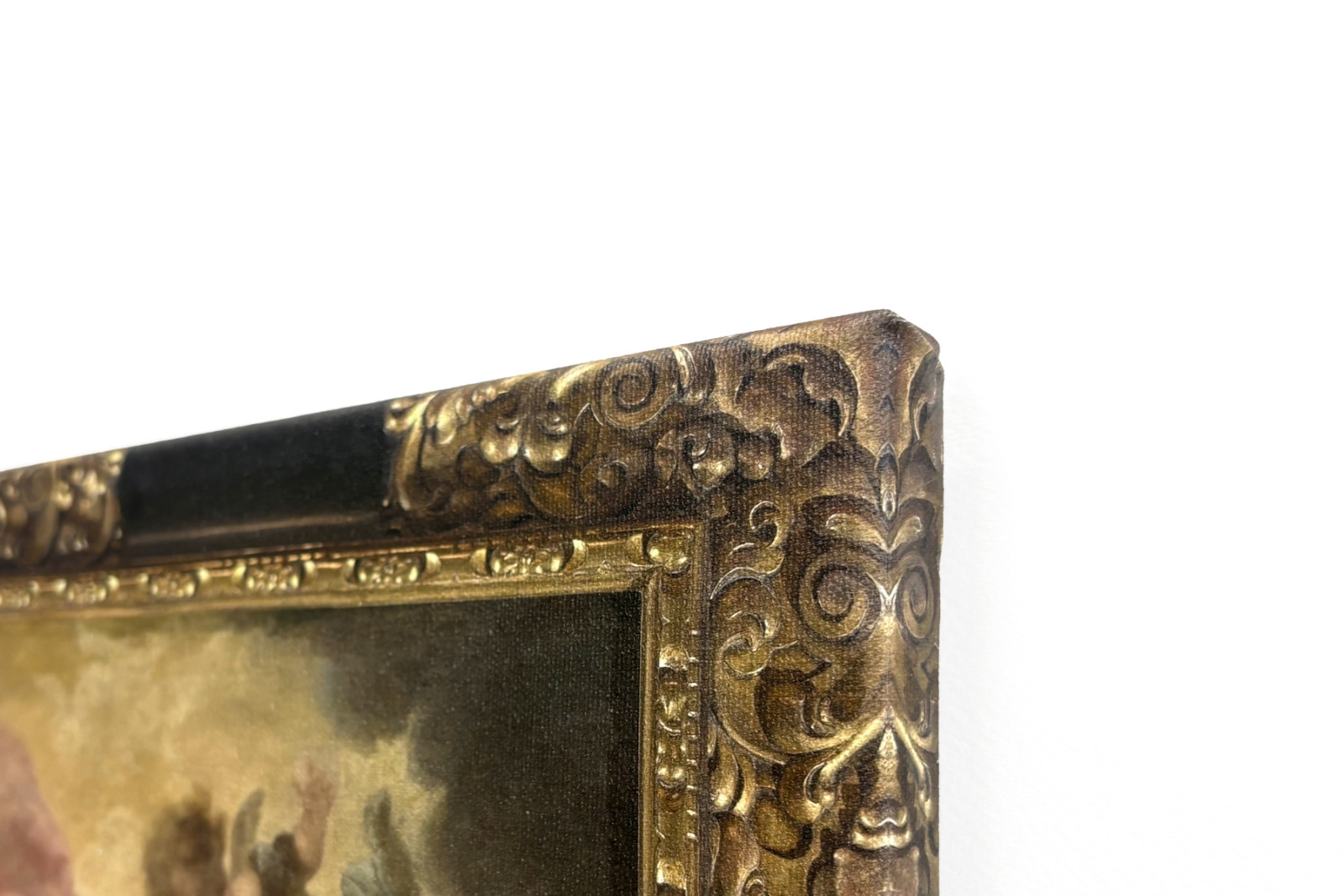
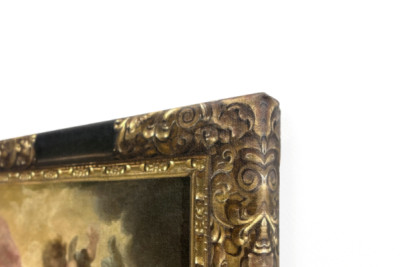
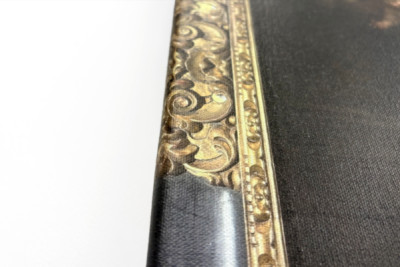
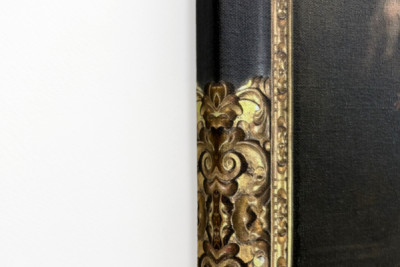
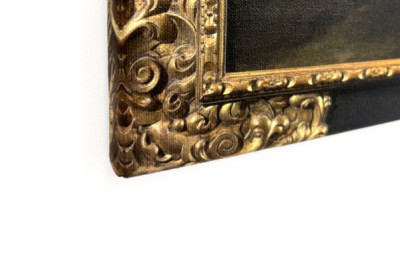
As for the frame, a clarification is needed at the outset: The gold is printed, not carved. The ornamentation, beaded border and black panels form part of the motif on the Leonardo canvas, whose satin fabric is visibly draped over acanthus tendrils and the moulding. In the top left-hand corner, the vine panels meet diagonally, and the painted mitre joint continues seamlessly over the edge, as the canvas wraps round the stretcher there. The narrow inner strip with its row of pearls remains the same width along its entire length; only when it reaches the edge of the picture does it end in a dark line. Between the corner cartouches, the surfaces remain jet black, and it is precisely this alternation of black and worn gold that echoes the darkness surrounding the group of clouds. Anyone who comes closer will, of course, notice that the shadows in the ornamentation come from the print; it took me a while before I stopped wanting to test the pearls with my finger. From a distance of two paces, the painted frame and the painted family merge into a single, 48 x 64 cm surface, and as far as I’m concerned, the painting sustains this illusion well.
 ×






 +43 4257 29415
 support@meisterdrucke.com
 Mo-Do: 7:00 - 16:00 | Fr: 7:00 - 13:00