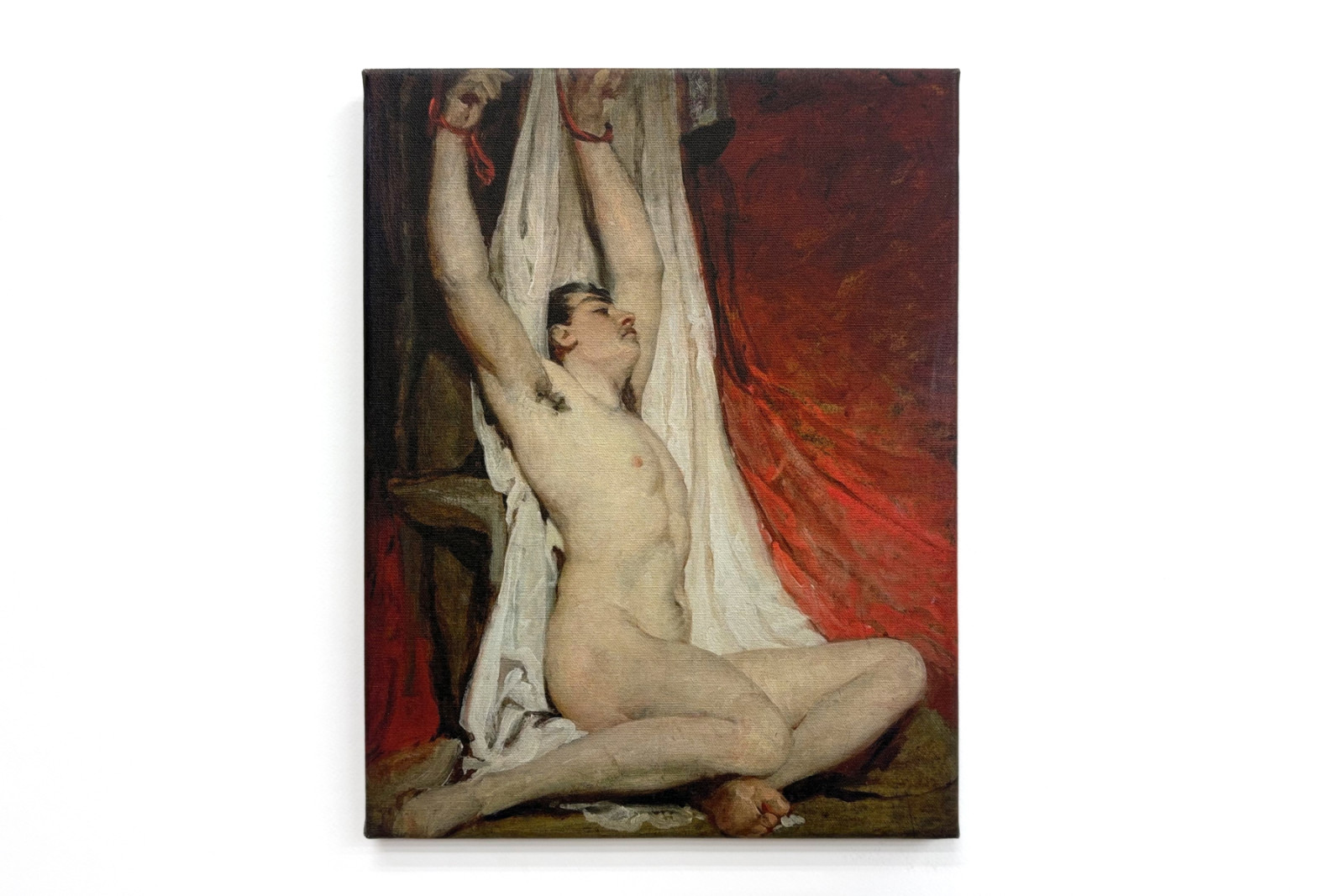
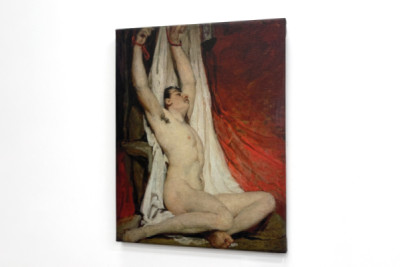
Two red strings hold the wrists at the top of the picture, and from there everything falls downwards: the outstretched arms, the head tilted back, the whitecloth, which hangs down behind the man like a second body, reaching down to his bent leg and the foot resting on the bottom edge. On the left, it remains dark and brown; on the right, a red curtain flares up; in between, the skin glows. William Etty painted this study in 1828, and one can see what matters to him: anatomy under tension, light on the chest and shoulders, the shadow in the armpit, the crimson shackle as the sole sharp splash of colour beside the curtain. The pose oscillates between surrender and exertion - the man is hanging, yet he is also sitting, and his face appears more relaxed than tormented, almost as if he were simply waiting for the painter to finish. Etty, known in England for his skin tones, usually kept such nude studies for himself; they were works on the human form, not intended for the salon. The original now hangs in the York Art Gallery.
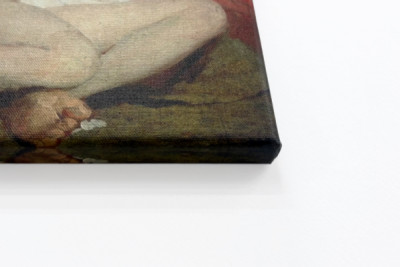
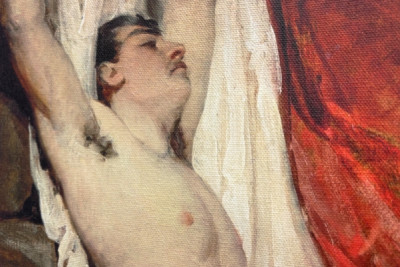
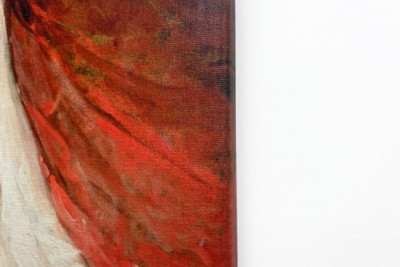
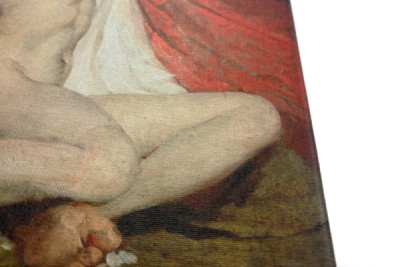
On the satin canvas ‘Leonardo’, 30 x 39 cm, the motif extends unframed over the edges and onto the sides of the stretcher - on the narrow right-hand side, the red curtain simply continues, and at the bottom, the olive-green floor cloth. Viewed up close, the surface reveals its texture: A fine grid lies beneath the paint, giving the smooth areas of skin a slight grain that comes closer to the oil ground of the original than any smooth paper. It is worth taking a closer look at the white cloth next to the head - there, Etty applies the paint thickly and quickly, and the print captures these impasto strokes as a visible relief, with light ridges and darker grooves in between. The shadow beneath the chin and the ankles of the foot also remain legible as distinct strokes, rather than as a soft expanse. Anyone expecting a strong silky sheen will find little of it; the canvas shimmers slightly, and the red appears rich, not varnished. The fact that a 41-year-old painter is primarily practising here, yet still presents a finished figure, is more evident in this piece than in many of his large historical paintings.
 ×



 +43 4257 29415
 support@meisterdrucke.com
 Mo-Do: 7:00 - 16:00 | Fr: 7:00 - 13:00