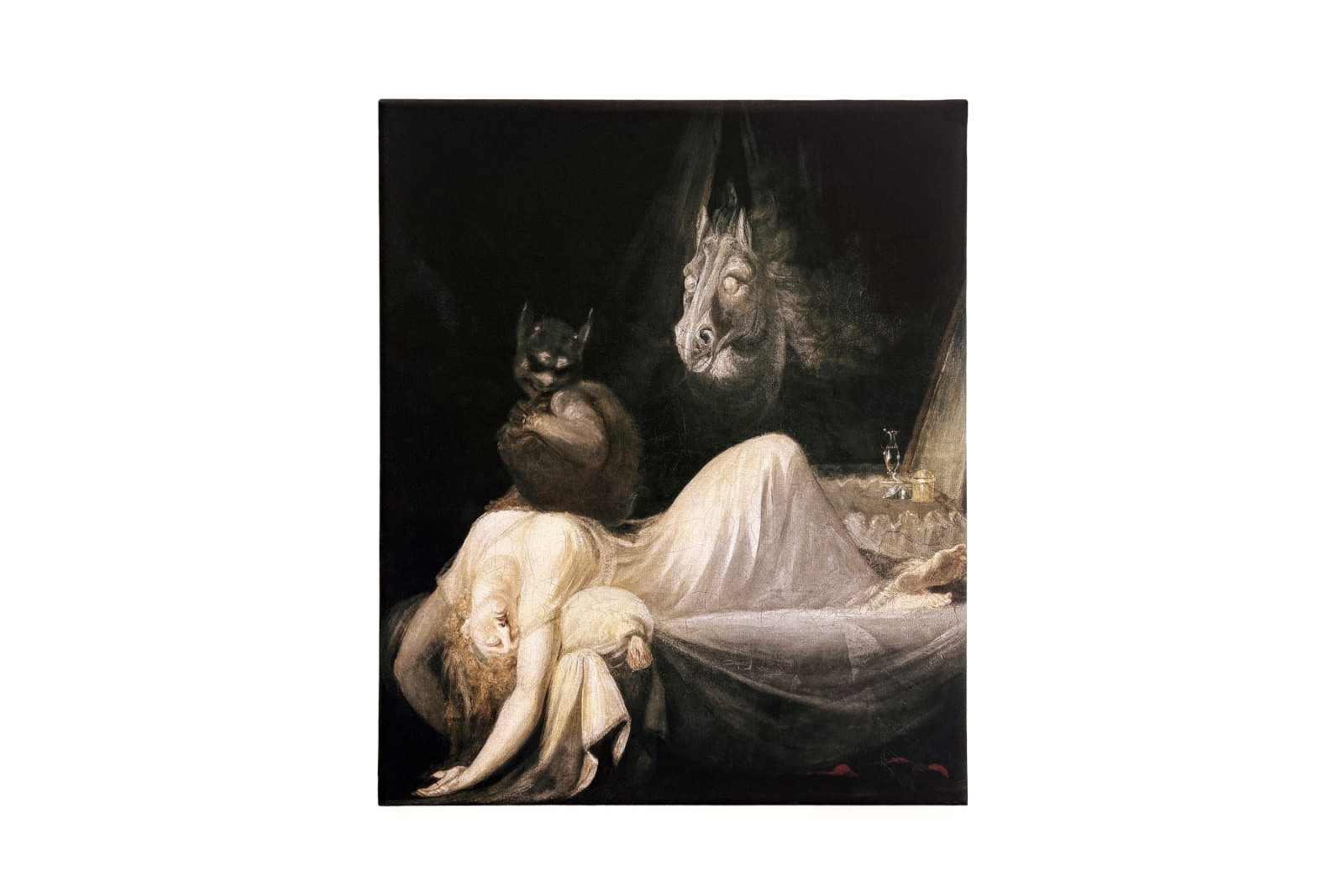
The woman in white lies sprawled across the bed, her head lolling backwards over the edge, one arm hanging down almost to the floor. Perched on her chest is the nightmare, a stocky, brown creature with pointed ears, looking not at her but at us - with a grin that, upon first seeing it, one might briefly want to return, but then finds oneself unable to. Behind the curtain, a horse’s head pushes its way into the picture, painted grey and smoky, with empty, pale eyes lacking pupils. Everything else is lost in black; only the sheet, the sleeper’s skin and, on the bedside table, a small glass vial next to a little jar still catch the light. Johann Heinrich Füssli, born in Zurich and living in London, painted the old folk belief of the ‘Mahr’ around 1781: a creature that sits upon sleepers at night and suffocates them until they wake up drenched in sweat. He does not depict the dream as an inner vision, but places the figures in the bedroom in the flesh. In 1782, the painting caused a sensation at the Royal Academy in London, and ever since it has haunted art history just as the Mahr haunts his sleeper - oscillating between Gothic Romanticism, eroticism and a humour that defies precise definition.
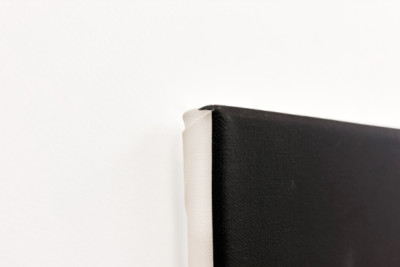
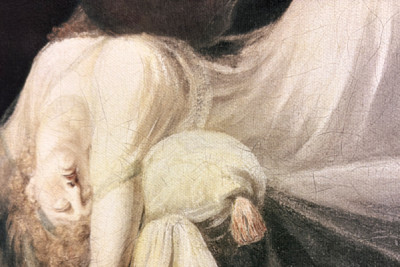
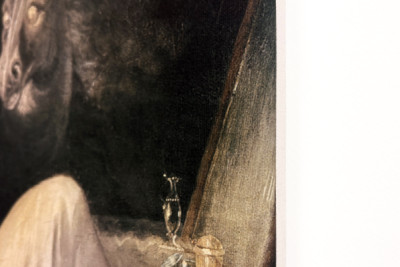
On Raphael’s matt canvas, the surface behaves exactly as this motif requires: the vast black surrounding the figures swallows the light rather than reflecting it back. If you tilt the stretcher frame in front of the window, no bright streak runs across the darkness; the horse’s head remains in its twilight, and the curtain reveals its painted folds without any glow of its own. The few points of light then truly originate from within the picture itself - the highlight on the neck of the glass vial, the horse’s bright eyes, the two points of red glinting at the edge of the bed. This can best be seen on the sheet. There, the print has retained the delicate craquelure of the original, a web of hair-thin cracks across fabric and skin; on a glossy surface, scattered light would obscure it; here, it remains legible in any light, even when viewed at an angle from the side. The fact that the side edges of the wedge frame remain white is, I take as a deliberate choice: from the front they disappear; in profile, they frame the black block with a narrow, light-coloured border. The format is compact, and it is precisely this that makes the scene appear like an open page, dense and sealed off from the outside world. From a distance of two metres, the picture is little more than a dark rectangle with a light-coloured sheet inside; only when you step closer do you realise that the Mahr has been watching you all along.
 ×



 +43 4257 29415
 support@meisterdrucke.com
 Mo-Do: 7:00 - 16:00 | Fr: 7:00 - 13:00