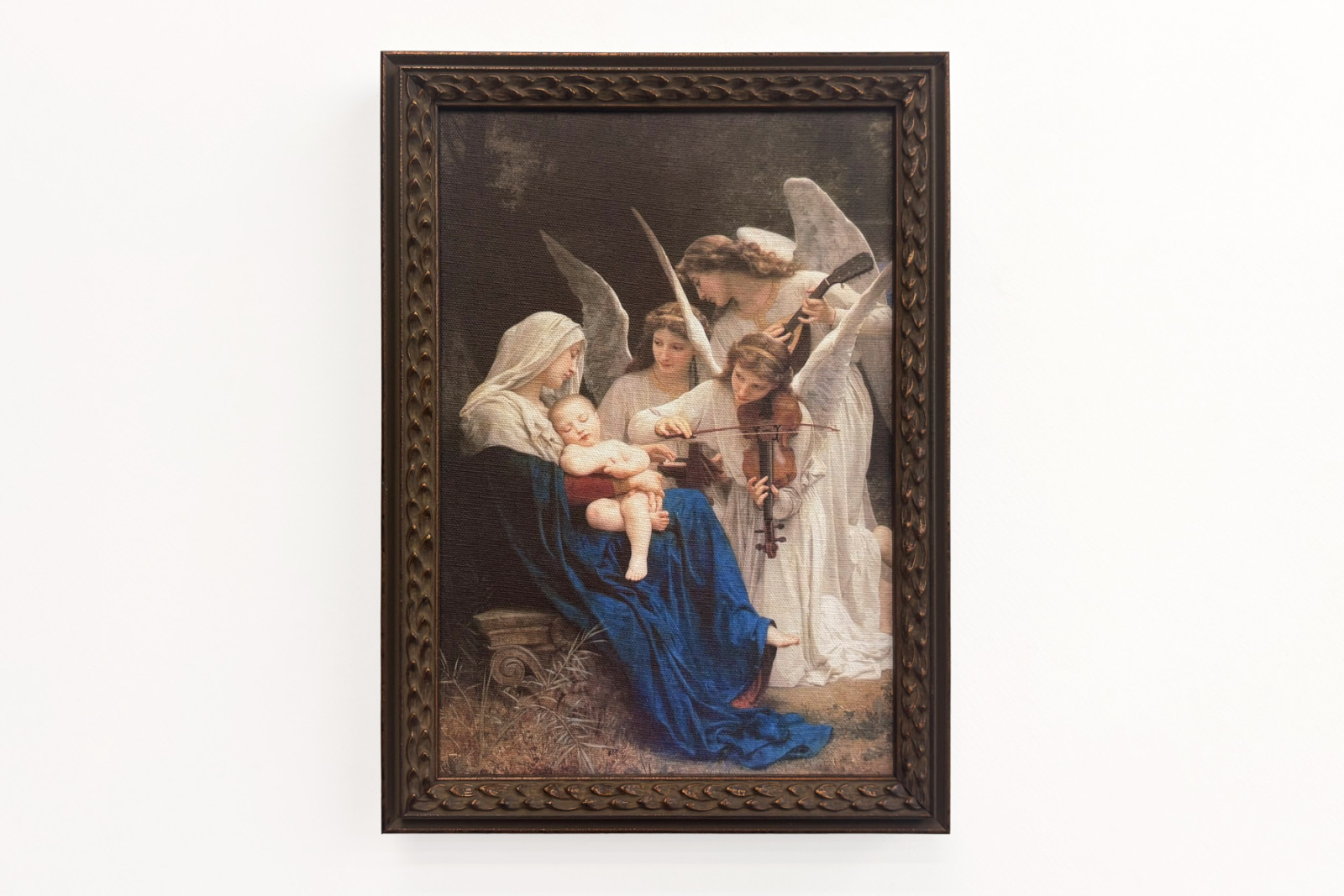
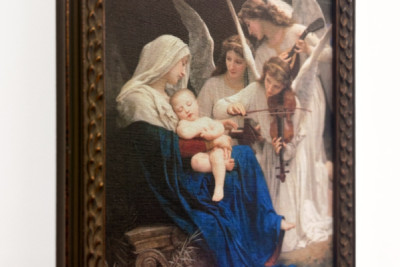
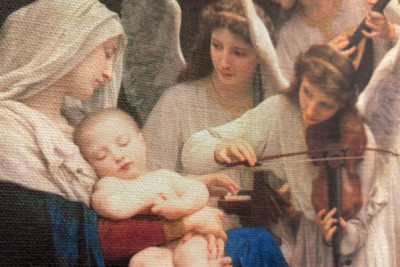
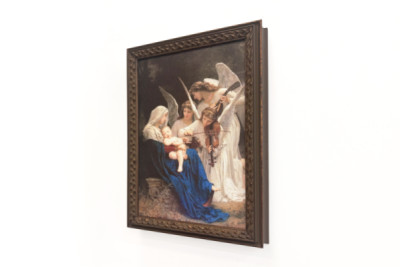
This is the sort of painting that brings the workshop to a brief standstill. In the top right-hand corner, a violin bow lies across the white sleeve of an angel, so delicate that it is barely wider than a thread of the fabric beneath it. From there, the eye wanders to the centre: a child sleeps on its mother’s lap, its head turned to one side, its fists half-open. Mary wears a light-coloured veil and a deep blue dress that falls over a stone plinth and down to the grass on the ground. Three angels stand close behind her, with a violin and a mandolin, playing so softly that no one wakes. The background remains almost black; only the wings catch a little light. William-Adolphe Bouguereau painted the scene in 1881, at the height of French Salon painting. Smooth skin, clear contours, every fold in its place. One might call it cool. Above all, I notice how still the group remains - and my gaze is drawn to the bow every time.
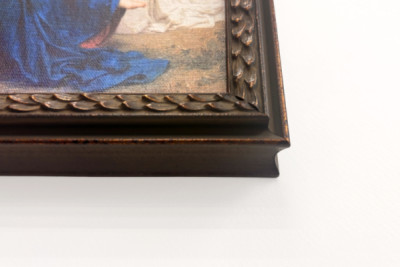
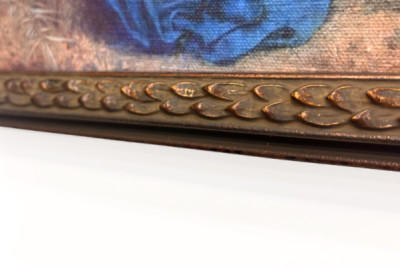
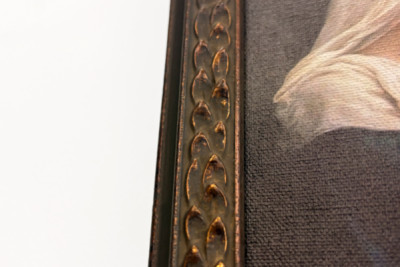
The painting is small, 20 x 29 cm, and that suits this stillness. Ria, a narrow bronze frame, is just 23 mm wide at the front but projects 41 mm from the wall. This transforms the picture into a box with a sense of volume. A band of embossed leaves runs across the front, interspersed with dark patina, with copper peeking through at the tips. You can feel this with your thumb. The ‘Leonardo’ canvas reveals its weave: on the child’s face, the weave is visible through the skin tones; against the black background, it lies like a coarse cloth. The satin sheen remains subdued; there is no glass in between. On the body of the violin, you can see the printed layer as a wafer-thin film over the fabric; the grain of the wood remains visible. Someone here has particular taste - and a keen eye for the frame. The row of leaves ends at the corners with a slight offset, visible at the bottom left where the blue of the coat meets the bronze. It doesn’t bother me. It shows that human hands were at work here.
 ×





 +43 4257 29415
 support@meisterdrucke.com
 Mo-Do: 7:00 - 16:00 | Fr: 7:00 - 13:00