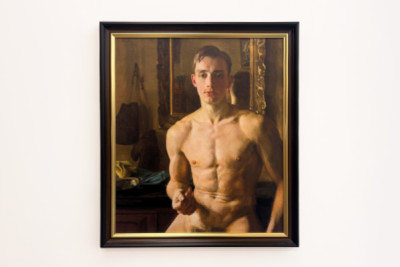
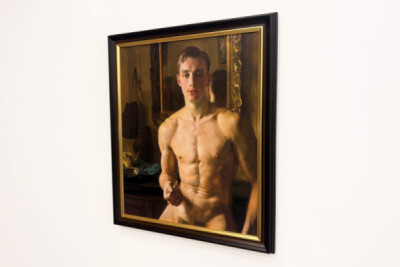
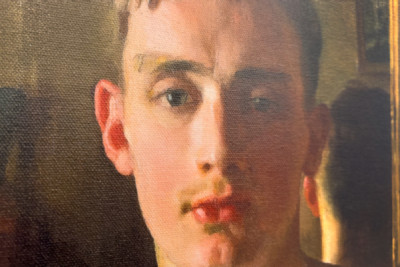
One would expect movement from a boxer - perhaps a punch, a dodge, or at least a visible readiness to fight - yet in 1933 Konstantin Andreyevich Somov depicts the young man with an unusual calm, facing the viewer head-on and almost upright, his gaze directed slightly past the viewer. The unclothed body fills the height of the picture; one hand is clasped in front of his abdomen, whilst the other extends out to the side from the neckline; the posture appears composed, yet by no means relaxed, as the shoulders, chest and abdomen remain tense. I find this very contrast particularly fascinating, because it makes the subject appear more like a psychological portrait than a sporting scene. Behind the figure lies not a boxing ring, but a subdued interior with a mirror, dark objects and partially visible furniture, whose brown, olive-coloured and black sections surround the light-coloured body. The light strikes the face and upper body from the front left, glides over the collarbone and chest, and fades into shadow on the right-hand side, so that physical strength is clearly emphasised without becoming the actual subject. Somov belongs to the circle of ‘Mir Iskusstva’, the Russian artists’ association that takes pose, refined visual effect and psychological nuances particularly seriously; here, too, the decisive element lies less in a narrative movement than in the elusive mood hovering between self-control, tension and vulnerability.
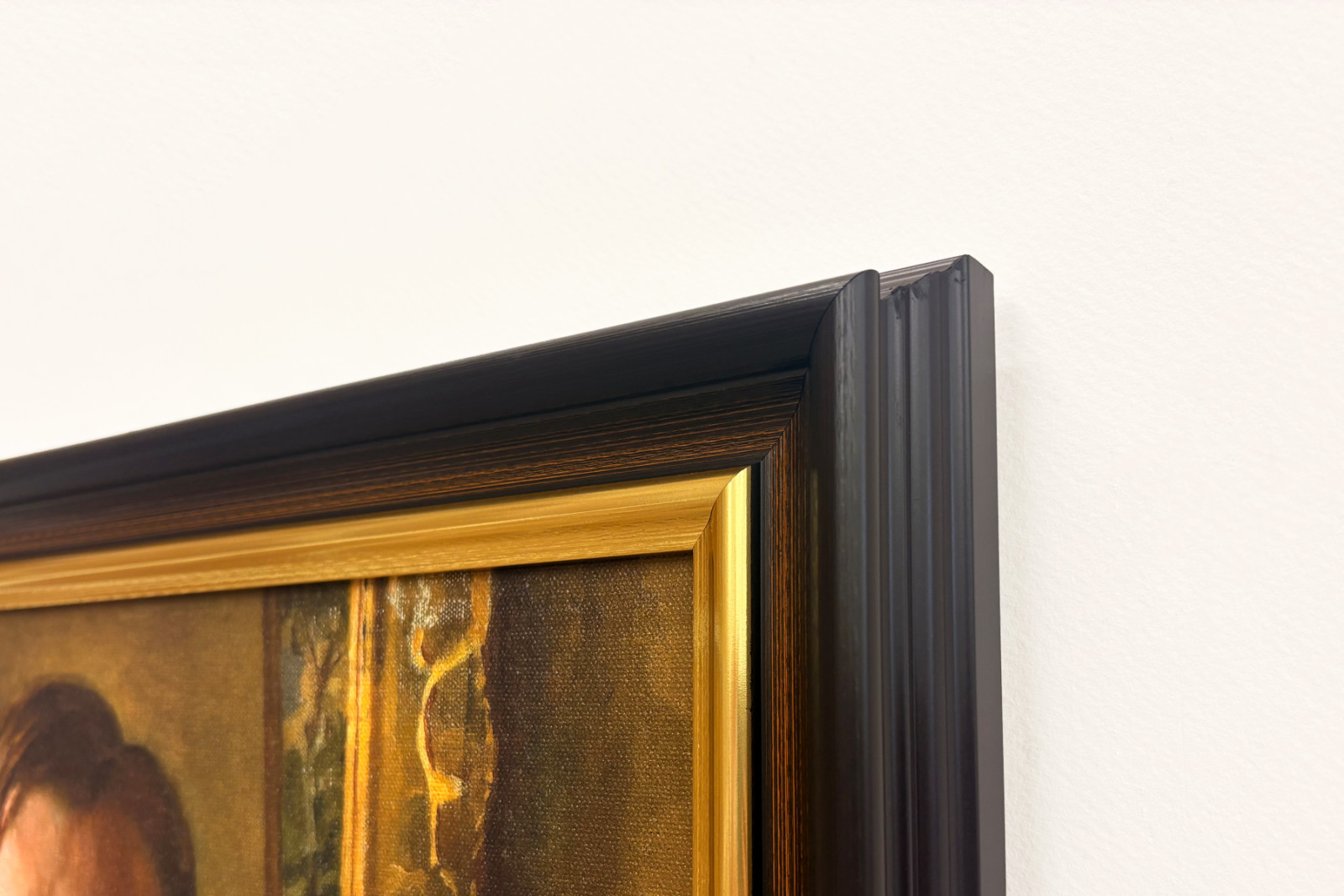
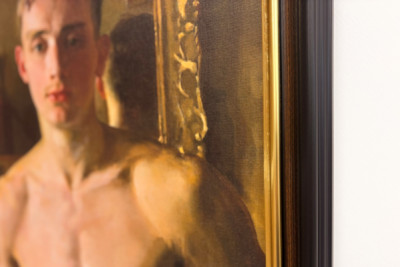
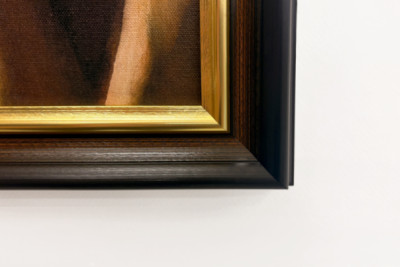
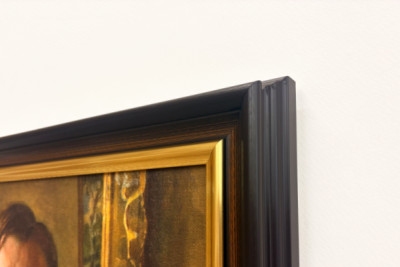
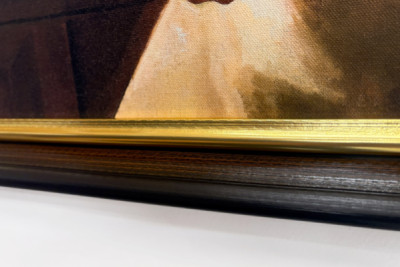
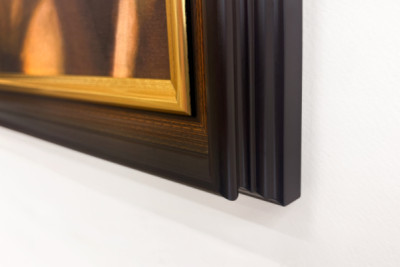
In this work, Lychorida imposes a distinct boundary on the understated portrait: black frames a light-brown moulding, whilst on the inside a narrow gold border marks the transition to the picture surface. However, it is the Leonardo (satin) canvas that sets the actual tone, as its gentle sheen does not distribute the incoming light evenly, but allows it to come to life in specific areas. No glass separates the viewer’s gaze from the printed surface. Soft reflections appear on the left breast and along the abdomen, revealing the printed brushstrokes, whilst the deep brown areas behind the body remain largely dark; whereas on the right shoulder blade a narrow glimmer of light appears, which shifts slightly depending on the viewing angle. This is not a completely matt finish, and it is precisely for this reason that the figure changes noticeably when viewed from the side: the forehead, cheek and chest stand out slightly brighter, without a uniform mirror-like sheen covering the face. Near the lower edge of the picture, the reflection gathers in the light areas of the thigh, breaks off at the dark shadow and only reappears on the golden inner edge - and yet, in the end, it is the posture that captures one’s attention: not the action, but this quiet, pent-up tension that holds the figure in its grip even within the frame.
 ×
×





 +43 4257 29415
 support@meisterdrucke.com
 Mo-Do: 7:00 - 16:00 | Fr: 7:00 - 13:00