On August 6, 1651, a young painter from Dordrecht stood in the audience chamber of Emperor Ferdinand III in Vienna and presented three paintings: a portrait, a Crowning with Thorns and a still life painted to look like a real letter rack, a wooden board behind whose leather straps letters and writing implements could be tucked. The emperor was deceived. Arnold Houbraken, a later pupil of the painter, recorded that Ferdinand declared him the first painter ever to have fooled him. As punishment, he kept the picture; in return, he gave the painter a gold chain with a medal of grace. The medal is now in the Kunsthistorisches Museum Vienna. The painter was Samuel van Hoogstraten, a Dutchman, and from then on he ostentatiously included the chain and medal in his still lifes. In “Feigned Letter Rack with Writing Implements”, now in the San Diego Museum of Art, it hangs among letters, a pair of scissors and a quill; the red seal glows against the dark wood.
Samuel van Hoogstraten was born in Dordrecht on August 2, 1627. His father Dirck, a painter and silversmith, gave him his first lessons; the family belonged to the Mennonite community. After his father's death, the adolescent entered Rembrandt's workshop in Amsterdam in the early 1640s. On May 16, 1651, he set out on the grand tour that took him to Vienna; in 1652 he traveled via Venice and Genoa to Rome, where the Bentvueghels, the fraternity of Dutch artists, gave him the nickname Batavier, after the ancient people of the Netherlands. In 1653 he returned to the imperial court and followed it to Regensburg that autumn.
“Man at a Window” dates from this period in Vienna and now hangs in the same museum as the imperial medal. An old man in a fur-trimmed cap leans behind the open casement of a leaded window, his gray beard falling over the frame, his gaze passing us by. A tiny glass vial stands on the stone sill, painted so precisely that one wants to reach for it. The picture feels like a practical test, for once again the eye is asked to trust a painted window.
He returned to Dordrecht in 1656. On May 22, the minters of Holland admitted him to their fellowship, and at the Dordrecht Mint he eventually served as provoost, a kind of superintendent; on June 18, he married Sara Balen. He also wrote sonnets and tragedies, while Aert de Gelder and that same Arnold Houbraken, who later recorded the imperial anecdote, studied in his workshop. From 1662 to 1667 he lived in London and painted a large perspective picture for the collector Thomas Povey. Samuel Pepys, England's most famous diarist, was fooled by it twice in January 1663 and noted that behind the open cupboard door there had been nothing but a flat painting; that was precisely what he admired most.
He took the game furthest in his perspective boxes. Six such seventeenth-century boxes survive worldwide; the most famous is by Hoogstraten and is the only one with two peepholes. The “Perspective Box of a Dutch Interior, 1663” demonstrates the principle, a walnut case painted in oils on the inside, with a glass mirror directing light into the interior. Viewed from the open side, the forms appear distorted; a cat crouches on the laid table beside a platter of oysters, while behind it a dark arch opens beneath the inscription Memento Mori, Remember Death. Only the peephole brings everything together into a convincing room.
The quietest of his illusions hangs in the Louvre: “The Slippers”. The museum dates the painting to the years 1655 to 1662; it shows a view through open doors into an empty sequence of rooms, with a broom leaning against the wall, a ring of keys hanging from a chair and the slippers waiting on the threshold. Misled by a false signature, the nineteenth century attributed the scene to the painter Pieter de Hooch, and for a time it was even considered a work by Vermeer; a dog and the figure of a girl were added to the painting and later removed. Only in 1955 did the art historian Eduard Plietzsch propose attributing the picture to Hoogstraten; today the attribution is undisputed, it hangs in the Louvre under his rightful name, and that same name now appears on the art prints we produce for our customers.
Finally, the deceiver turned his gaze upon himself and his knowledge. In 1677 he painted a “Self-Portrait”; in 1678 his textbook, the Inleyding, appeared in Rotterdam, an introduction to the high art of painting in nine books, each assigned to a Muse, and at the same time the only comprehensive theory of painting by a Dutch artist from the later seventeenth century. In it, Rembrandt's pupil passed judgment on “The Night Watch”, his teacher's famous group portrait of a civic guard: it was so painterly in conception and so powerful that all other militia paintings looked like playing cards beside it; he wished only that it had more light. Its author had only months left after publication. October 19, 1678, was his last day; Dordrecht buried its mint provoost in the Minters' Chapel of the Grote Kerk. Sara, his wife, died only a few weeks after him, on November 22, 1678.
 ×
× 






 Passionate Customer Service

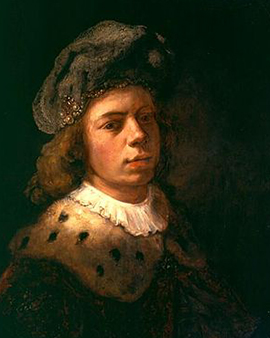
.jpg "Feigned Letter Rack with Writing Implements, c.1655 by Samuel van Hoogstraten")
.jpg)
.jpg "Man at a Window, 1653 by Samuel van Hoogstraten")
.jpg)
.jpg "The Slippers, late 17th century by Samuel van Hoogstraten")
.jpg)
.jpg "Perspective Box of a Dutch Interior by Samuel van Hoogstraten")
.jpg)
.jpg "Trompe-l'œil by Samuel van Hoogstraten")
.jpg)
.jpg "Trompe-l'œil by Samuel van Hoogstraten")
.jpg)
_-_1677_-_O_-_(MeisterDrucke-1323109).jpg "Self-Portrait by Samuel van Hoogstraten")
_-_1677_-_O_-_(MeisterDrucke-1323109).jpg)
.jpg "A Trompe-l'Oeil of Objects Attached to a Letter Rack, 1664 by Samuel van Hoogstraten")
.jpg)
.jpg "The Slippers. An Interior of a House in Holland - Painting by Samuel Hoogstraten (1626-1678), Flemish school, 17th century, 1.03 x 0.70 m, Paris, Musée du Louvre by Samuel van Hoogstraten")
.jpg)
.jpg "Perspective Box of a Dutch Interior, 1663 by Samuel van Hoogstraten")
.jpg)
.jpg "Trompe-l'œil by Samuel van Hoogstraten")
.jpg)
.jpg "Perspective Box of a Dutch Interior, 1663 by Samuel van Hoogstraten")
.jpg)
.jpg "Boy Looking through the Window, c. 1647 by Samuel van Hoogstraten")
.jpg)
.jpg "Judas receiving the thirty pieces of silver by Samuel van Hoogstraten")
.jpg)
.jpg "Still Life in Trompe-l'oeil by Samuel van Hoogstraten")
.jpg)
_Oil_on_canvas_-_(MeisterDrucke-1011044).jpg "Old Man in the Window by Samuel van Hoogstraten")
_Oil_on_canvas_-_(MeisterDrucke-1011044).jpg)
.jpg "Moses and Reuel's Daughters at the Well by Constantijn à Renesse")
.jpg)
.jpg "Portrait of a young man in a red cap by Samuel van Hoogstraten")
.jpg)
.jpg "Group Portrait of the Mint Masters of Dordrecht by Samuel van Hoogstraten")
.jpg)
.jpg "Perspective View with a Woman Reading a Letter by Samuel van Hoogstraten")
.jpg)
.jpg "Self-portrait by Samuel van Hoogstraten")
.jpg)
.jpg "Group Portrait of the Mint Masters of Dordrecht by Samuel van Hoogstraten")
.jpg)
_Councillor_of_the_Indies_-_(MeisterDrucke-1394279).jpg "Portrait of Mattheus van den Broucke (1620-1685), Councillor of the Indies by Samuel van Hoogstraten")
_Councillor_of_the_Indies_-_(MeisterDrucke-1394279).jpg)
.jpg "Portrait of Jacob Muys van Holy by Samuel van Hoogstraten")
.jpg)
.jpg "Resurrection of Christ by Samuel van Hoogstraten")
.jpg)
.jpg "Main Square Inside the Imperial Castle in Vienna by Samuel van Hoogstraten")
.jpg)
_-_(MeisterDrucke-1659617).jpg "Trompe l'oeil by Samuel van Hoogstraten")
_-_(MeisterDrucke-1659617).jpg)
.jpg "Angel Appearing to Zacharias, Third Quarter 1600s by Samuel van Hoogstraten")
.jpg)
.jpg "The Virgin and the Immaculate Conception by Samuel van Hoogstraten")
.jpg)
.jpg "Madonna with Child Surrounded by Angels by Samuel van Hoogstraten")
.jpg)
.jpg "Portrait of Count Ferdinand Von Werdenberg by Samuel van Hoogstraten")
.jpg)
_-_(MeisterDrucke-896479).jpg "Adoration of the Shepherds by Samuel van Hoogstraten")
_-_(MeisterDrucke-896479).jpg)
.jpg "A Doctor Visiting a Young Lady in a Bedroom by Samuel van Hoogstraten")
.jpg)
.jpg "Portrait of a Studying Youth (Self-portrait) by Samuel van Hoogstraten")
.jpg)
.jpg "Old Man on Deathbed by Ignace Joseph de Claussin (attributed to)")
.jpg)
.jpg "Resurrection of Christ by Samuel van Hoogstraten")
.jpg)
.jpg "The Anemic Lady by Samuel van Hoogstraten")
.jpg)
.jpg "The Adoration of the Christ Child by Samuel van Hoogstraten")
.jpg)
_-_(MeisterDrucke-108959).jpg "The Adoration of the Shepherds by Samuel van Hoogstraten")
_-_(MeisterDrucke-108959).jpg)
.jpg "Adoration by the Shepherds by Samuel van Hoogstraten")
.jpg)
.jpg "Portrait of Mattheus van den Broucke by Samuel van Hoogstraten")
.jpg)
.jpg "The Anemic Lady by Samuel van Hoogstraten")
.jpg)
_Head_of_a_Young_Woman_Asleep_(verso)_-_(MeisterDrucke-1299186).jpg "Jacob and Esau (recto); Head of a Young Woman Asleep (verso) by Samuel van Hoogstraten")
_Head_of_a_Young_Woman_Asleep_(verso)_-_(MeisterDrucke-1299186).jpg)
.jpg "Young Man in a Pearl-trimmed Cap by Rembrandt van Rijn")
.jpg)
.jpg "The Anemic Lady by Samuel van Hoogstraten")
.jpg)
.jpg "Resurrection of Christ by Samuel van Hoogstraten")
.jpg)
.jpg "Portrait of Adriaan van Blyenburg, Lord of Schobbeland by Samuel van Hoogstraten")
.jpg)
.jpg "The Annunciation of the Death of the Virgin by Samuel van Hoogstraten")
.jpg)
.jpg "Self-Portrait, 1645 by Samuel van Hoogstraten")
.jpg)
.jpg "The Slippers by Samuel van Hoogstraten")
.jpg)
.jpg "The Women at the Fireplace in Rembrandt's House by Willem Drost")
.jpg)
.jpg "Seated Female Nude by Samuel van Hoogstraten")
.jpg)
_Peinture_de_Samuel_Dirksz_van_Hoogstraten_(1627-167_-_(MeisterDrucke-1320774).jpg "Self-Portrait by Samuel van Hoogstraten")
_Peinture_de_Samuel_Dirksz_van_Hoogstraten_(1627-167_-_(MeisterDrucke-1320774).jpg)
.jpg "Lady in a yellow and red dress by Samuel van Hoogstraten")
.jpg)
_-_(MeisterDrucke-1659758).jpg "The Inner Castle Square in Vienna by Samuel van Hoogstraten")
_-_(MeisterDrucke-1659758).jpg)
.jpg "Angel Appearing to Zacharias by Samuel van Hoogstraten")
.jpg)
.jpg "The Anemic Lady by Samuel van Hoogstraten")
.jpg)
.jpg "Still Life with Letter by Samuel van Hoogstraten")
.jpg)
.jpg "Self-Portrait by Samuel van Hoogstraten")
.jpg)
.jpg "The Doubting Thomas by Samuel van Hoogstraten")
.jpg)

 +43 4257 29415
 support@meisterdrucke.com
 Mo-Do: 7:00 - 16:00 | Fr: 7:00 - 13:00