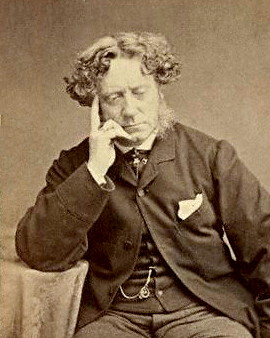
Celtic legends and folklore shaped the painter Joseph Noel Paton, born in Scotland in 1821. Paton also made a name for himself as a poet, sculptor and illustrator. It showed that Paton's artistic work was not limited to painting alone. Paton came from a family that made money by making damask. He himself tried his hand at business for a short time and worked as a designer in a cotton factory. In the end, however, Paton saw his destiny in art. Interestingly, two of his siblings were also artists: Amelia, his sister, was a sculptor, his brother Waller Hugh
worked as a landscape painter.
In 1843 Paton studied for a short time in London at the academy of arts. Here he met the painter John Everett Millais. Through Millais Paton came into contact with the group of painters of the Pre-Raphaelites. Their models were the Nazarenes and Italian painting of the 14th and 15th centuries. The group was interested in faithful reproduction of nature and a vivid depiction of man. Paton himself devoted his painting to allegorical, religious, fairy-tale and historical themes.
"The Struggle of Oberon and Titania" is a fine example of how Paton, with a huge arsenal of partly fairy-tale, partly mythological figures and a rich palette of colours, stages an extremely lively painting that convinces with skilful perspective. Paton received a prize for this painting at the Royal Scottish Academy. He also made a name for himself as an illustrator: in 1842 Paton illustrated the "Book of British Ballads" at the suggestion of the journalist Samuel Carter Hall, who valued Paton's literary education. Paton died in 1901 as a highly decorated citizen and artist.
 ×
× 





 Passionate Customer Service

.jpg "The Quarrel of Oberon and Titania by Joseph Noel Paton")
.jpg)
.jpg "The Fairy Raid: Carrying off a Changeling - Midsummer Eve by Joseph Noel Paton")
.jpg)
.jpg "Oberon and the Mermaid by Joseph Noel Paton")
.jpg)
 - (MeisterDrucke-96282).jpg "Puck and Fairies, from 'A Midsummer Night's Dream', c.1850 by Joseph Noel Paton")
 - (MeisterDrucke-96282).jpg)
.jpg "Christian at the Foot of the Cross by Joseph Noel Paton")
.jpg)
.jpg "The Fairy Queen by Joseph Noel Paton")
.jpg)
.jpg "Puck Removing the Ass' Head from Bottom, Study for 'The Reconciliation of Oberon and Titania' by Joseph Noel Paton")
.jpg)
.jpg "Study for The Quarrel of Oberon and Titania by Joseph Noel Paton")
.jpg)
 (see also 68757) - (MeisterDrucke-167380).jpg "Study for The Quarrel of Oberon and Titania, c. 1849 by Joseph Noel Paton")
 (see also 68757) - (MeisterDrucke-167380).jpg)
.jpg "Puck and Fairies, from A Midsummer Night's Dream by Joseph Noel Paton")
.jpg)
.jpg "Dante's Dream, from the 'Divine Comedy' by Joseph Noel Paton")
.jpg)
.jpg "Hesperus, the Evening Star, Sacred to Lovers by Joseph Noel Paton")
.jpg)
.jpg "Puck and Fairies, from 'A Midsummer Night's Dream' by Joseph Noel Paton")
.jpg)
.jpg "A Midsummer Night's Dream by Joseph Noel Paton")
.jpg)
_-_(MeisterDrucke-1110860).jpg "I Wonder Who Lived in There? by Joseph Noel Paton")
_-_(MeisterDrucke-1110860).jpg)
.jpg "Scottish Landscape by Joseph Noel Paton")
.jpg)
.jpg "Puck and Fairies, from \"A Midsummer Night's Dream\" by Joseph Noel Paton")
.jpg)
 - (MeisterDrucke-61763).jpg "La Belle Dame Sans Merci (The Story of Thomas Rhymer) by Joseph Noel Paton")
 - (MeisterDrucke-61763).jpg)
 1866 - (MeisterDrucke-260438).jpg "Mors Janua Vitae (The Gateway of Life), 1866 by Joseph Noel Paton")
 1866 - (MeisterDrucke-260438).jpg)
.jpg "Titania, Princess of the Fairies, and the Young Indian Page, Illustration for A Midsummer Night's Dream by William Shakespeare by Joseph Noel Paton")
.jpg)
_-_(MeisterDrucke-1126119).jpg "Death the Gateway to Life by Joseph Noel Paton")
_-_(MeisterDrucke-1126119).jpg)
_-_(MeisterDrucke-903991).jpg "'The isle is full of noises': Stephano and Trinculo led by Ariel by Joseph Noel Paton")
_-_(MeisterDrucke-903991).jpg)
.jpg "The Pursuit of Pleasure by Joseph Noel Paton")
.jpg)
.jpg "Study from Nature: Inveruglas, 1857 by Joseph Noel Paton")
.jpg)
.jpg "Beati Mundo Corde by Joseph Noel Paton")
.jpg)
.jpg "The Dream of Latmos, Evocation of the Myth of Endymion by Joseph Noel Paton")
.jpg)
.jpg "Lead, Kindly Light, amid the Encircling Gloom, lead thou me on!...and with the Morn those Angel Faces Smile, which I Have Loved Long Since, and Lost Awhile, 1894 by Joseph Noel Paton")
.jpg)
.jpg "Home, c.1856 by Joseph Noel Paton")
.jpg)
 - (MeisterDrucke-194063).jpg "Sketch for 'Sir Galahad' by Joseph Noel Paton")
 - (MeisterDrucke-194063).jpg)
_-_(MeisterDrucke-1175028).jpg "The Song of Silenus by Joseph Noel Paton")
_-_(MeisterDrucke-1175028).jpg)
.jpg "Lovers’ Tryst by Joseph Noel Paton")
.jpg)
.jpg "The Valley of the Shadow of Death by Joseph Noel Paton")
.jpg)
.jpg "At Bay by Joseph Noel Paton")
.jpg)
.jpg "The Bluidie Tryst by Joseph Noel Paton")
.jpg)
.jpg "Evening by Joseph Noel Paton")
.jpg)
.jpg "Two Lovers in a Starlit Garden, 1862 by Joseph Noel Paton")
.jpg)
.jpg "How an angel rowed Sir Galahad across Dern Mere by Joseph Noel Paton")
.jpg)
 - (MeisterDrucke-107528).jpg "Study of a Fairy by Joseph Noel Paton")
 - (MeisterDrucke-107528).jpg)
.jpg "The Dowie Dens of Yarrow by Joseph Noel Paton")
.jpg)
_-_(MeisterDrucke-1125076).jpg "Puck and the Fairy by Joseph Noel Paton")
_-_(MeisterDrucke-1125076).jpg)
.jpg "The Man of Sorrows, 1875 by Joseph Noel Paton")
.jpg)
.jpg "The Man with the Muck Rake by Joseph Noel Paton")
.jpg)
_-_(MeisterDrucke-1628880).jpg "La Lippina by Joseph Noel Paton")
_-_(MeisterDrucke-1628880).jpg)
.jpg "The Lady of Shalott by Joseph Noel Paton")
.jpg)
 - (MeisterDrucke-299010).jpg "Fairies on a Shell by Joseph Noel Paton")
 - (MeisterDrucke-299010).jpg)
.jpg "Medieval figures staring at an elf by Joseph Noel Paton")
.jpg)
.jpg "A Fairy in Flight by Joseph Noel Paton")
.jpg)
_-_(MeisterDrucke-904466).jpg "The Quarrel - Oberon and Titania by Joseph Noel Paton")
_-_(MeisterDrucke-904466).jpg)
.jpg "Ulysses on Ogygia by Joseph Noel Paton")
.jpg)

 +43 4257 29415
 support@meisterdrucke.com
 Mo-Do: 7:00 - 16:00 | Fr: 7:00 - 13:00