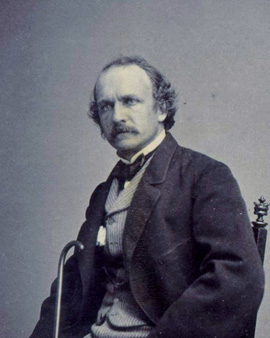
Felix Octavius Carr "F. O. C.“ Darley (1822-1888) was an American illustrator, mainly for literary works. He became famous for his illustrations for numerous American authors such as Charles Dickens, Washington Irving, Edgar Allen Poe or James Fenimore Copper. He also illustrated many works by Shakespeare or scenes from American history.
Darley was born in 1822 in Philadelphia, Pennsylvania. Through his parents he had connections to the theater and acting but his interest lay first of all in art. He taught himself to draw. At the age of 14 he worked in the Philadelphia Dispatch Transportation Line and immortalized his work environment in his drawings. Some of his caricatures found their way into The Saturday Museum, whose editor was Edgar Allen Poe. He then drew for various publications, initially in Philadelphia. Later he moved to New York and his illustrations appeared in magazines like Harpers Weekly and in various books, such as Washington Irving's "The Legend of Sleepy Hollow" or Darley's own work: "Scenes in Indian Life". He often worked together with the writer Irving, for example he provided illustrations for Irving's "The Sketch Book of Geoffrey Crayon, Gent", "Rip Van Winkle" or "Wolfert's Roost". By 1850 his reputation had grown far beyond that of other illustrators in the United States. Yet he never thought himself too good for certain jobs. He often worked productively on many smaller projects besides a few large ones.
Through Darley's productivity, the clarity of his drawings and compositions, and his bold, energetic style, he set the standard for future generations of American artists and illustrators. Darley made drawings, lithographs, engravings, etchings, and paintings with watercolors. The latter often depict ordinary life in the United States. He has also become famous for his art-rich vignettes of American banknotes.
 ×
×







 Passionate Customer Service

 at the Battle of Balls Bluff Virginia 1861 - (MeisterDrucke-96377).jpg "Death of Colonel Edward D. Baker at the Battle of Balls Bluff, Virginia by Felix Octavius Carr Darley")
 at the Battle of Balls Bluff Virginia 1861 - (MeisterDrucke-96377).jpg)
.jpg "Touchstone and Audrey by Felix Octavius Carr Darley")
.jpg)
.jpg "Landing of the Pilgrims, 1620, engraved by A. Bollett, from")
.jpg)
.jpg "Roping a Grizzly, illustration from")
.jpg)
_Rip_with_Junto_at_the_Village_inn_-_(MeisterDrucke-1608432).jpg "Rip Van Winkle, illustration (detail) by Felix Octavius Carr Darley")
_Rip_with_Junto_at_the_Village_inn_-_(MeisterDrucke-1608432).jpg)
.jpg "Dombey and Son: First Appearance of Bunsby, engraved by Vistus Balch by Felix Octavius Carr Darley")
.jpg)
.jpg "General GB McClellan, American Civil War major general by Felix Octavius Carr Darley")
.jpg)
_Rip_Amusing_Children_-_(MeisterDrucke-1603217).jpg "Rip Amusing Children (Rip Van Winkle, illustration) by Felix Octavius Carr Darley")
_Rip_Amusing_Children_-_(MeisterDrucke-1603217).jpg)
 1868 - (MeisterDrucke-154849).jpg "Old Curiosity Shop: The Fugitives, Engraved by Joseph Ives Pease by Felix Octavius Carr Darley")
 1868 - (MeisterDrucke-154849).jpg)
_-_(MeisterDrucke-1455224).jpg "Illustrations Of Rip Van Winkle, Plate 5 by Felix Octavius Carr Darley")
_-_(MeisterDrucke-1455224).jpg)
.jpg "Struggle on a Bridge During the Retreat from Manassas, July 1861, engraved by W. Ridgway by Felix Octavius Carr Darley")
.jpg)
.jpg "History of the West Conquete Settlers: American Pioneers by Felix Octavius Carr Darley")
.jpg)
.jpg "Uprising of the New England Yeomanry by Felix Octavius Carr Darley")
.jpg)
.jpg "Death of Pakenham at the Battle of New Orleans, published 1860 by Felix Octavius Carr Darley")
.jpg)
 charge at the Battle of Wilsons Creek Missouri 1861 - (MeisterDrucke-38687).jpg "General Lyon")
 charge at the Battle of Wilsons Creek Missouri 1861 - (MeisterDrucke-38687).jpg)
.jpg "David Copperfield: Saved From Destruction, engraved by H.B. Hall und Sons, 1867 by Felix Octavius Carr Darley")
.jpg)
.jpg "Struggle on a Bridge During the Retreat from Manassas, Virginia by Felix Octavius Carr Darley")
.jpg)
.jpg "Emigration to the Western Country by Felix Octavius Carr Darley")
.jpg)
_-_(MeisterDrucke-1448392).jpg "Illustrations of The Legend of Sleepy Hollow, Plate 5 by Felix Octavius Carr Darley")
_-_(MeisterDrucke-1448392).jpg)
_Rip_Returns_to_His_House_in_Ruins_-_(MeisterDrucke-1605174).jpg "Rip Returns to His House in Ruins (Rip Van Winkle, illustration) by Felix Octavius Carr Darley")
_Rip_Returns_to_His_House_in_Ruins_-_(MeisterDrucke-1605174).jpg)
.jpg "Massachusetts militia passing through Baltimore, Pennsylvania, 1861 by Felix Octavius Carr Darley")
.jpg)
_-_(MeisterDrucke-1455763).jpg "Illustrations Of The Legend Of Sleepy Hollow, Plate 6 by Felix Octavius Carr Darley")
_-_(MeisterDrucke-1455763).jpg)
_Rip_Serving_Liquor_to_the_Strange_Men_in_the_Mount_-_(MeisterDrucke-1605562).jpg "Rip Van Winkle, Rip Serving Liquor to the Strange Men in the Mountains (illustration) by Felix Octavius Carr Darley")
_Rip_Serving_Liquor_to_the_Strange_Men_in_the_Mount_-_(MeisterDrucke-1605562).jpg)
.jpg "Charge of General Smith")
.jpg)
.jpg "Battle at Wilson")
.jpg)
.jpg "Oliver Encounters")
.jpg)
.jpg "Oliver Twist and Fagin (Engraved by T. Phillibrown) by Felix Octavius Carr Darley")
.jpg)
_-_(MeisterDrucke-1455245).jpg "Illustrations Of Rip Van Winkle, Plate 3 by Felix Octavius Carr Darley")
_-_(MeisterDrucke-1455245).jpg)
_Rip_Telling_His_Fabulous_Story_-_(MeisterDrucke-1607821).jpg "Rip Van Winkle, Illustration: Rip Telling His Fabulous Story by Felix Octavius Carr Darley")
_Rip_Telling_His_Fabulous_Story_-_(MeisterDrucke-1607821).jpg)
.jpg "Chef Tossing Pancakes and Group of Four Men by Felix Octavius Carr Darley")
.jpg)
.jpg "George Washington entering New York in 1783, engraved by Alexander Hay Ritchie by Felix Octavius Carr Darley")
.jpg)
![Bernini Fountain, Rome [recto] by Felix Octavius Carr Darley](/kunstwerke/300px/Felix_Octavius_Carr_Darley_-_Bernini_Fountain_Rome_recto_-_(MeisterDrucke-1217699).jpg "Bernini Fountain, Rome [recto] by Felix Octavius Carr Darley")
![Bernini Fountain, Rome [recto] by Felix Octavius Carr Darley](/kunstwerke/400w/Felix_Octavius_Carr_Darley_-_Bernini_Fountain_Rome_recto_-_(MeisterDrucke-1217699).jpg)
_Rip_Nagged_by_His_Wife_-_(MeisterDrucke-1600970).jpg "Rip Nagged by His Wife (Rip Van Winkle, illustration) by Felix Octavius Carr Darley")
_Rip_Nagged_by_His_Wife_-_(MeisterDrucke-1600970).jpg)
.jpg "Columbus and His Train Entering Barcelona by Felix Octavius Carr Darley")
.jpg)
.jpg "Battle of Shiloh, Tennessee, c.1862 by Felix Octavius Carr Darley")
.jpg)
.jpg "The Taking of the Bridge on Antietam Creek at the Battle of Antietam, Maryland, 1862 by Felix Octavius Carr Darley")
.jpg)
.jpg "Old Curiosity Shop - The Marchioness and Mr Swiveller by Felix Octavius Carr Darley")
.jpg)
.jpg "The Boston Massacre, March 5th 1770, engraved by A. Bollett by Felix Octavius Carr Darley")
.jpg)
.jpg "The Squatter")
.jpg)
.jpg "The Battle of Lexington by Felix Octavius Carr Darley")
.jpg)
.jpg "G. Washington by Felix Octavius Carr Darley")
.jpg)
.jpg "Martin Chuzzlewit: Mrs Gamp, engraved by C.H. Smith by Felix Octavius Carr Darley")
.jpg)
.jpg "Village Scene with Dutch Colonial Figures from Hosack Album by Felix Octavius Carr Darley")
.jpg)
.jpg "Man Flailing by Felix Octavius Carr Darley")
.jpg)
.jpg "Spanish Priests Destroying the Aztec Idols of Mexico by Felix Octavius Carr Darley")
.jpg)
_-_(MeisterDrucke-1607973).jpg "Untitled (broken shoe) by Stephen Alonzo Schoff")
_-_(MeisterDrucke-1607973).jpg)
.jpg "Compositions in Outline from Hawthorne")
.jpg)
.jpg "Blacksmith in the Goldfields by Felix Octavius Carr Darley")
.jpg)
.jpg "The Scalp-Dance of the Sioux by Felix Octavius Carr Darley")
.jpg)
.jpg "John Pendleton Kennedy by Felix Octavius Carr Darley")
.jpg)
.jpg "George Brinton McClellan by Felix Octavius Carr Darley")
.jpg)
.jpg "Parable of the Sticks by Felix Octavius Carr Darley")
.jpg)
.jpg "Haying Scene by Felix Octavius Carr Darley")
.jpg)
.jpg "John Eliot Preaching to the Indians by Felix Octavius Carr Darley")
.jpg)
.jpg "A Rowdy Party by Felix Octavius Carr Darley")
.jpg)
.jpg "Farmer with Horse, Dog and Pigeons by Felix Octavius Carr Darley")
.jpg)
.jpg "\"On the Corniche Road,\" an Early Idea for \"Sketches Abroad with Pen and Pencil\" by Felix Octavius Carr Darley")
.jpg)

 +43 4257 29415
 support@meisterdrucke.com
 Mo-Do: 7:00 - 16:00 | Fr: 7:00 - 13:00