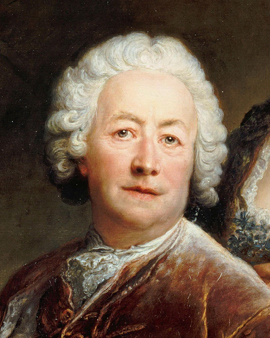
Antoine Pesne was a French painter who achieved Europe-wide fame primarily for his portraits of the Prussian aristocracy of the 18th century. Pesne is considered one of the founders of Rococo painting, particularly Friderician Rococo, and in addition to his portraits he created a series of ambitious, large-scale ceiling paintings as well as a series on dancers and actresses who performed at the Berlin Opera, based on the style of Antoine Watteau.
Born in Paris on 29 May 1683, Pesne first studied in his native city with his uncle, the painter Charles de la Fosse, and other leading French portraitists, such as Nicolas de Largillière and HHyacinthe Francois Rigaud, before enrolling at the Académie Royale in Rome on a scholarship. This scholarship enabled him to spend extended periods in Venice, Naples, and Rome, where he was taught for several months by the noted Baroque painter Andrea Cellesti. In 1707, Pesne's full-length portrait of the Prussian envoy in Venice, Baron von Knyphausen, attracted the attention of Frederick I of Prussia, who appointed him court portraitist to succeed the Dutchman Augustin Terwesten. This prestigious position was to have a lasting impact on his influence and importance to European court painting. Through his position at the Prussian court he met the architect Georg Wenzeslaus von Knobelsdorff in the 1730s, with whom he undertook the artistic design of Rheinsberg, Charlottenburg, Sanssouci and Potsdam City Palace. His lifelong patron King Frederick financed his house at Oberwallstrasse 3 in Berlin, where he lived until his death on August 5, 1757. Pesne was not only highly esteemed by his contemporaries. His reputation and his services to the Prussian state prompted the magistrate of Berlin, even 150 years after his death, to place a memorial plaque on the late painter's house in 1902, which is no longer preserved today. Historians assume that it was melted down during the Second World War for the purpose of weapons production. Currently, Pesne's works can be found in the collections of institutions such as the Charlottenburg, Rheinsberg and Sanssouci palaces, as well as in many German museums.
Pesne's distinctive stylistic qualities include a soft discreet application of paint that seems to anticipate the Impressionist works of Pierre-August Renoir, and his ability to place the portrayed aristocrats in a larger context of meaning through allegorical and mythological allusions.
 ×
× 





 Passionate Customer Service

.jpg "Frederick William I, King of Prussia by Antoine Pesne")
.jpg)
.jpg "Elisabeth Christine von Braunschweig as Queen by Antoine Pesne")
.jpg)
.jpg "King Frederick I of Prussia by Antoine Pesne")
.jpg)
.jpg "Kurt Christoph Count von Schwerin on horseback, 1750 by Antoine Pesne")
.jpg)
_de_Rege_Enkel_des_Kuenstlers_mit_einem_Kanarienvogel_-_(MeisterDrucke-1729673).jpg "Vollrat (?) de Rège, the artist's grandson, with a canary by Antoine Pesne")
_de_Rege_Enkel_des_Kuenstlers_mit_einem_Kanarienvogel_-_(MeisterDrucke-1729673).jpg)
_-_(MeisterDrucke-1753570).jpg "The Painter and Engineer Johann Sigismund Ebert (?-1727) by Antoine Pesne")
_-_(MeisterDrucke-1753570).jpg)
.jpg "Louisa Ulrika of Prussia, Queen of Sweden and Finland (1720-1782), portrait by Antoine Pesne (1683-1757). Dimensions: 145 x 110 cm. Nationalmuseum Stockholm by Antoine Pesne")
.jpg)
.jpg "Crown Prince Frederick II, 1728 by Antoine Pesne")
.jpg)
.jpg "Crown Princess Elisabeth Christine of Prussia, c.1735 by Antoine Pesne")
.jpg)
_-_(MeisterDrucke-1562577).jpg "Portrait of Heinrich Voguell (1681–?) by Antoine Pesne")
_-_(MeisterDrucke-1562577).jpg)
.jpg "Portrait of Frederick II of Hohenzollern, known as Frederick the Great (Berlin) by Antoine Pesne")
.jpg)
.jpg "Portrait of the Marchese Paolo Corbelli, full-length, Seated on a Bank at the Edge of a Wood by Antoine Pesne")
.jpg)
_(Portret_mczyzny_w_peruce_i_z_orde_-_(MeisterDrucke-1562528).jpg "Friedrich Wilhelm Kettler (1692–1711) (Portrait of a Man in a Wig with the Black Eagle Order) by Antoine Pesne")
_(Portret_mczyzny_w_peruce_i_z_orde_-_(MeisterDrucke-1562528).jpg)
 1746 - (MeisterDrucke-67534).jpg "King Frederick II the Great of Prussia (1712-86), 1746 by Antoine Pesne")
 1746 - (MeisterDrucke-67534).jpg)
_mit_Maske_in_der_Ha_-_(MeisterDrucke-697500).jpg "Portrait of Luise Ulrike, Princess of Prussia (1720-1782), with a Mask in Her Hand by Antoine Pesne")
_mit_Maske_in_der_Ha_-_(MeisterDrucke-697500).jpg)
_-_(MeisterDrucke-1273523).jpg "Portrait of a Painter (presumably C. L. Agricola, 1667-1719) by Antoine Pesne")
_-_(MeisterDrucke-1273523).jpg)
_after_1733_(oil_on_canvas)_-_(MeisterDrucke-1517340).jpg "Friedrich Wilhelm I: King of Prussia (1688-1740) by Antoine Pesne")
_after_1733_(oil_on_canvas)_-_(MeisterDrucke-1517340).jpg)
.jpg "Portrait of Queen Elisabeth Christine of Prussia, Duchess of Brunswick-Bevern (1715-1797) by Antoine Pesne")
.jpg)
_-_(MeisterDrucke-1746784).jpg "Portrait of Charles Alexander of Lorraine (1712-1780) by Antoine Pesne")
_-_(MeisterDrucke-1746784).jpg)
.jpg "Friedrich Wilhelm I, King in Prussia and as Friedrich Wilhelm II Elector and Margrave of Brandenburg by Antoine Pesne")
.jpg)
.jpg "Crown Prince Frederick II with His Sister Wilhelmine, 1714 by Antoine Pesne")
.jpg)
_-_(MeisterDrucke-1562520).jpg "Portrait of Friedrich Ernst von Knyphausen (1678–1731) by Antoine Pesne")
_-_(MeisterDrucke-1562520).jpg)
_Prince_of_Holstein-Gottorp_Prince-Bishop_of_Luebeck_-_(MeisterDrucke-1745619).jpg "Adolf Frederick (1710-1771), Prince of Holstein-Gottorp, Prince-Bishop of Lübeck, King of Sweden, 1743 by Antoine Pesne")
_Prince_of_Holstein-Gottorp_Prince-Bishop_of_Luebeck_-_(MeisterDrucke-1745619).jpg)
.jpg "Frederick the Great as Crown Prince by Antoine Pesne")
.jpg)
.jpg "Portrait of Johanna-Elizabeth, Electress of Anhalt-Zerbst, Mother of Catherine II by Antoine Pesne")
.jpg)
.jpg "Crown Prince Frederick of Prussia by Antoine Pesne")
.jpg)
.jpg "Portrait of Christian August, Prince of Anhalt-Zerbst, 1725 by Antoine Pesne")
.jpg)
.jpg "Anna Elisabeth von der Schulenburg, 1720-1741, née von Arnim-Boytzenburg, countess, Prussian lady-in-waiting by Antoine Pesne")
.jpg)
.jpg "Diana and her Nymphs Bathing, 1747 by Antoine Pesne")
.jpg)
.jpg "Portrait of Christian August, Prince of Anhalt-Zerbst, 1725 by Antoine Pesne")
.jpg)
.jpg "Karl-Heinrich Graun and his wife Anna-Louise by Antoine Pesne")
.jpg)
_-_(MeisterDrucke-695995).jpg "Portrait of Frederick I of Prussia (1657-1713) by Antoine Pesne")
_-_(MeisterDrucke-695995).jpg)
_(Portret_mezczyzny_w_peruce_i_z_orderem_Cz_-_(MeisterDrucke-1749427).jpg "Friedrich Wilhelm Kettler (1692-1711) (Portrait of a Man with a Wig and the Order of the Black Eagle) by Antoine Pesne")
_(Portret_mezczyzny_w_peruce_i_z_orderem_Cz_-_(MeisterDrucke-1749427).jpg)
 engraved by Johann Esaias Nilson (1721-88) - (MeisterDrucke-50497).jpg "Portrait of Frederick II (1712-86), Engraved by Johann Esaias Nilson (1721-88) by Antoine Pesne")
 engraved by Johann Esaias Nilson (1721-88) - (MeisterDrucke-50497).jpg)
.jpg "Gustav Adolf Graf von Gotter and his Niece Friederike von Wangenheum in Pilgrim Costumes by Antoine Pesne")
.jpg)
_and_His_Nephew_Frederick_William_II_(1744-97)_engraved_by_-_(MeisterDrucke-115122).jpg "Frederick II and His Nephew Frederick William II, Engraved by Johann Probst by Antoine Pesne")
_and_His_Nephew_Frederick_William_II_(1744-97)_engraved_by_-_(MeisterDrucke-115122).jpg)
.jpg "Marie de Rège, née Pesne, with a Pug by Antoine Pesne")
.jpg)
.jpg "Nature Study for a Naked Seated Girl by Antoine Pesne")
.jpg)
.jpg "Portrait of Frederick II of Brandenburg, known as the Great by Antoine Pesne")
.jpg)
.jpg "Franz Isaak von Chasot by Antoine Pesne")
.jpg)
.jpg "Portrait of a Gentleman, Said to be August William, Half Length, Wearing a Blue Jacket, White Shirt, and Armour Breast Plate by Antoine Pesne")
.jpg)
.jpg "Founding of the Order of the Black Eagle by Antoine Pesne")
.jpg)
.jpg "Portrait of Louisa Ulrika of Prussia by Antoine Pesne")
.jpg)
.jpg "The Crown Prince Frederick II, c.1736 by Antoine Pesne")
.jpg)
.jpg "Portrait of Frederick II of Prussia 1712-1786 as Crown Prince, 1739 by Antoine Pesne")
.jpg)
.jpg "Portrait of Johanna-Elizabeth, Electress of Anhalt-Zerbst, c.1746 by Antoine Pesne")
.jpg)
.jpg "Barbara Campanini by Antoine Pesne")
.jpg)
_Margravine_of_Brandenburg-Bayreuth_-_-_(MeisterDrucke-995131).jpg "Princess Wilhelmine of Prussia (1709-1758), Margravine of Brandenburg-Bayreuth. 79.5 x 65.5 cm. Private Collection by Antoine Pesne")
_Margravine_of_Brandenburg-Bayreuth_-_-_(MeisterDrucke-995131).jpg)
.jpg "Crown Prince Frederick II, c.1740 by Antoine Pesne")
.jpg)
.jpg "Portrait of Johanna Charlotte of Anhalt-Dessau by Johann Georg Wolffgang")
.jpg)
_-_(MeisterDrucke-1744009).jpg "Portrait of Johann Melchior Dinglinger (1664-1731) by Antoine Pesne")
_-_(MeisterDrucke-1744009).jpg)
.jpg "Johanna Elizabeth, Princess of Anhalt-Zerbst by Antoine Pesne")
.jpg)
.jpg "Portrait of Adolph Frederick, Crown Prince of Sweden by Antoine Pesne")
.jpg)
.jpg "Portrait of the engraver Georg Friedrich Schmidt and his wife Dorothea Luise, née Videbant by Antoine Pesne")
.jpg)
.jpg "Frederick the Great, King of Prussia, 1903 by Antoine Pesne")
.jpg)
_-_(MeisterDrucke-1731137).jpg "Portrait of Zofia Jadwiga von Tettau (Sophia Hedwig von Tettau 1662-1733) by Antoine Pesne")
_-_(MeisterDrucke-1731137).jpg)
.jpg "Portrait of Johanna-Elizabeth, Electress of Anhalt-Zerbst by Antoine Pesne")
.jpg)
_-_(MeisterDrucke-1728877).jpg "Portrait of Friedrich Ernst von Knyphausen (1678-1731) by Antoine Pesne")
_-_(MeisterDrucke-1728877).jpg)
.jpg "Prince Augustus William Aged Four, 1734 by Antoine Pesne")
.jpg)
.jpg "Portrait of Adolph Frederick, 1710-1771, Crown Prince of Sweden by Antoine Pesne")
.jpg)
.jpg "Friedrich Hoffmann, engraved by F.G Wolffgang by Antoine Pesne")
.jpg)
 - (MeisterDrucke-95461).jpg "The Crown Prince Frederick II in his Corps de Cadets, uniform of the King's Regiment by Antoine Pesne")
 - (MeisterDrucke-95461).jpg)
.jpg "Graf von Schwerin by Antoine Pesne")
.jpg)
_-_(MeisterDrucke-1738594).jpg "Anna Orzelska (1707-1769) by Antoine Pesne")
_-_(MeisterDrucke-1738594).jpg)
.jpg "Portrait of Baron von Erlach with his Family, c1710 by Antoine Pesne")
.jpg)
.jpg "Crown Princess Elisabeth Christine of Prussia by Antoine Pesne")
.jpg)
.jpg "King Frederick I on the silver throne by Antoine Pesne")
.jpg)
.jpg "Lady Playing a Spinet and a Flautist by Antoine Pesne")
.jpg)
.jpg "Field Marshal Jacob von Keith by Antoine Pesne")
.jpg)
_-_(MeisterDrucke-1562519).jpg "Portrait of Friedrich Ernst von Knyphausen (1678–1731) by Antoine Pesne")
_-_(MeisterDrucke-1562519).jpg)
.jpg "Frederick II, Crown Prince with Order by Antoine Pesne")
.jpg)
_Abbess_of_Quedlinburg_c1744_(oil_on_canvas)_-_(MeisterDrucke-1641427).jpg "Anna Amalia of Prussia, Abbess of Quedlinburg, c.1744 by Antoine Pesne")
_Abbess_of_Quedlinburg_c1744_(oil_on_canvas)_-_(MeisterDrucke-1641427).jpg)
.jpg "Leopold I, Prince of Anhalt-Dessau by Antoine Pesne")
.jpg)
_-_(MeisterDrucke-1555133).jpg "Friedrich II by Antoine Pesne")
_-_(MeisterDrucke-1555133).jpg)
_-_(MeisterDrucke-1752448).jpg "Louisa Ulrika, Princess of Prussia (1720-1782) by Antoine Pesne")
_-_(MeisterDrucke-1752448).jpg)
.jpg "Prince Augustus William by Antoine Pesne")
.jpg)
.jpg "Portrait of Stanislaw I Leszczynski by Antoine Pesne")
.jpg)
_-_(MeisterDrucke-574610).jpg "Portrait of Jean Mariette (1660-1742) by Antoine Pesne")
_-_(MeisterDrucke-574610).jpg)
.jpg "Portrait of Frederick II of Prussia, known as the Great by Antoine Pesne")
.jpg)
.jpg "Portrait of Adolph Frederick by Antoine Pesne")
.jpg)
.jpg "Portrait of Goldsmith Johann Melchior Dinglinger by Johann Georg Wolffgang")
.jpg)
.jpg "Anna Louise Elisabeth, 1738-1820, Princess of Brandenburg-Schwedt, Princess of Prussia by Antoine Pesne")
.jpg)
.jpg "Portrait of Frederick II of Prussia by Antoine Pesne")
.jpg)
.jpg "Portrait of Christian Ludwig of Brandenburg-Schwedt by Antoine Pesne")
.jpg)
.jpg "Frederick the Great as Crown Prince by Antoine Pesne")
.jpg)
.jpg "Portrait of Johann Melchior Dinglinger by Antoine Pesne")
.jpg)
.jpg "Portrait of Frederick William I of Prussia (Berlin) by Antoine Pesne")
.jpg)
.jpg "Portrait of Baron von Erlach with his family by Antoine Pesne")
.jpg)
.jpg "Four Types of Roses by Antoine Pesne")
.jpg)
.jpg "Count Friedrich Heinrich von Seckendorf by Antoine Pesne")
.jpg)
.jpg "Lot and His Daughters by Antoine Pesne")
.jpg)
 Presented to Minerva 1735 - (MeisterDrucke-106297).jpg "Jean-Philippe Baratier Presented to Minerva, 1735 by Antoine Pesne")
 Presented to Minerva 1735 - (MeisterDrucke-106297).jpg)
.jpg "Christian Louis Brandenburg by Antoine Pesne")
.jpg)
.jpg "The Masquerade Ball by Antoine Pesne")
.jpg)
.jpg "Frederick the Great by Antoine Pesne")
.jpg)
.jpg "Nicolas Vleughels, Painter by Antoine Pesne")
.jpg)
.jpg "Portrait of the Jeweller Johann Melchior Dinglinger, c1721 by Antoine Pesne")
.jpg)
.jpg "Portrait of Wilhelmine Dorothee von der Marwitz by Antoine Pesne")
.jpg)
.jpg "The Captain of the Swiss Guard von Erlach with his Family by Antoine Pesne")
.jpg)
.jpg "Self-Portrait Before the Easel with His Daughters Henriette Joyard and Marie de Rège by Antoine Pesne")
.jpg)

 +43 4257 29415
 support@meisterdrucke.com
 Mo-Do: 7:00 - 16:00 | Fr: 7:00 - 13:00