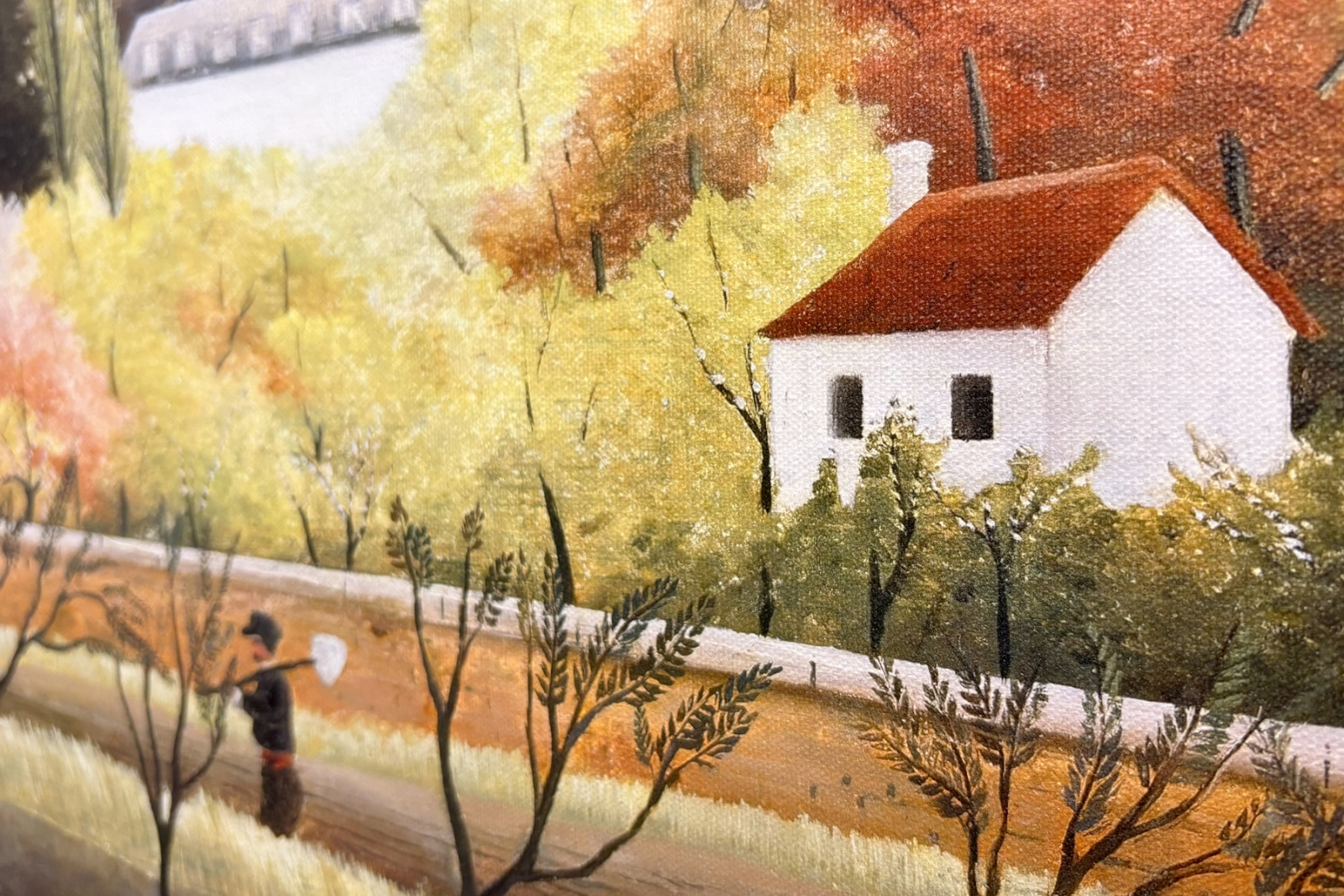
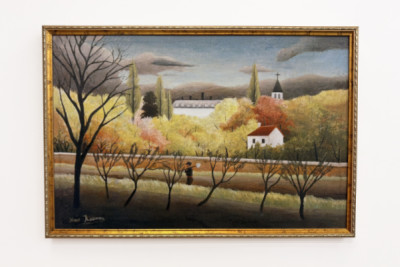
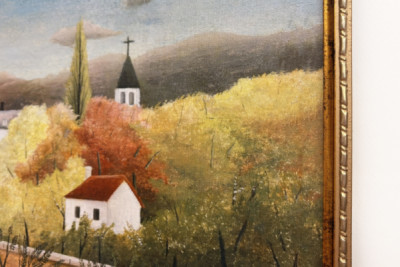
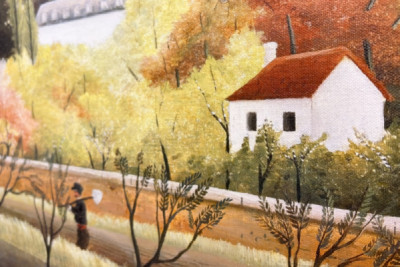
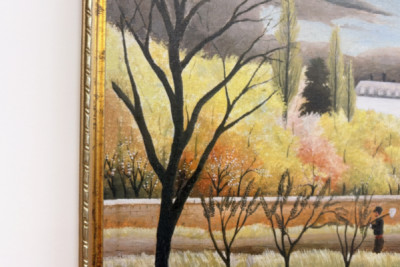
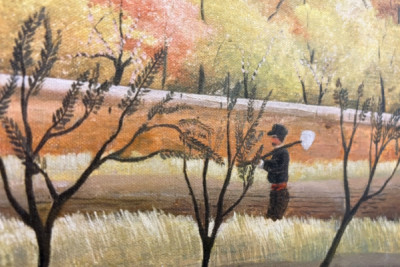
Bare branches stretch out across the landscape from the tree on the left-hand edge. Beneath them, a series of small fruit trees is arranged in tiers, leading up to the farmer in the centre of the picture, who is carrying a tool over his shoulder. Behind him, fields and treetops rise up, in shades of yellow, rust-red and green. A white house provides a distinct focal point, whilst further up the church rises against a backdrop of brown hills. The muted blue of the sky frames the scene. Almost black tree trunks structure the composition like a framework of lines - creating a sense of spatial depth without resorting to academic perspective. The picture appears calm and yet strangely charged; the solitary farmer remains small in comparison to the orderly natural world. Henri Rousseau painted this landscape in 1896. The French self-taught artist is regarded as one of the defining outsiders of modern art. His clear contours and idiosyncratic scales combine precise observation with a deliberately two-dimensional composition.
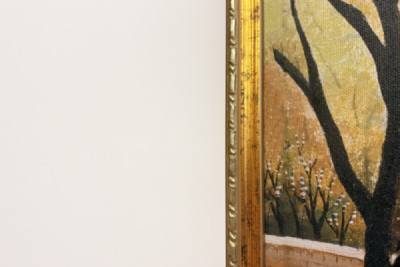
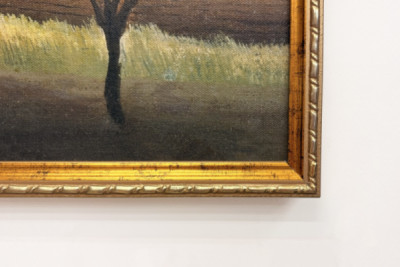
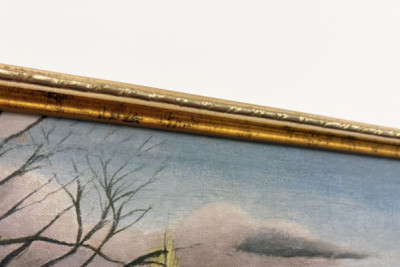
This reproduction renders Rousseau’s areas of colour on the matt Salvador canvas. This pays particular dividends where the motif is at its brightest: above the white house and in the pale sky, only a soft reflection appears, and no specular highlights form on the yellow tree tops either. No glass adds a second sheen; the ambient light remains subdued on the picture surface and the dark branches retain their clarity. Noemi reacts more distinctly to the lighting: along the gold edge, there are bright trails of light, whilst in the patinated areas the sheen fades to darker tones. The narrow profile captures the landscape succinctly - this motif needs nothing more. It is a print that makes you want to pause and look. Particularly in the delicate branches in front of the house and the small figure, the sharpness of the lines remains astonishingly close to the original; this precision holds up even when viewed at close quarters.
 ×
× 





 +43 4257 29415
 support@meisterdrucke.com
 Mo-Do: 7:00 - 16:00 | Fr: 7:00 - 13:00