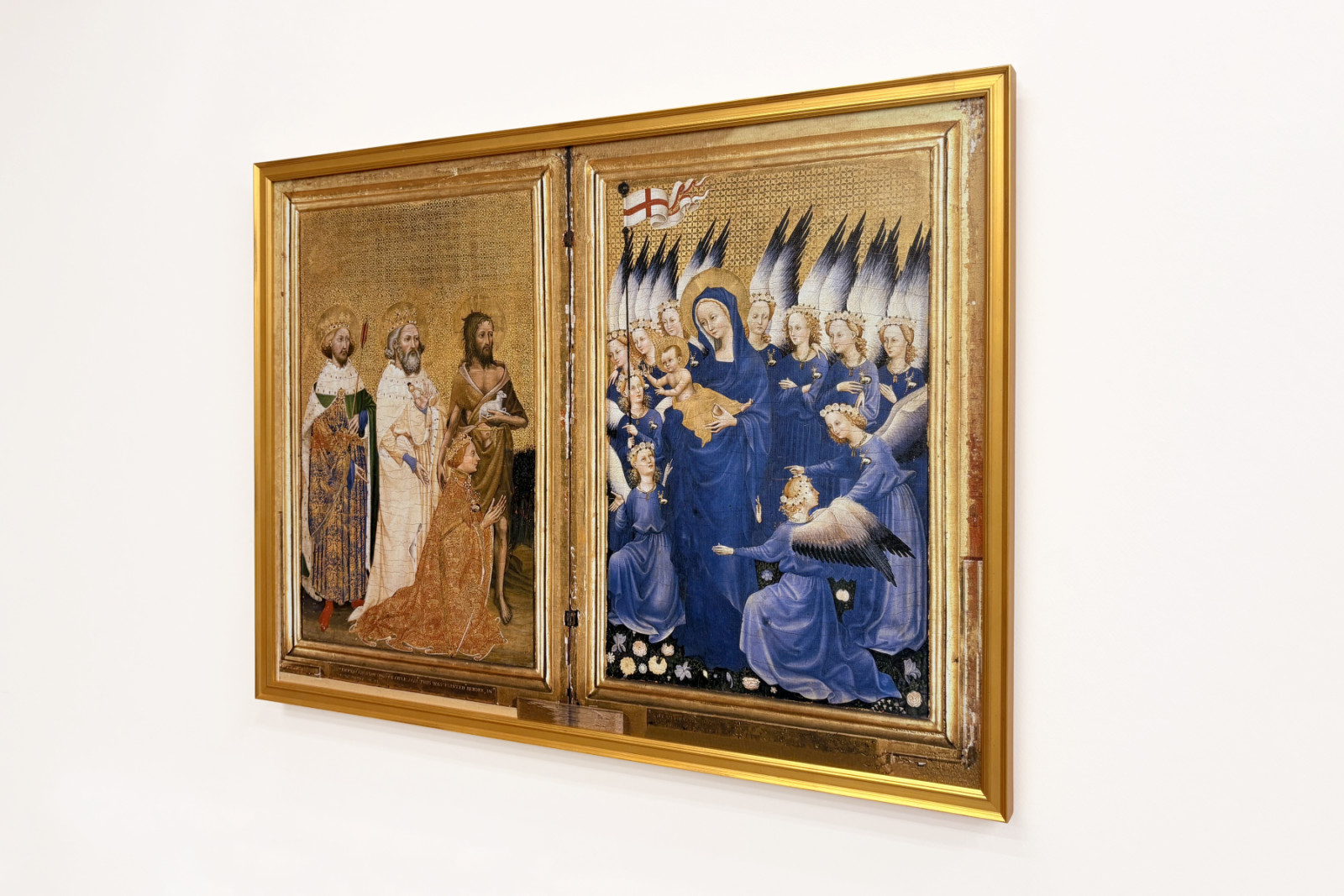
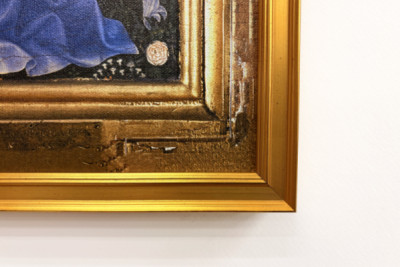
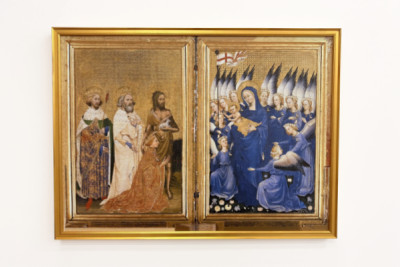
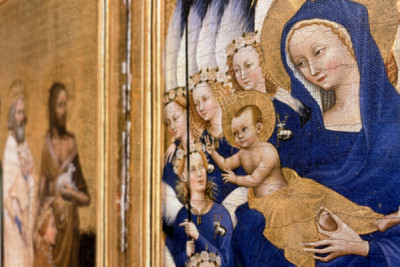
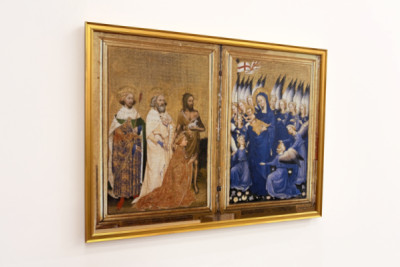
Eleven angels are dressed in the same ultramarine as the Virgin, and yet each garment remains individually distinguishable - the folds, the white rosaries in their hair, the small insignia featuring a white stag on each breast. The subject is the Wilton Diptych, painted around 1395-99 by an anonymous master for the English King Richard II. On the left-hand panel, the young king kneels in a gold-patterned cloak, with his intercessors standing behind him: John the Baptist with the Lamb, and the Holy Kings Edward and Edmund. On the right, Mary and the Child receive homage, surrounded by a host of blue angels, above whom an angel holds the banner bearing the Cross of St George. The embossed gold ground, the finely cracked craquelure of the old panels, even the central hinge joint of the folding devotional image - all these features are reproduced, ensuring that the diptych retains its physical character, even though a single panel is displayed here.
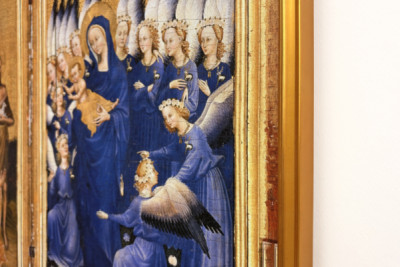
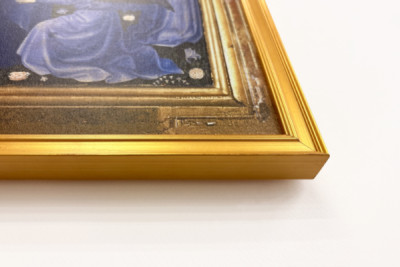
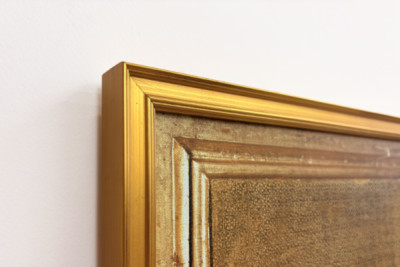
The whole work is executed in the format 66 x 48 cm on ‘Leonardo’, a satin-finished canvas - and it is precisely this surface that determines how the abundant gold appears. When light falls at an angle on the surface, the embossed ground brightens as a whole without creating harsh highlights; the blue of the robes remains deep and calm alongside it. Viewed head-on, the shimmer disappears almost entirely, and the image takes on a matt, altar-like quality. This shift in appearance depending on one’s vantage point actually held me up briefly whilst hanging the painting. ‘Lena’, a narrow gold profile just 18 mm wide, frames the panel without competing with the painted gold frames within the picture. As you walk past the piece, a faint streak of lustre runs across the gold background - here, the light moves perceptibly within the picture, not just on the frame.
 ×
× 





 +43 4257 29415
 support@meisterdrucke.com
 Mo-Do: 7:00 - 16:00 | Fr: 7:00 - 13:00