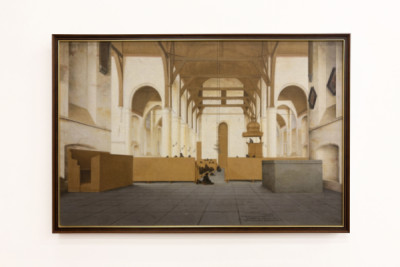
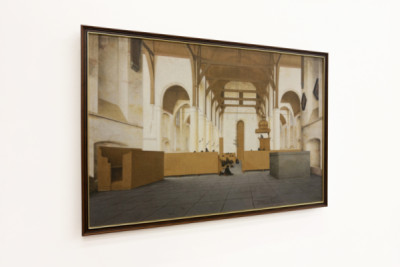
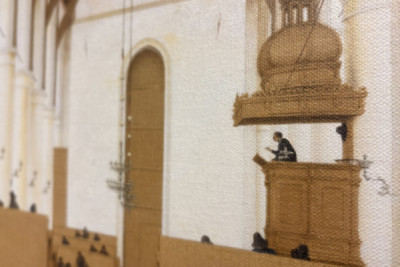
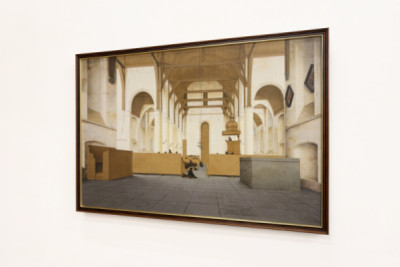
The viewer’s gaze falls upon a tall, white church. Wooden beams stretch across the ceiling, arches open to the left and right, and in the centre, ochre-coloured pews are arranged in tiers like a small fortress. On the far right, the preacher stands in his pulpit beneath the sounding board. A few black figures sit scattered about; there is more space than people. In 1649, Pieter Janszoon Saenredam painted the Sint-Odulphuskerk in Assendelft, his home church - his own father lies buried beneath the grey gravestone in the foreground. The stillness of the picture is not emptiness. It is measured, constructed, almost mathematical. Saenredam measured his churches on site and reconstructed them in his studio. That is why the light appears so clear and the space so vast, even though hardly anything is happening.
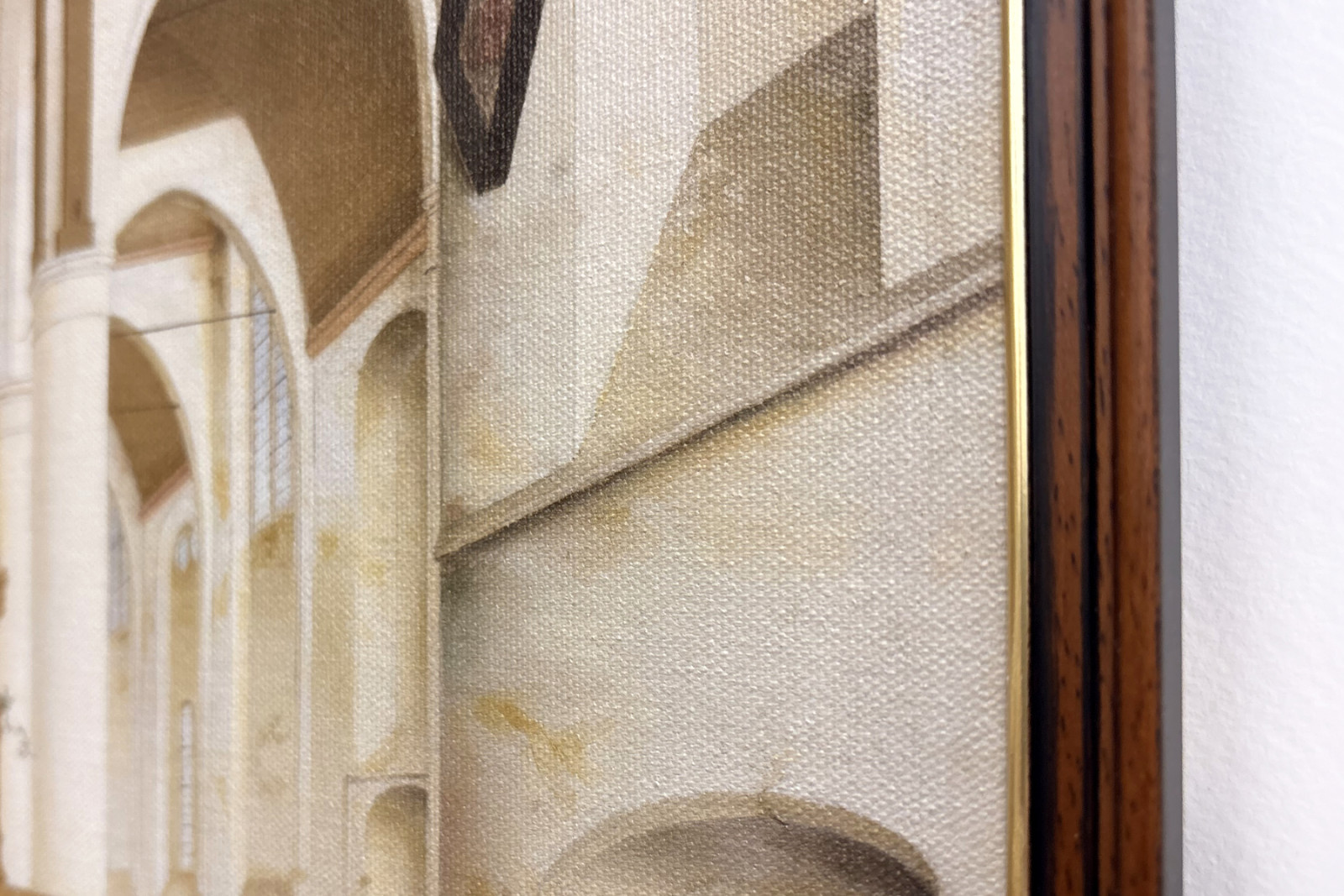
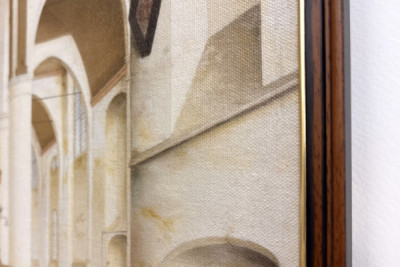
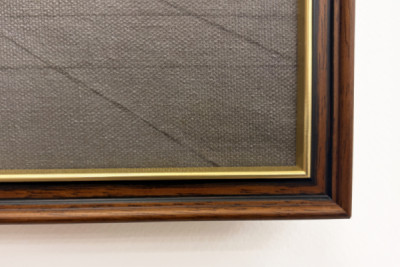
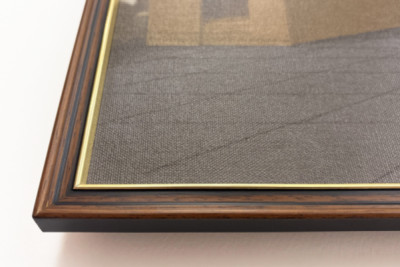
This version hangs in a frame called ‘Elina’, brown with a gold edge, just fifteen millimetres wide. This motif needs nothing more. At the bottom corner, the mitre joint sits neatly; the grain of the brown wood runs across both sides and breaks at the seam, barely visible - you really have to get up close to spot it at all. Between the wood and the picture area lies a narrow black step, followed by the polished gold moulding, three zones spanning one and a half centimetres. The outer curve captures the ambient light as a thin strip and guides it around the entire frame. Inside, the canvas print remains exposed, without glass, with the fabric visible beneath the grey backing boards. I wouldn’t necessarily have expected the narrow frame, measuring 61 x 40 cm, to hold its own against the vast church architecture - yet it does, effortlessly.
The dark wood tone does not detract from the light-coloured church interior. Saenredam’s white begins right at the gold edge - a transition could scarcely be more abrupt, and that is precisely what suits this sober painting.
 ×
×






 +43 4257 29415
 support@meisterdrucke.com
 Mo-Do: 7:00 - 16:00 | Fr: 7:00 - 13:00