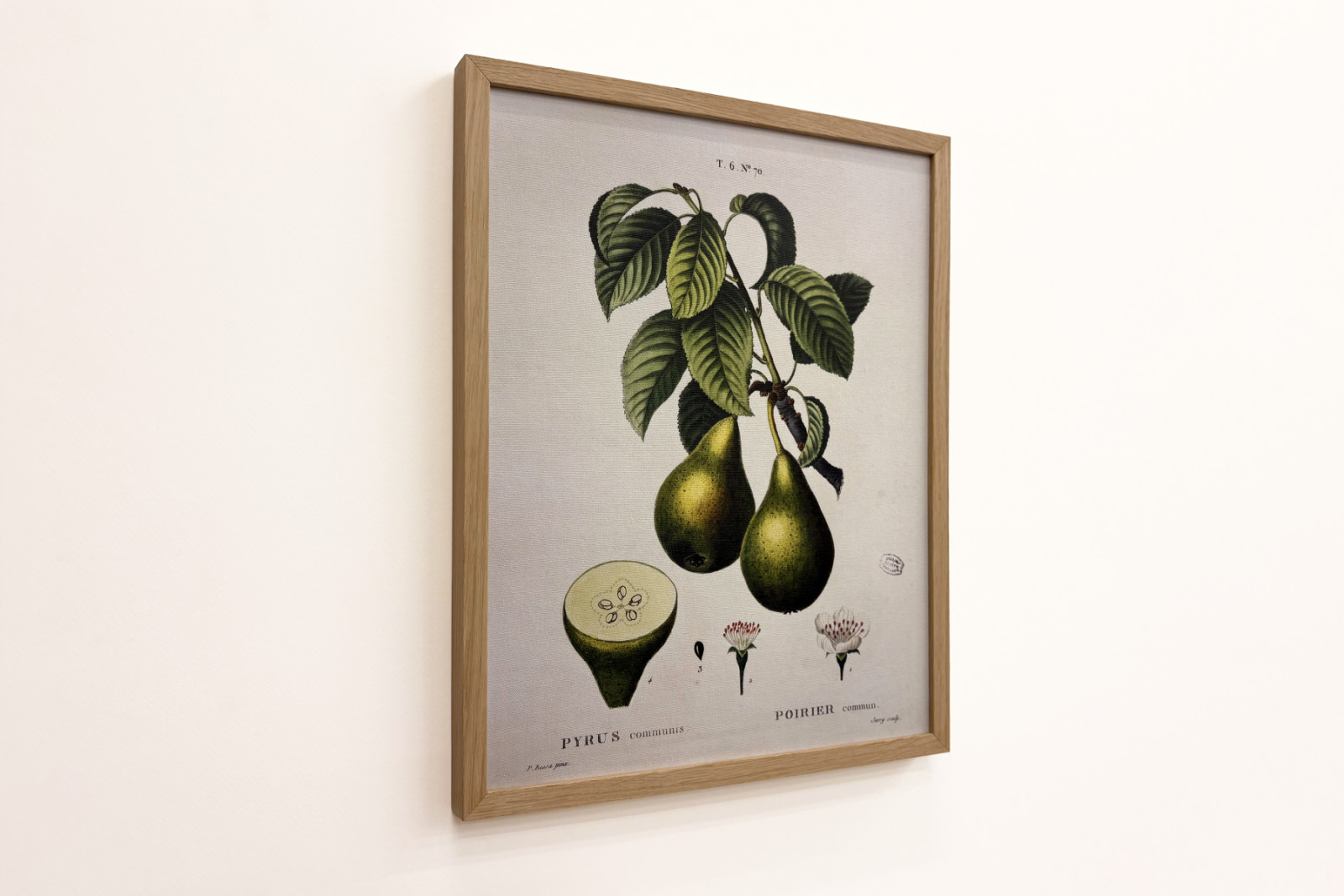
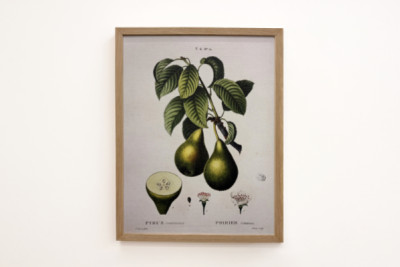
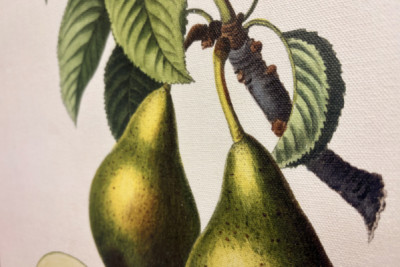
Two pears hang heavily from the branch; above them, serrated leaves with finely defined veins fan out. Beneath them, the label sets out its information: a cross-section of the fruit showing the core, a single seed, two flowers with reddish stamens. ‘Pyrus communis’ is written on the left, ‘Poirier commun’ on the right, with nothing superfluous in between. The plate is taken from the *Nouveau Duhamel du Monceau*, the major French work on the trees and shrubs cultivated in France, based on drawings by Pierre-Joseph Redouté and Pancrace Bessa. Redouté is regarded as the most important floral painter of his time. Here we can see why: the depiction is scientifically precise yet sensuous. One can see the speckled texture of the fruit’s skin, the matt sheen on its curve, the dark wood of the twig. Here, botany and art do not work at cross-purposes. They need one another.
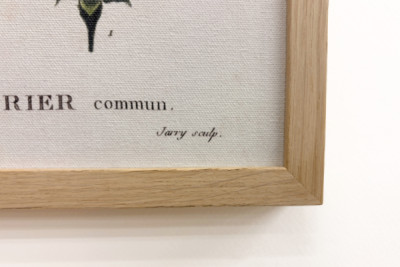
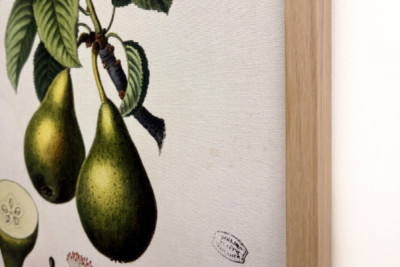
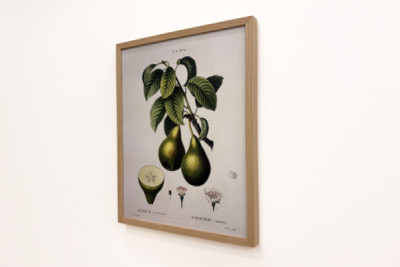
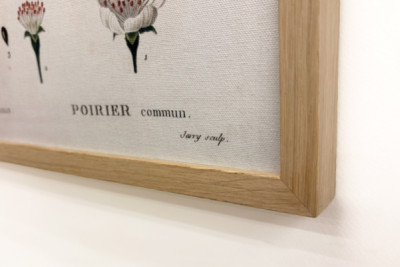
The plate is printed on ‘Leonardo’, a satin-finished canvas whose fine grid pattern lends the old engraving a pleasantly tactile quality. In the bottom right-hand corner is even the engraver’s mark, ‘Jarry sculp.’, clearly legible in tiny cursive script - it is such small details that catch one’s eye, precisely because the print does not swallow them up. Surrounding the whole is ‘Sinead’, a simple profile in oak veneer. At the corners, the mitres meet cleanly; the grain of the veneer runs visibly across the strips, sometimes denser, sometimes more open. No frills, no chamfer, just wood with an honest finish. In terms of colour, the light oak sits exactly between the warm tone of the leaf background and the olive green of the fruit. Prints like this aren’t produced in a rush. And it is precisely this sense of calm that suits the motif: a botanical study that takes its time - for the fruit, the flower and the seed in between.
 ×
×






 +43 4257 29415
 support@meisterdrucke.com
 Mo-Do: 7:00 - 16:00 | Fr: 7:00 - 13:00