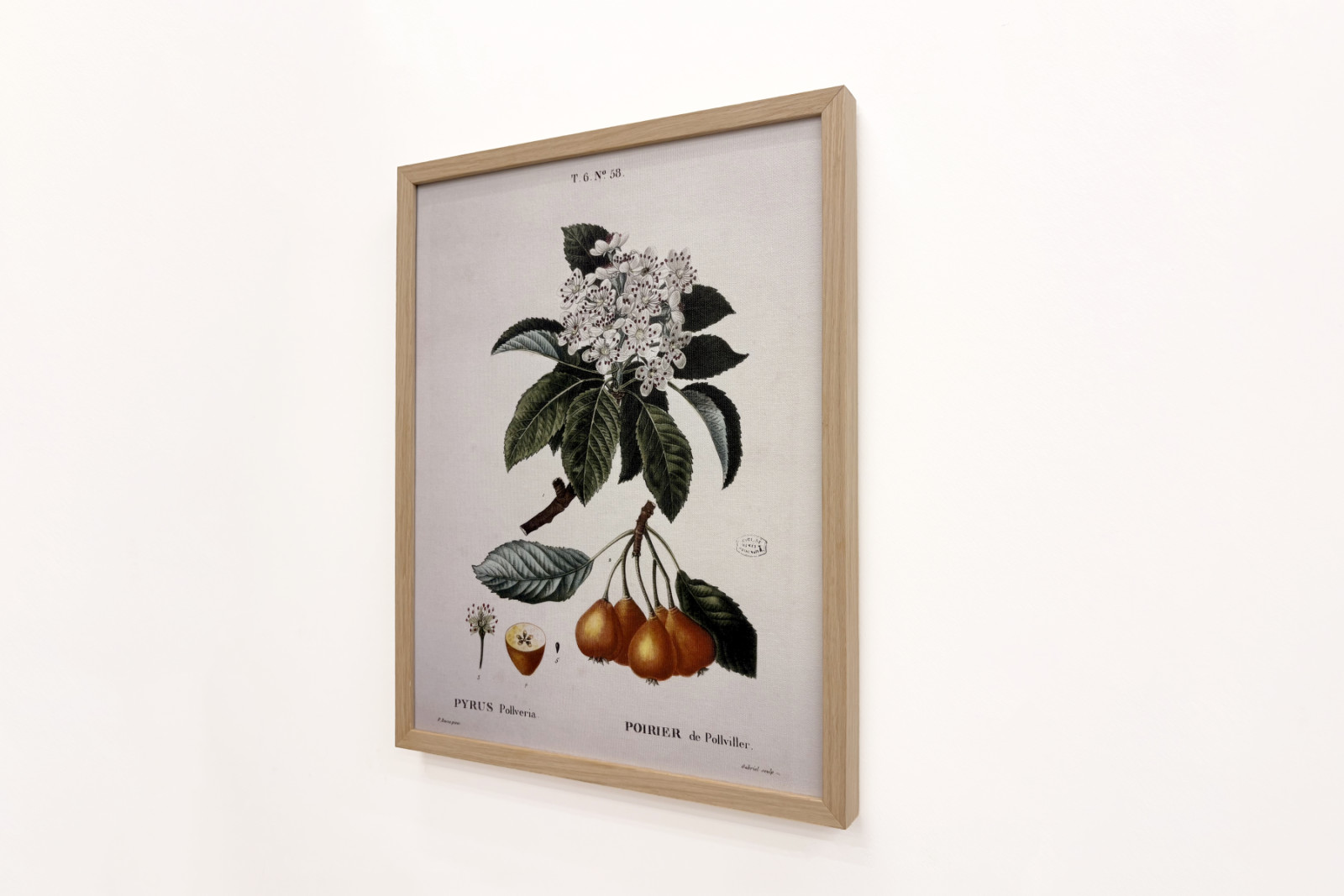
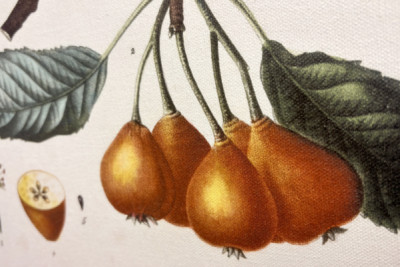
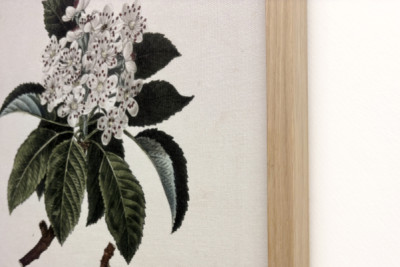
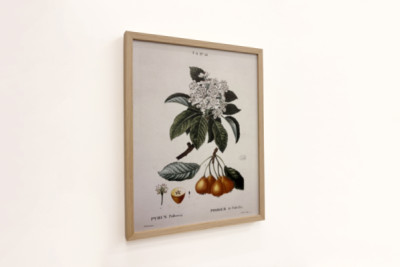
The blossom at the top, the fruit at the bottom - this panel divides the Pollviller pear tree into two sections, separated by a narrow strip of empty space. The flowering branch fills the upper half of the picture with a dense white inflorescence, whose dark red stamens sit like fine dots above the serrated leaves; beneath hang five plump fruits in a warm rust-brown on long stalks, flanked by a cut-open pear revealing its five-lobed core. Above it all stands the sober inscription ‘T. 6. No. 58.’ - science and art intertwine here, as was typical of botanical illustration around 1800. The original artwork is by Pierre-Joseph Redouté, arguably the most famous botanical illustrator of his time, who depicted numerous fruit trees for the *Nouveau Duhamel du Monceau*. What these plates still possess today is their dual nature: precise enough for the botanist, beautiful enough for the wall.
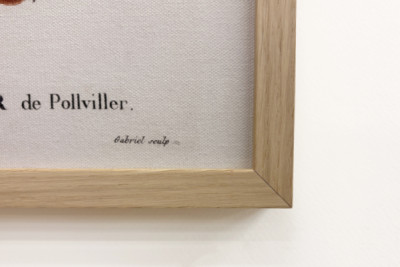
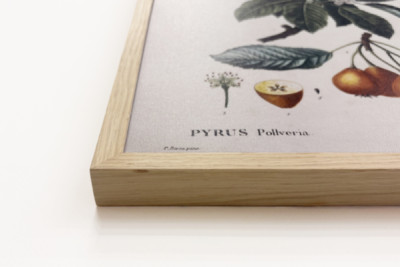
The satin-finished canvas is mounted in ‘Sinead’, a simple frame made of oak veneer - and the corners reveal why this choice works so well. The mitre joint at the bottom right is so tight that only a hair’s breadth of a line remains, whilst the grain runs in different directions on both sides, lending the frame a sense of vitality. There is no varnish to make the wood appear sealed; the surface remains light and open-pored, with occasional darker streaks of grain along the narrow visible edge. Against the off-white background of the sheet, the oak almost reads as a continuation of the paper’s tone in wood. What catches my eye: the small engraver’s signature ‘Gabriel sculp’ at the bottom edge is razor-sharp - even these few millimetres of lettering come through without any blurring.
 ×
× 





 +43 4257 29415
 support@meisterdrucke.com
 Mo-Do: 7:00 - 16:00 | Fr: 7:00 - 13:00