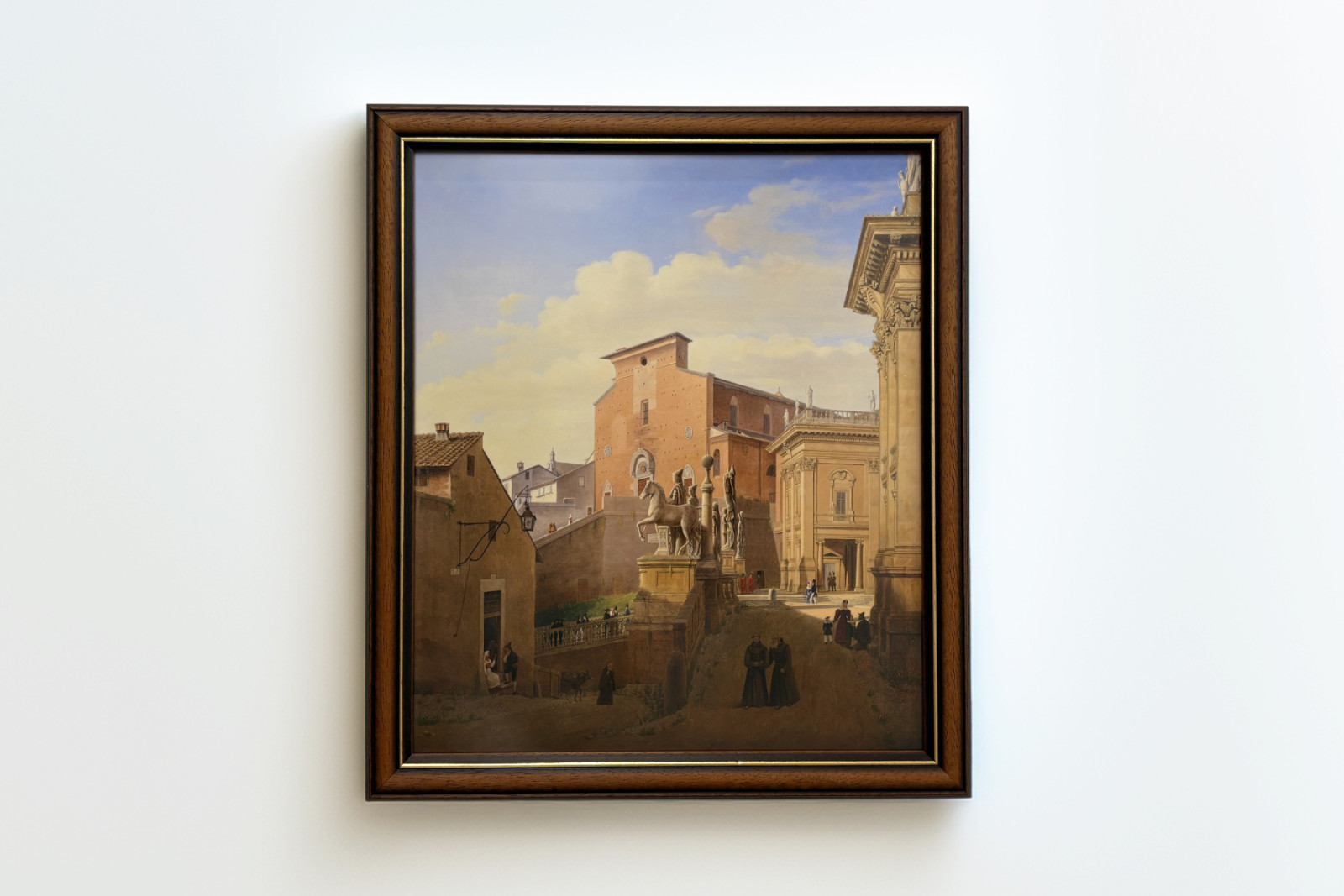
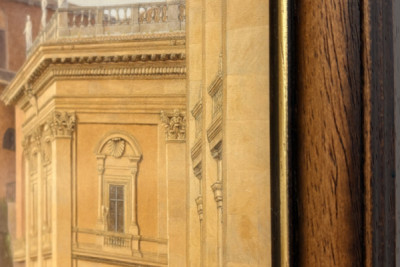
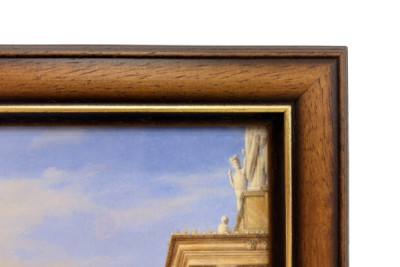
Staircases, retaining walls and terraced façades guide the eye through a Rome comprising many layers of history. At the centre stand the ancient Dioscuri with their horses; behind them rises the red-brick architecture of Santa Maria in Aracoeli. To the right, a pale palace façade pushes its way into the picture plane. Cornices, capitals and balustrades are drawn with precision; small figures provide a sense of scale to the buildings and, incidentally, convey scenes of everyday life set against the backdrop of the church, ancient sculpture and urban order. Ochre and earthy brown dominate the lower part; above, a blue sky with light clouds opens up. The light remains soft, shaping the architecture without rendering it overly dramatic. Wilhelm Brücke, a 19th-century German architectural and landscape painter, demonstrates his strengths particularly clearly in this view, dated 1831: He captures Rome as a cohesive built environment; even minor details such as sections of wall, windows and balustrades retain their significance. The scene thus appears almost documentary in nature - yet it is by no means cold. A tranquil sense of connection to the historic site emerges between the dark figures and the sun-warmed façades.
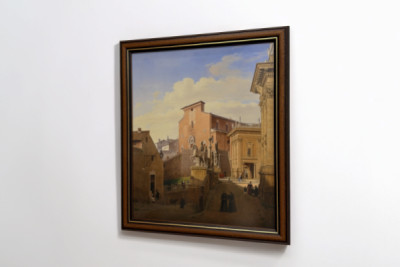
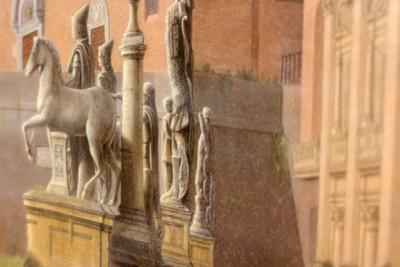
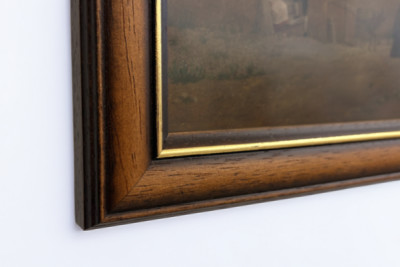
In this version, the image measures 35 x 41 cm on FineArt Photo Matt behind anti-reflective glass - a combination that works surprisingly well. The matt print surface preserves the muted tones and allows Brücke’s lines to stand out clearly. Around the horse, the columns and the brick wall, fine grain and hair-like traces emerge; they lend the print a textured surface without giving the impression of a painted canvas. One’s gaze is indeed drawn to the light-coloured stones: there, the layers of ink are visibly graded from grey shadows to chalky highlights. The anti-reflective glass minimises glare; even when viewed from the side, window frames and figures remain legible - whilst also protecting the delicate paper surface. A passe-partout has been deliberately omitted, so the architecture begins immediately at the narrow gold edge. The ‘Alexis’ frame encloses the sheet in a brown wood-effect finish with a dark inner profile; the gold line adds just a touch of lustre. Any further ornamentation would compete with the many cornices in the image - as it is, it is perfectly sufficient. The tactile depth of the finished piece arises from the fine grain of the matt print and the graduated frame body; it is precisely this direct interplay that complements Roman architecture so well.
 ×
×






 +43 4257 29415
 support@meisterdrucke.com
 Mo-Do: 7:00 - 16:00 | Fr: 7:00 - 13:00