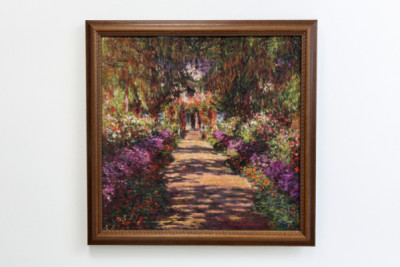
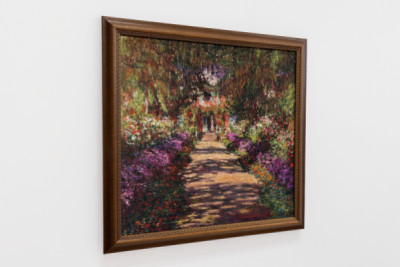
The gravel path winds its way through the picture like a pale ribbon, speckled with patches of light filtering through the canopy of leaves - to the left and right, purple and pink flowering perennials grow so densely that the path is almost swallowed up by them. Right at the back, small and in a warm red, Monet’s house emerges from amongst the trees, more of a hint than an architectural form. Here, in 1902, Claude Monet painted his own garden in Giverny, which he had laid out himself over decades and tended as if it were a walk-in palette. The founder of Impressionism was less interested in botany than in what the light does to the colours: In the shaded areas, the sandy path takes on a violet hue; the green of the trees breaks down into dozens of shades; and the orange-red splashes at the edge of the path sit like brief exclamations amidst the cooler tones. It is a picture without people, and yet one senses an invitation to walk along this path.
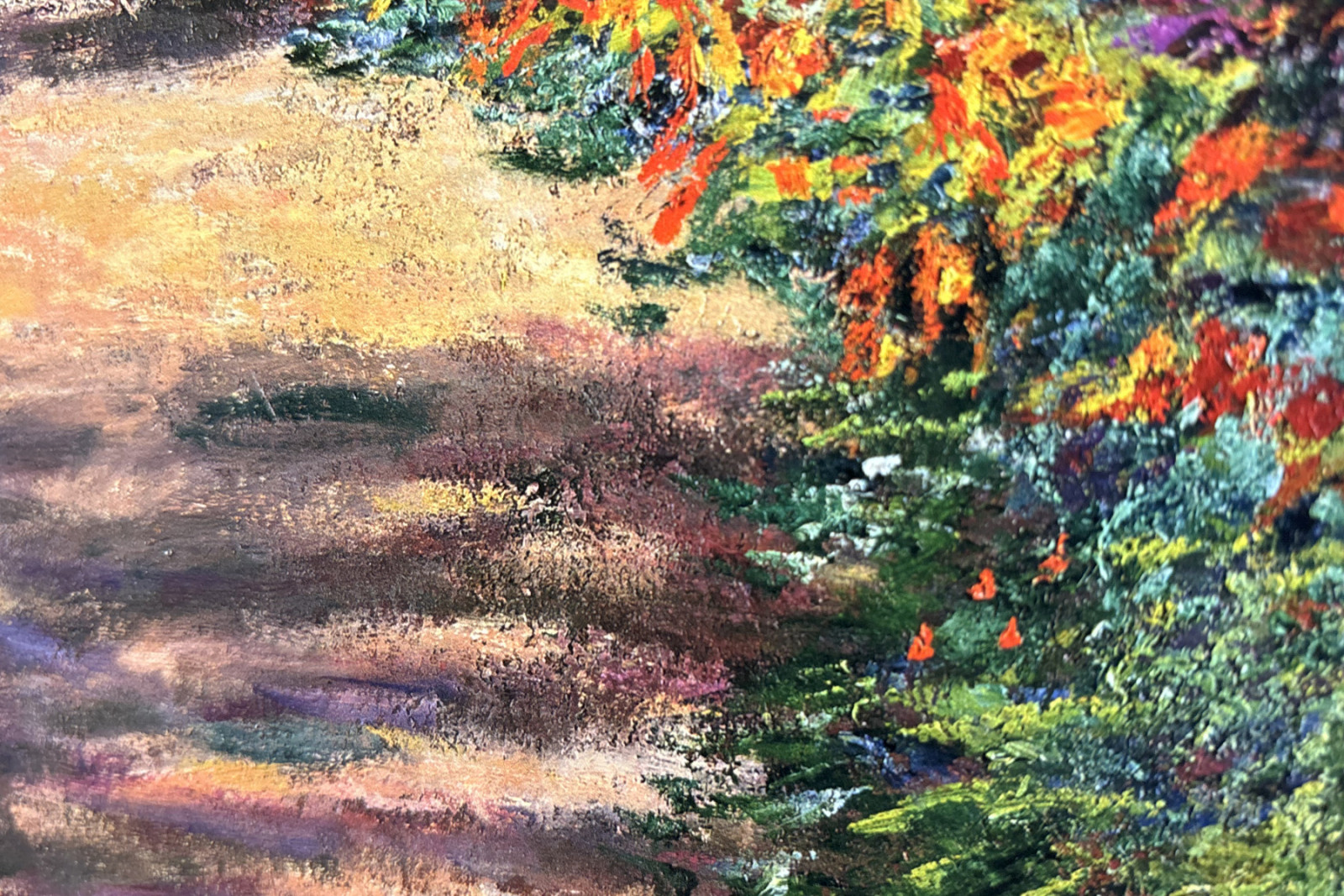
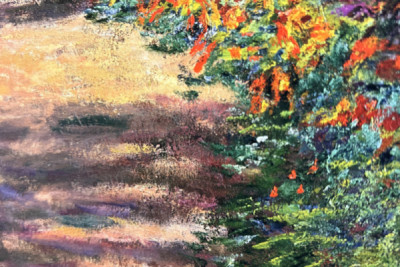
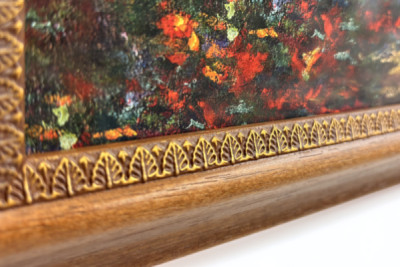
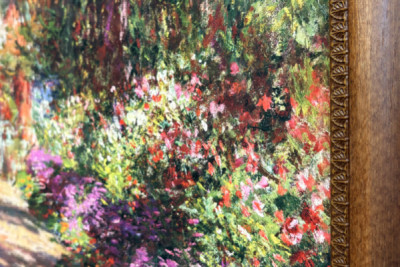
The print measures 49 x 48 cm and is produced on matt FineArt photo paper, which allows Monet’s muted patches of colour to remain without any inherent sheen - even the dark red areas at the bottom of the picture retain their texture. The finishing touch is provided by Kusuma, a classic Italian wooden frame: the broad curve reveals an open walnut grain, and on the inside, a carved border of small golden leaf motifs runs around the entire picture, each motif individually carved in relief. At the corners, the rows of carvings meet cleanly without the pattern breaking - a detail that makes you linger longer than intended. There is no passe-partout; the motif extends right up to the border. When side light falls on the surface, the paper remains calm and matt; the anti-reflective glass allows hardly any reflections, and only the golden arches take on a subtle sheen. That is all this motif needs.
 ×
×






 +43 4257 29415
 support@meisterdrucke.com
 Mo-Do: 7:00 - 16:00 | Fr: 7:00 - 13:00