Above Judith’s head, the names appear as if engraved against a gold background - ‘Judith’ and ‘Holofernes’ - and beneath them she gazes at the viewer with her eyelids half-lowered, her lips slightly parted, the collar of gold and precious stones drawn high around her neck. Of the decapitated general, Klimt shows only a fragment of his face at the right-hand edge of the picture, half in shadow, touched almost casually by her hand. This is the provocation of this 1901 painting: not a pious heroine from the Old Testament, but a Viennese woman of the turn of the century, self-assured, triumphant, sensual. Stylised fig trees and ornamental scales fill the background, all in the gold that characterises Klimt’s work from those years - in contrast to the soft, almost veiled rendering of the face and body. It is precisely in this juxtaposition of hard ornamental surfaces and breathing skin that the tension lies, which continues to hold the painting’s power to this day.
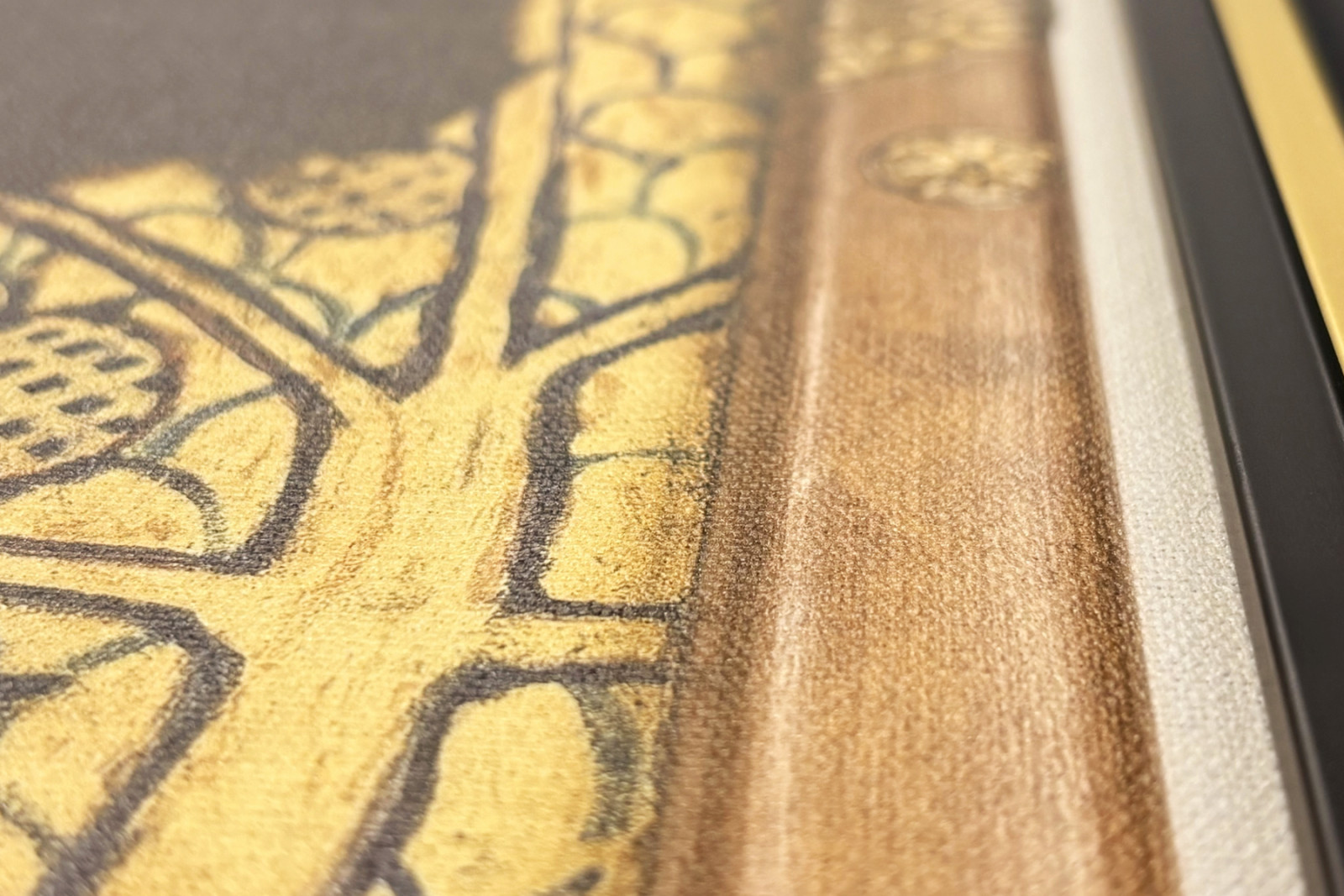
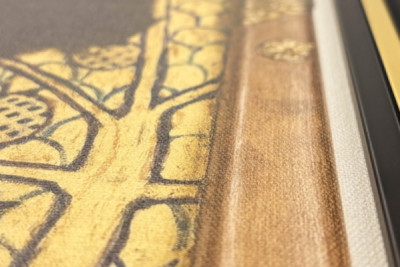
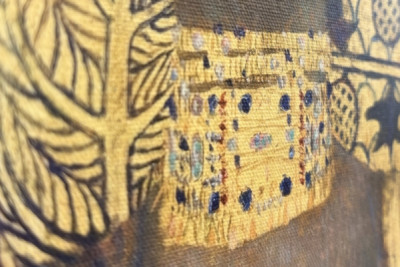
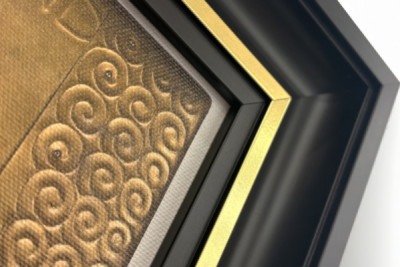
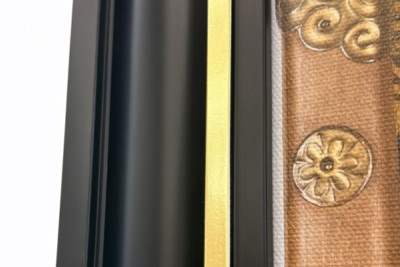
And here, this gold is given an antagonist: Leonie, a solid wood profile in deep black, whose inner edge, polished to a gold finish, leads towards the picture plane. As the gaze moves from the outside in, it passes through three distinct tonal shifts - matt black, then the narrow, coolly gleaming strip of gold, then the warm, muted ochre of the subject. The colour of the edge is lighter and smoother than Klimt’s gold, which on the canvas looks more like embossed metal, dull and with a brownish sheen; it is precisely this difference that prevents the frame and the painting from blending into one another. The black, in turn, finds its counterparts in the motif: in Judith’s dark hair, in the contours of the trees, in the blue dots on her robe, which sit on the satin-finished canvas almost like tiny dots of lacquer - the eye is indeed drawn to this detail. A narrow shadow gap separates the gold edge from the print, so that the canvas stands freely in front of the fold. Nothing more is needed here; anything else would only overwhelm the picture.
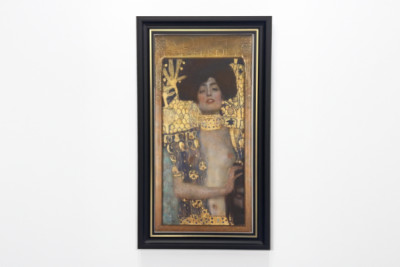
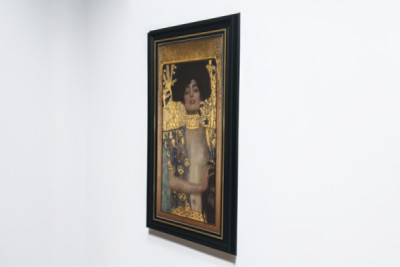
Klimt’s Judith is one of those paintings that demand proximity - only when you stand right in front of it does the gold ground dissolve into scales, rosettes and spirals. In portrait format, measuring 34 x 67 cm, it hangs on a light-coloured wall like a dark, slender stele, and the black-and-gold of the frame ensures that, even from a distance of several metres, it immediately commands the space.
 ×
×





 +43 4257 29415
 support@meisterdrucke.com
 Mo-Do: 7:00 - 16:00 | Fr: 7:00 - 13:00