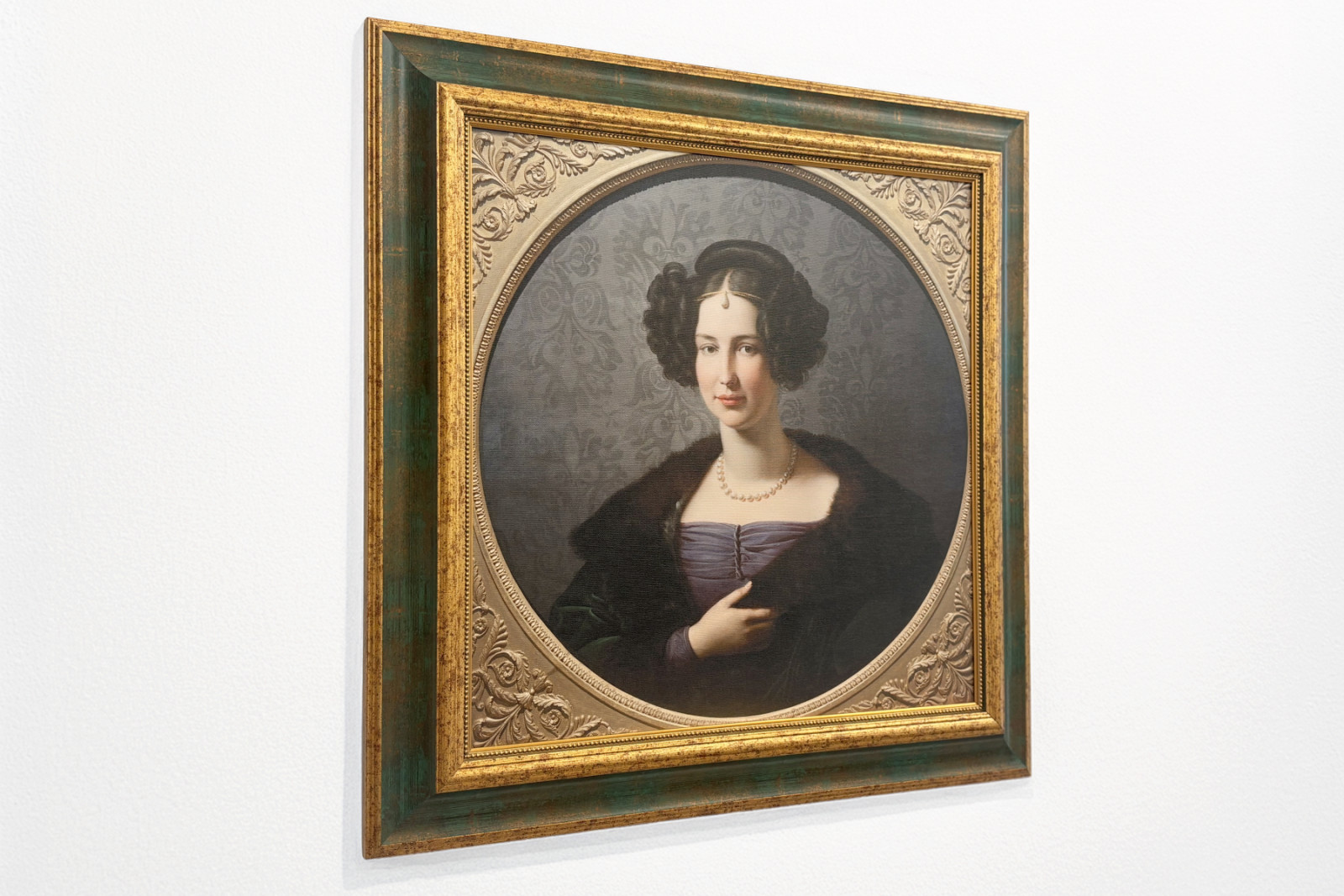
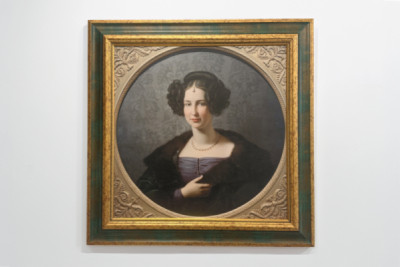
Round within a square: Schadow sets the portrait within a tondo and fills the four spandrels with painted acanthus reliefs, as though the portrait were already carved in stone. In the centre sits Wilhelmine Luise, Princess of Prussia, against a shimmering grey damask background - her dark hair styled in spiral curls, a slender pearl jewel on her forehead, and a single-strand pearl necklace around her neck. One hand holds together the fur-trimmed cloak draped over her lilac-coloured silk dress; her gaze passes calmly, almost scrutinisingly, over the viewer. Schadow, son of the sculptor Johann Gottfried Schadow and, from 1826, Director of the Düsseldorf Academy of Fine Art, painted this portrait in 1840 with the smooth, porcelain-like precision that characterised Düsseldorf portraiture of those years. Nothing in the painting imposes itself - it rests within itself, carried by the muted tones of grey, violet and brown, and it is precisely this restraint that lends the young woman her quiet authority.
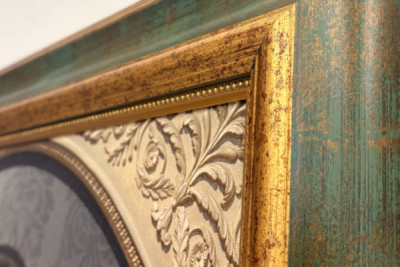
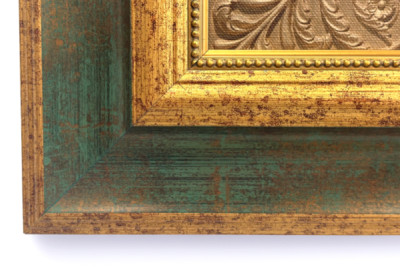
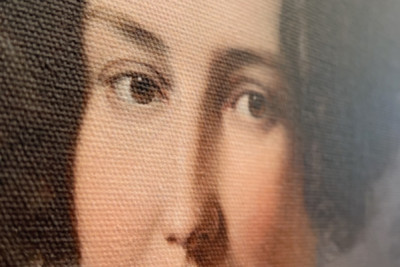
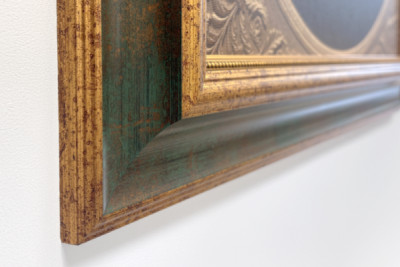
When hung on the wall, it becomes clear just how precisely the colours interlock: The green of the ‘Lydia’ frame, veined with gold, initially stands out like a distinct note alongside the painting - until one discovers the dark green of the velvet cloak peeking out from beneath the fur, and the two suddenly seem to belong together. In between, the ‘Andrea’ fillet, with its delicate beaded moulding-whose gold flows into the painted relief spandrels-ensures that painted and real ornamentation are almost indistinguishable. The layering is most evident in the lower corner of the frame: speckled gold on the outside, then the broad green centre panel with its copper-coloured openwork, and gold again on the inside - a sequence that effectively condenses the square format of 48 x 48 cm into the picture plane. Viewed up close, the satin-finished canvas renders the soft transitions of the face without any harshness; even the tiny points of light in the brown eyes sit exactly where Schadow placed them.
Rarely does the choice of frame fit so logically: The green-gold of ‘Lydia’ simply extends the play of colours from the velvet, fur and painted relief outwards, and as a result the portrait appears less framed than extended - a transition that noticeably benefits the courtly solemnity of the portrait.
 ×
×




 +43 4257 29415
 support@meisterdrucke.com
 Mo-Do: 7:00 - 16:00 | Fr: 7:00 - 13:00