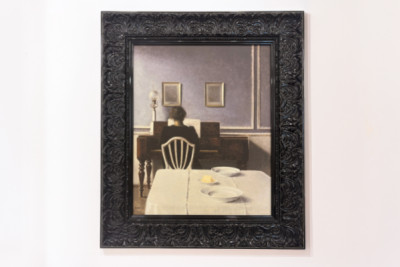
From the brightly laid table in the foreground, the viewer’s gaze travels past three plates and a small yellow object on a saucer to the curved back of a chair, behind which the young woman sits with her back to the viewer at the dark piano. Hammershøi organises the room using horizontal and vertical lines: the edge of the table, the wall cornice and the instrument lend a sense of calm to the space, whilst the figure seen from behind, a lamp and two small pictures appear almost rigidly positioned within it; even the muted violet-grey of the wall blends into this order. Nevertheless, the scene is not static, for the milky light is distributed unevenly across the tablecloth, crockery and furniture, causing contours to blur in places and creating that peculiar blend of intimacy and inaccessibility that characterises many of the Danish painter’s interiors. In 1901, when the painting was created, Hammershøi was one of the distinctive voices of Nordic art at the turn of the century - he did not craft narratives from everyday spaces, but rather states of quiet anticipation.
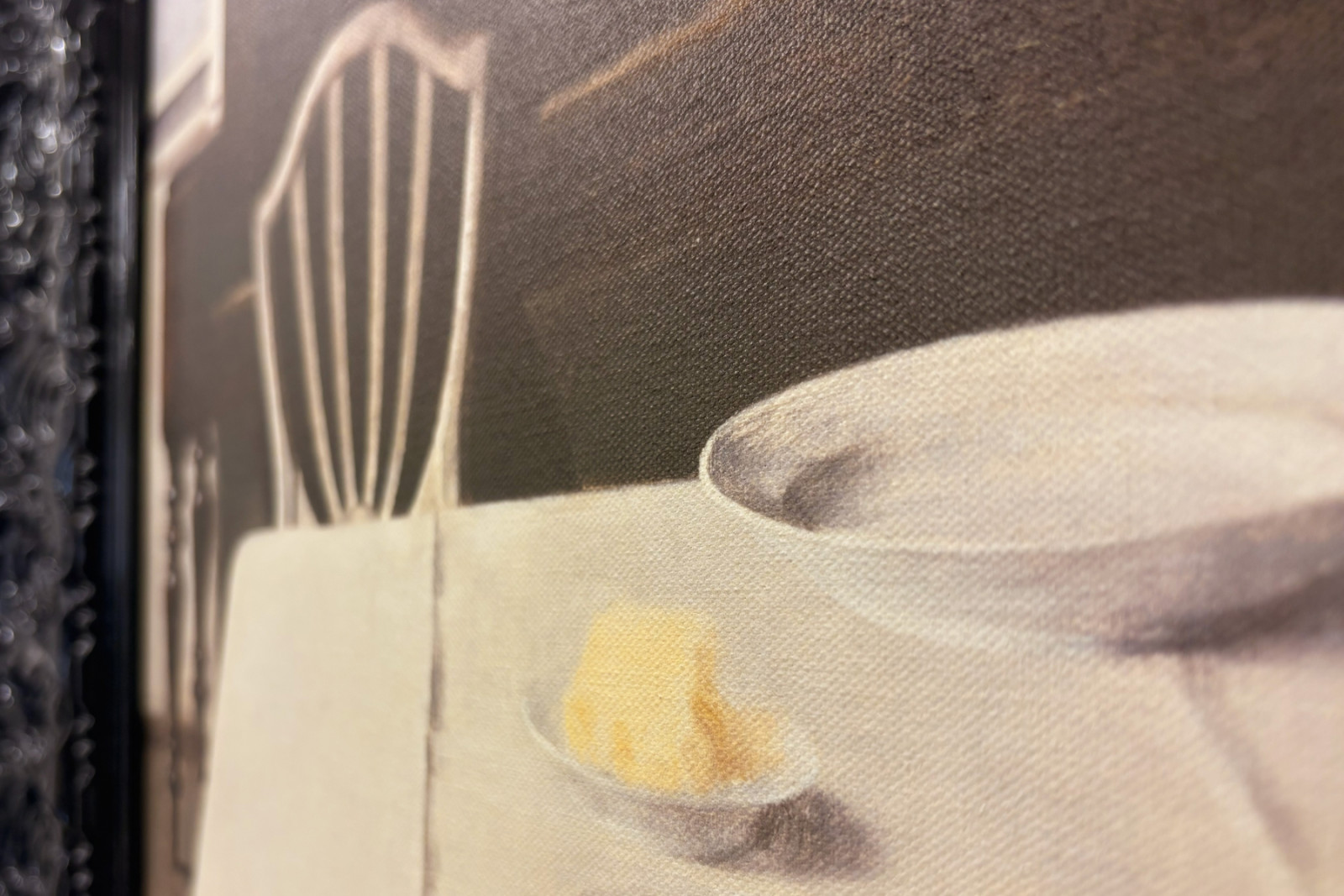
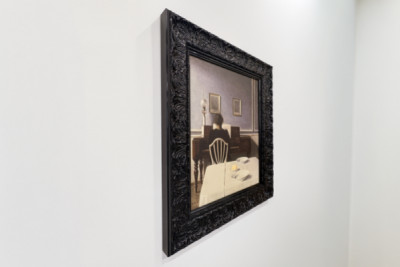
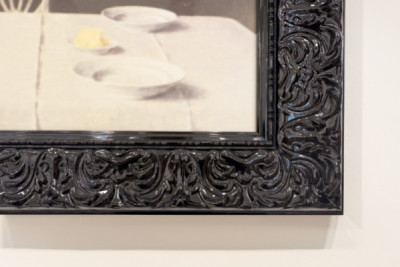
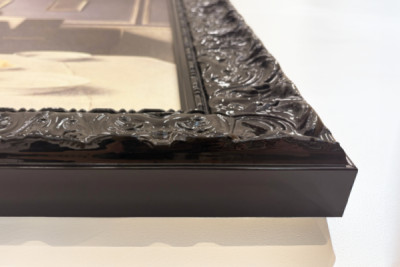
In this version on canvas, ‘Leonardo’ - whose satin-finished surface remains clearly visible without glass - one’s gaze is drawn, of all things, to the most inconspicuous detail of the motif: the yellow object on the small plate, little more than a warm splash of colour against the off-white background. The print preserves its soft edges as well as the narrow shadow beside it, so that the splash neither glows decoratively nor disappears into the light-coloured tablecloth; even the dark seam or crease running towards it from the edge of the table remains clear enough to convey the spatial arrangement of the foreground. The plates, for their part, are not pure white, but rendered in shades of cream, grey and violet, with blurred shadows that convincingly convey Hammershøi’s restrained painting style. Vitura frames the 44 x 54 cm reproduction with high-gloss black and bold ornamentation - a striking frame that deliberately contrasts with the sparse room, and one may either appreciate this or perceive it as a source of friction.
It is precisely this contrast that heightens the tranquillity of the painting without explaining it. The woman with her back turned is the one who lingers longest in the memory: her silent silhouette creates more tension than any visible gesture.
 ×
× 





 +43 4257 29415
 support@meisterdrucke.com
 Mo-Do: 7:00 - 16:00 | Fr: 7:00 - 13:00