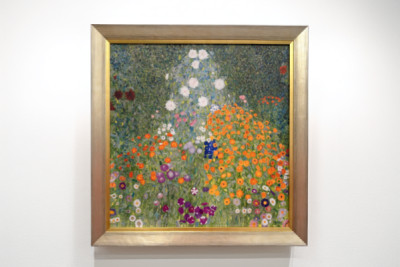
With no horizon and no open sky, the garden rises like a densely packed wall of blossoms. Orange flower heads gather on the right to form a large patch, whilst white blossoms in the centre create a loose vertical line; in between, red, violet and blue speckles are set amongst the undulating greenery. Klimt arranges this profusion not according to botanical precision, but according to rhythm and colour. The eye finds no path through the garden; it wanders from flower to flower and is eventually lost in the darker foliage of the upper part of the picture. In 1905, during Klimt’s Viennese years, nature thus appears less as a landscape than as a two-dimensional composition. It is precisely this affinity with the ornamental art of Art Nouveau that lends the cottage garden its distinctive tranquillity: everything is growing, yet nothing encroaches beyond the edge of the picture.
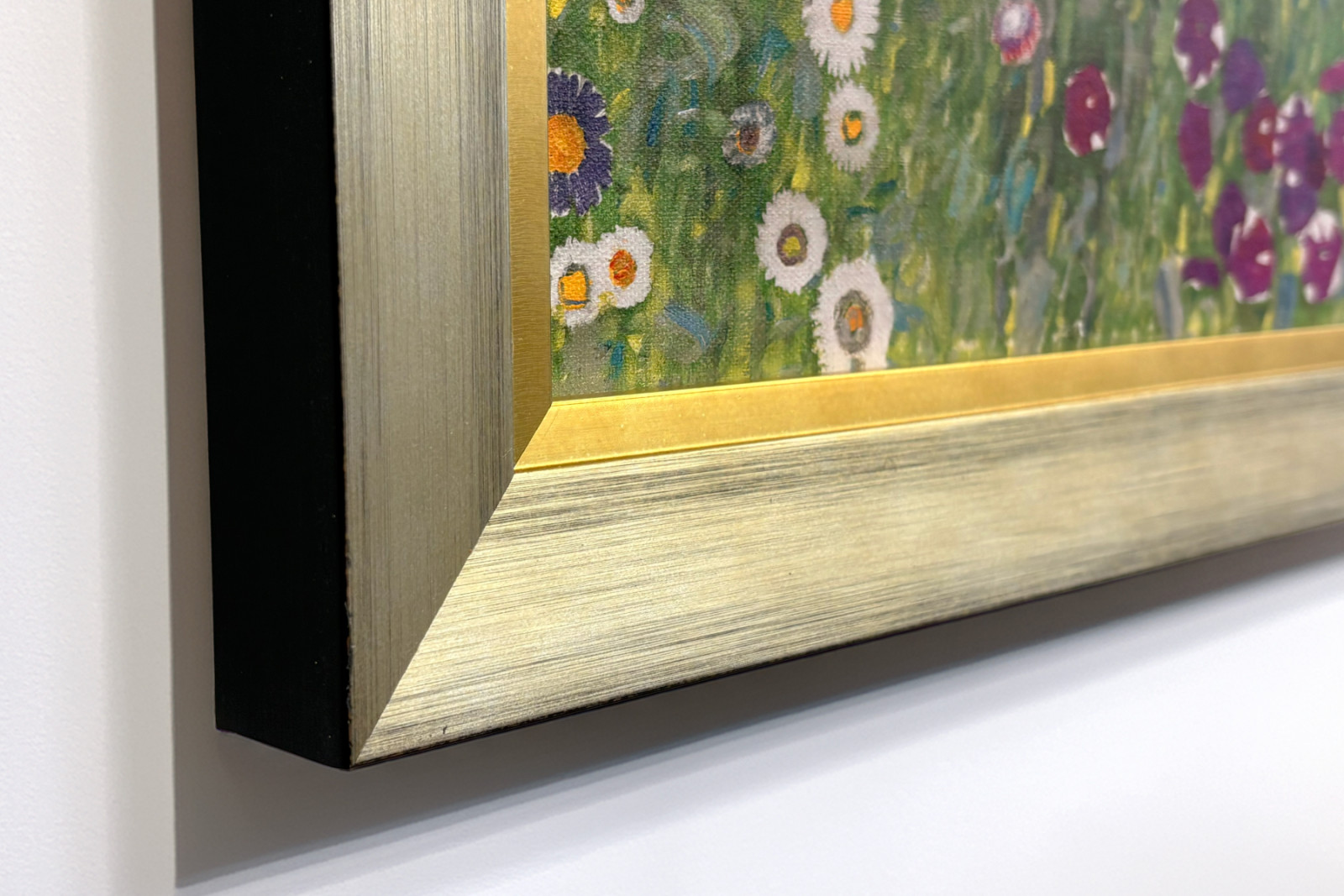
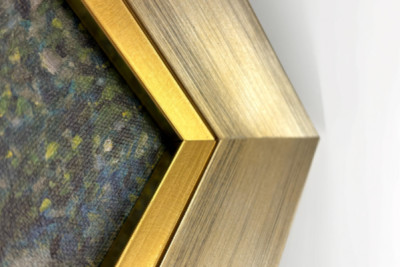
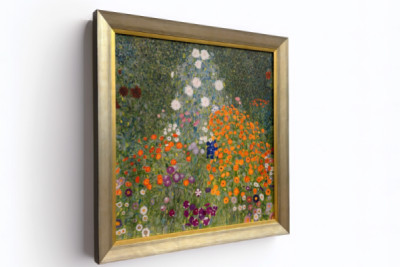
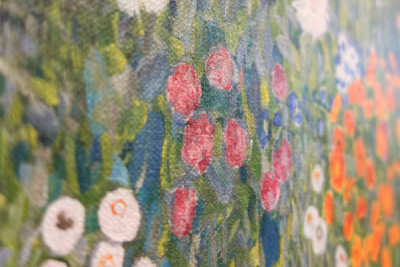
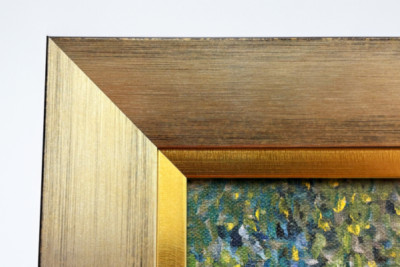
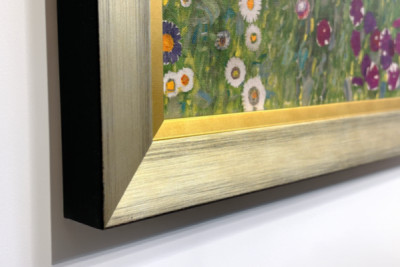
In this version, the satin-finished canvas, ‘Leonardo’, bears the almost square composition measuring 48 x 49 cm. Mare frames it with a champagne-coloured wooden moulding; a narrow gold border separates the painting directly from the frame, as there is no passe-partout or glass. What catches the eye when viewing the work is a small cluster of round red blossoms to the left of centre. Viewed up close, the print reveals how Klimt builds them up using short, circular brushstrokes: in some of the blooms, a light rim remains visible, whilst others thicken into a dark red, and between them, green and blue strokes run vertically through the foliage. The reproduction even preserves the irregular contours, so that no flower looks like a mere dot of colour. One of those works where the effort put in remains visible.
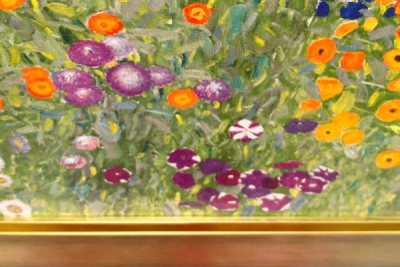
At the bottom edge, white daisies stand alongside purple blossoms, whose light inclusions appear as recessed areas in the application of paint. Further up, a single red flower head almost dissolves into the blue-green background; only its dark centre holds the small form together.
 ×
×






 +43 4257 29415
 support@meisterdrucke.com
 Mo-Do: 7:00 - 16:00 | Fr: 7:00 - 13:00