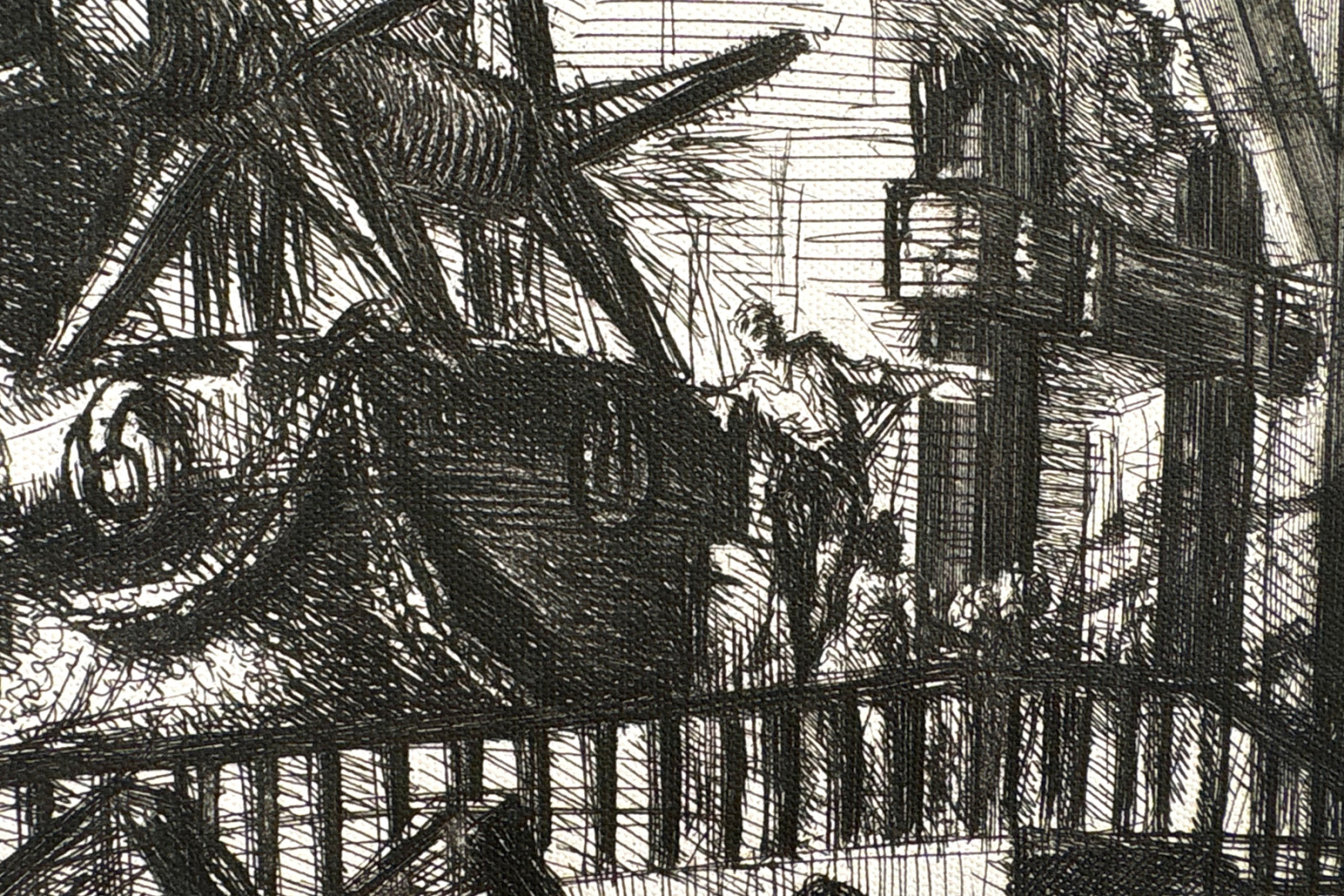
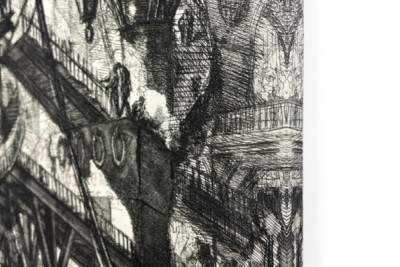
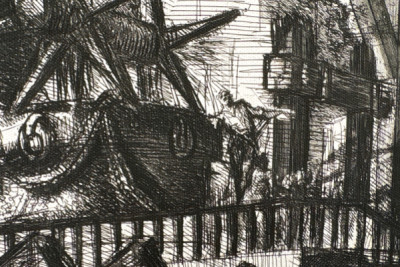
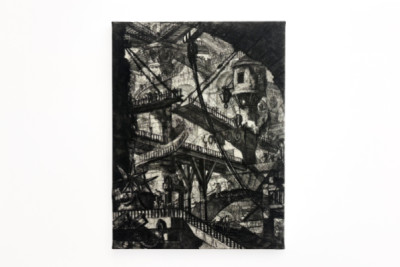
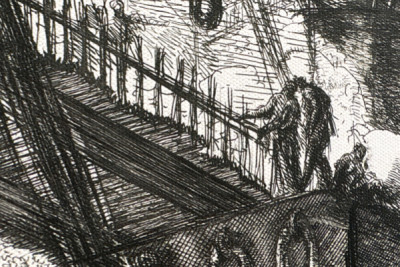
Halfway down the page, a figure is leaning against the bridge railing and looking down, where there is nothing but more walkways, steps and arches. The cable of the raised drawbridge runs as a thick black diagonal line from the top left across the entire picture, crossing beams, walkways and a round watchtower with a lantern, and ends at the bottom near a cogwheel with jagged teeth that looks like an instrument of torture. Tiny people stand on the parapets; none of them seem to have a destination. The architecture stacks up upwards and backwards, with no apparent way out; light and dark do not follow any light source, but rather the tangle of hatching. Giovanni Battista Piranesi, trained in Venice and working as a veduta engraver in Rome, etched the *Carceri d’Invenzione* in 1745 as a young man and returned to the plates some fifteen years later to make them darker and denser. The Drawbridge is one of the prints that already conveyed this sense of unease in its first version: spaces larger than any real dungeon, and people who are lost within them.
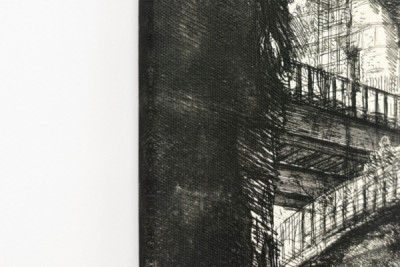
In this version, the etching is mounted on a matt ‘Salvador’ canvas, 48 x 65 cm, unframed and without glass. The weave remains visible beneath the drawing: In the white areas between the hatching, the fabric’s weave emerges as a fine grain, and the thin lines on the figures on the stairs run across it without fraying. Where the plate is jet black - on the left-hand edge and in the vault at the top - the print covers the fabric almost completely; only at the folded edge does the canvas texture, with its light-coloured intersections, remain visible. I would not have expected a copperplate print on fabric to lose so little of its sharpness. The matt finish produces no glare, not even on the wall in daylight. Without a frame, Piranesi’s Prison extends right to the edge and around the edge, as if the space were truly boundless. Paper behind glass would have been the obvious solution; the fact that someone has chosen not to use it here suits the print better than I would initially have thought.
 ×






 +43 4257 29415
 support@meisterdrucke.com
 Mo-Do: 7:00 - 16:00 | Fr: 7:00 - 13:00