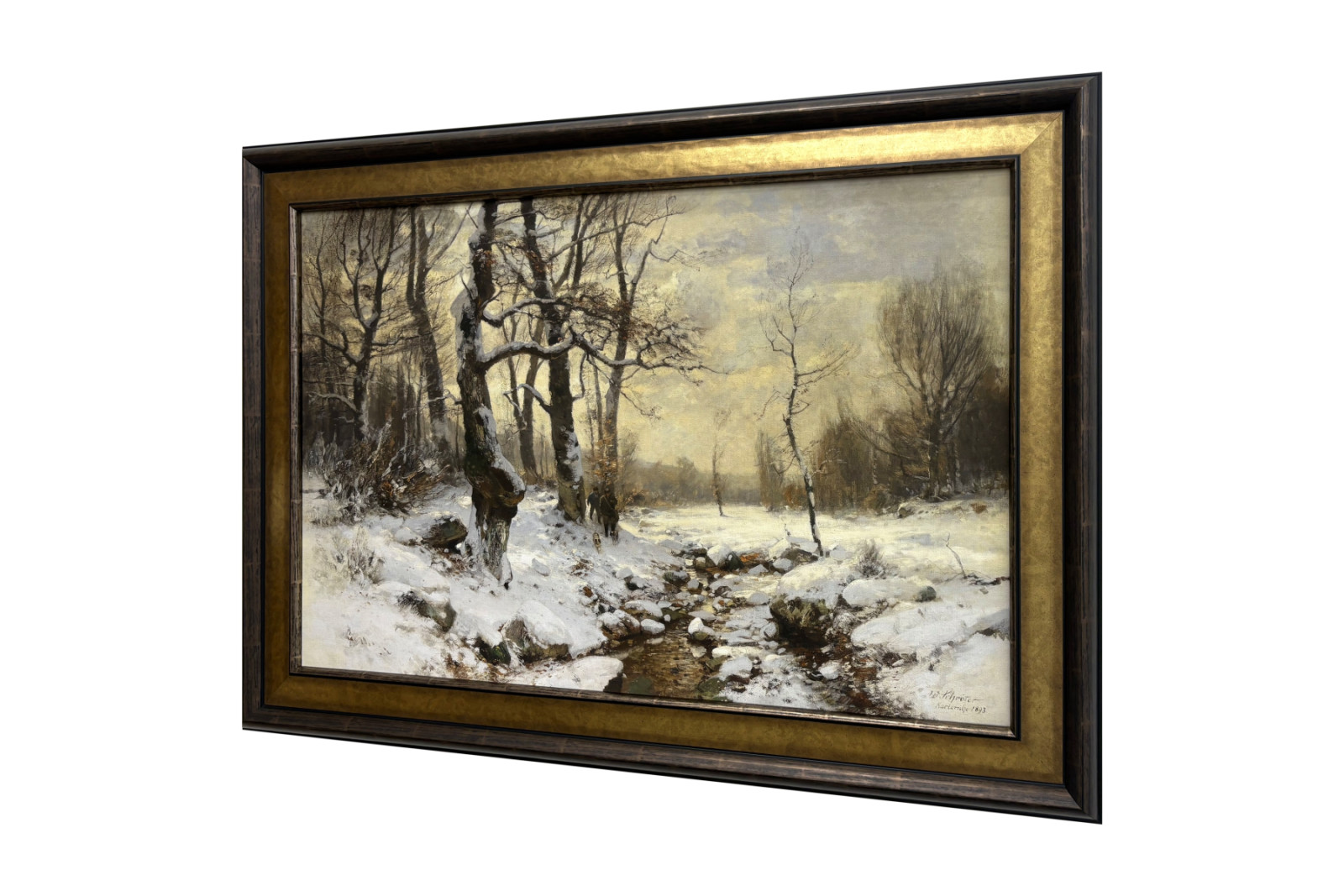
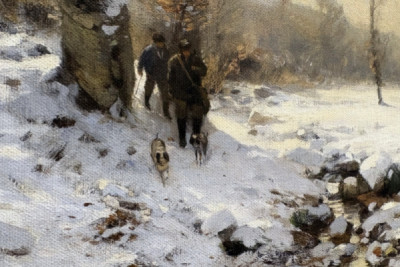
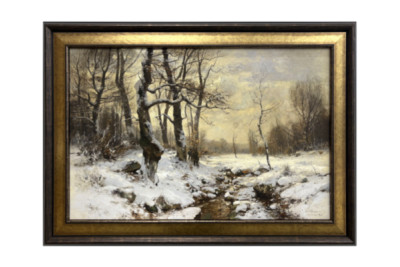
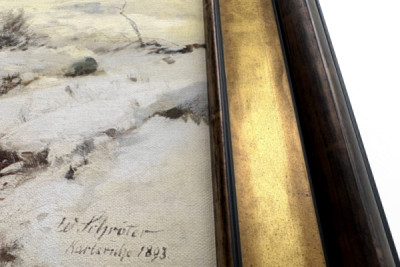
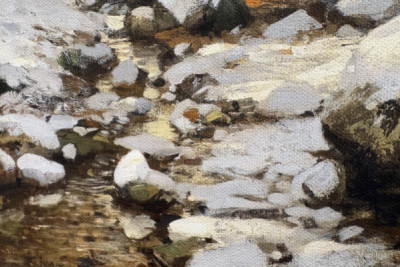
The stream is not frozen over. Brown water flows through the foreground between snow-covered stones, catching the little light the sky has to offer. On the left stands an old oak with a twisted trunk; behind it are further trunks, bare and dusted with snow. On the right, the landscape opens out into a clearing. Above it, a yellow-grey sky; it is late afternoon in winter, the sun already hidden behind the clouds. At the edge of the forest, two men with rifles are walking, two dogs running ahead of them. They are small in the picture, little more than dark spots in the snow. The forest is the subject, not the hunt. Wilhelm Schröter painted this in Karlsruhe in 1893, as indicated by the signature in the bottom right-hand corner. He is one of the landscape painters of the late 19th century who do not depict snow as white, but in shades of grey, blue and ochre. The picture is still. No wind, no tracks except those the hunters are leaving behind. The cold is embedded in the colours, not in any gesture.
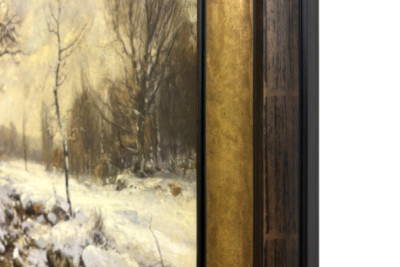
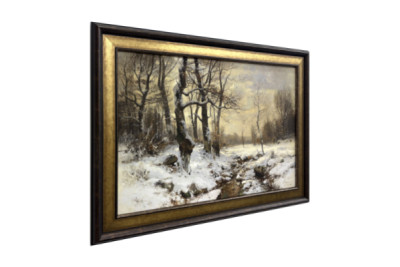
The four figures are the detail that this print is all about. In the original they measure just a few centimetres, and in this 68 x 45 cm version, every detail remains clear: the strap across the chest of the hunter in the foreground, the light-coloured fur of one dog, the grey fur of the other, the legs sinking into the snow. Raphael’s canvas has a matt surface; nothing reflects. That is why the snow around the group remains still, and the blue shadows beneath the stones by the stream retain their depth. In the white areas, the canvas shows through slightly, which enhances rather than detracts from the coarse brushstrokes. The signature in the bottom right-hand corner can be made out with the naked eye, as can the place and year below it. The whole piece is framed in ‘Ilaria’: a wide gold panel on the inside, dark wood on the outside, with a narrow black border in between - Art Deco without any frills. No glass in front of it. During the final inspection, a piece like this tends to stay on the table a little longer than usual; people always find themselves looking for the dogs again.
Because the gold of the frame comes so close to the yellow of the winter sky, the picture appears warmer than its subject actually is. You could see this as a slight distortion or as a concession. In any case, it holds its own on a wall with little natural light, and the hunters can still be spotted even from the doorway.
 ×






 +43 4257 29415
 support@meisterdrucke.com
 Mo-Do: 7:00 - 16:00 | Fr: 7:00 - 13:00