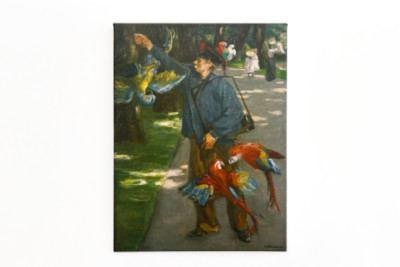
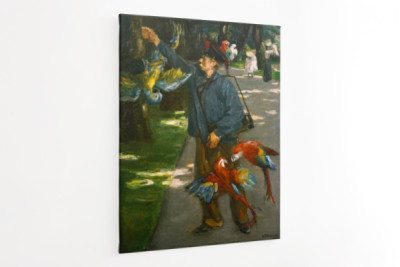
With his arm raised, the parrot man stands amidst fluttering wings and long tail feathers. He appears calm, even though there is a flurry of activity all around him. To the left, blue-and-yellow birds spread their plumage; at his feet, red parrots with patches of blue and yellow on their wings jostle for space. Amidst them, the man’s jacket forms a patch of muted blue. Behind him, a path leads to walkers whose clothing stands out against the shade of the trees; patches of sunlight break up the green and grey of the ground. In his 1902 painting, Max Liebermann focuses on this everyday interaction with the animals, without allowing the scene to become frozen into a performance. He suggests much with just a few brushstrokes - and it is precisely this that keeps the moment in motion. Whilst the man looks up to the left, the birds beneath his hand take on a life of their own, which he does not even seem to notice. The painting derives its tension from his calm and their flapping wings.
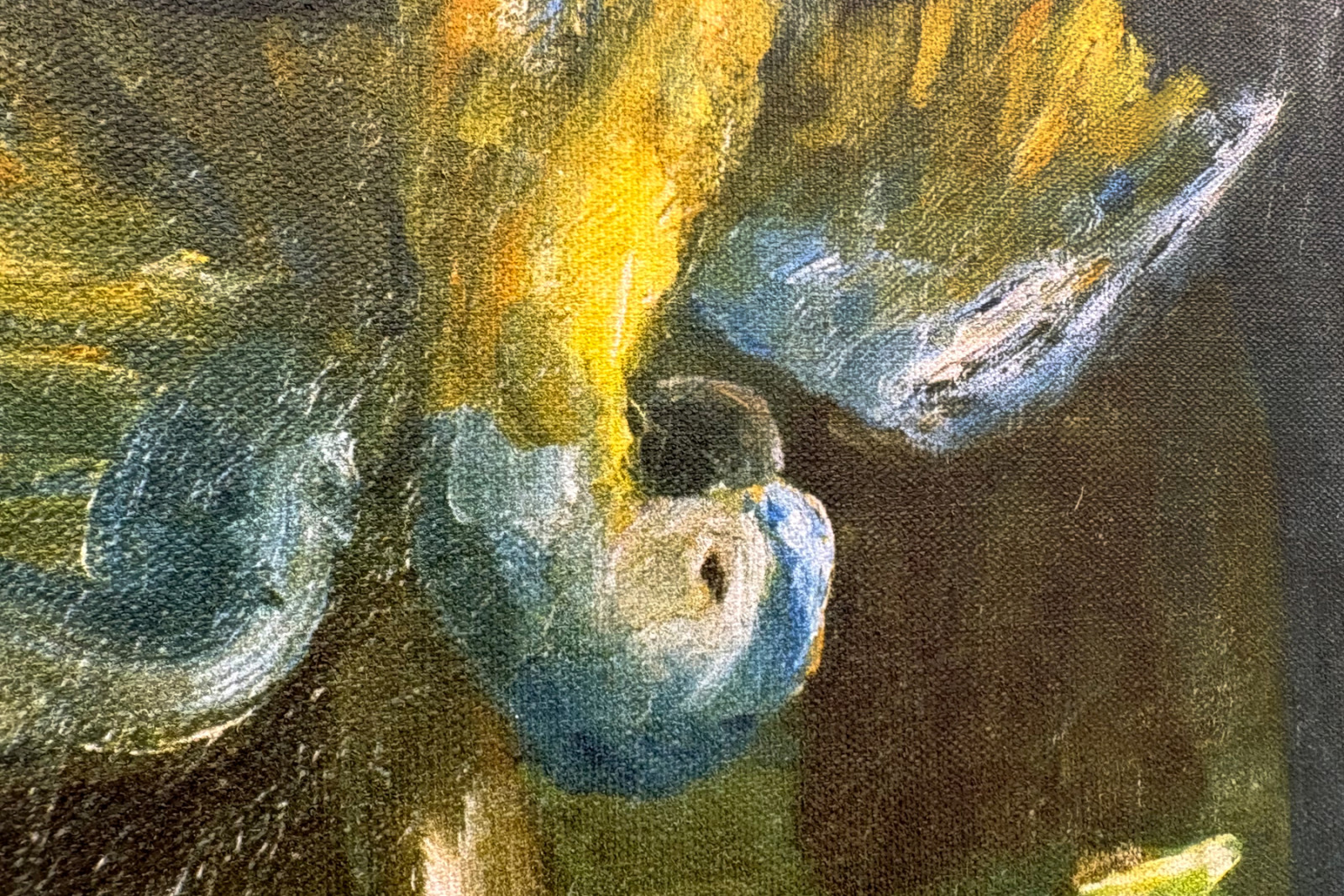
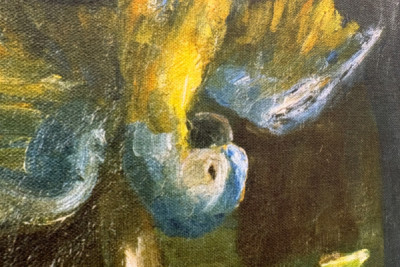
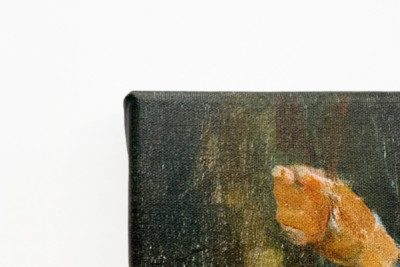
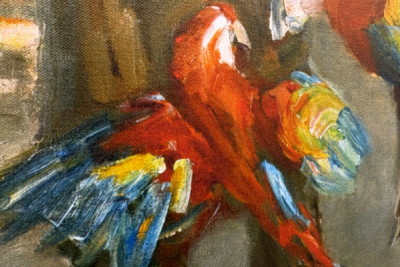
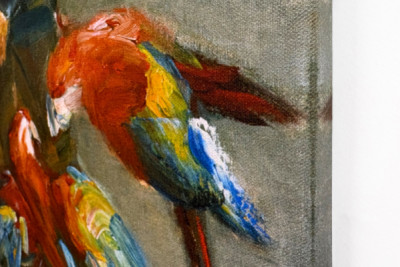
With this reproduction on satined ‘Leonardo’ canvas, it is worth taking a closer look at the parrots. On the upside-down bird on the left, the fabric runs across the cheek, beak and yellow feathers alike; its delicate raised areas simply extend beyond the boundaries of the printed brushstrokes. Two textures meet here - the reproduced painting and the actual relief of the canvas - and this results in anything but a smooth picture surface. This is most clearly evident in the red bird in front of the man’s legs: long strokes depict the blue flight feathers, whilst the weave of the canvas breaks them down again into small sections. Above the red breast, this grid remains just as visible as it is in the narrow white lines beside the head - a spot where, whilst looking at the painting, I lingered longer than on any other detail.
 ×






 +43 4257 29415
 support@meisterdrucke.com
 Mo-Do: 7:00 - 16:00 | Fr: 7:00 - 13:00