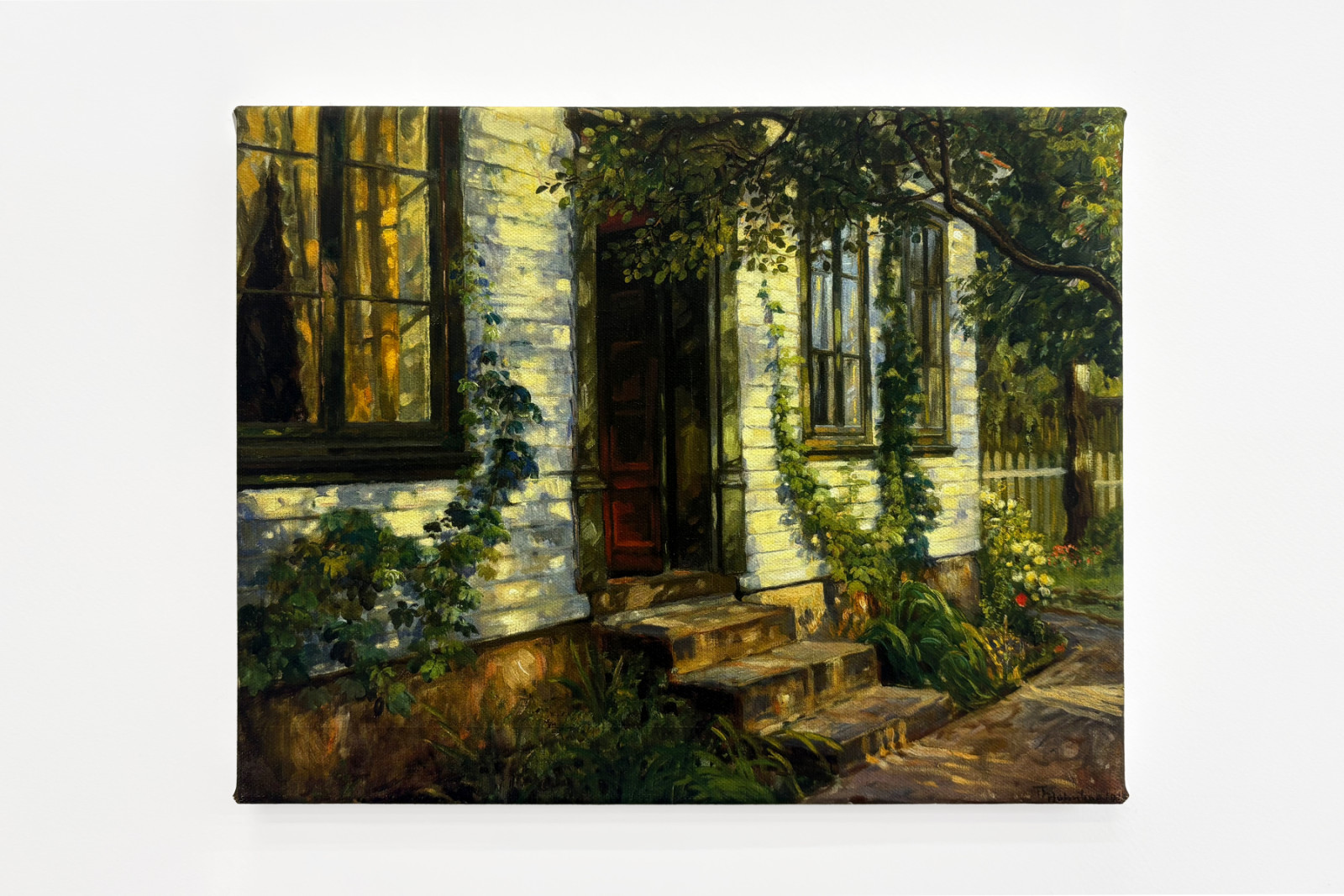
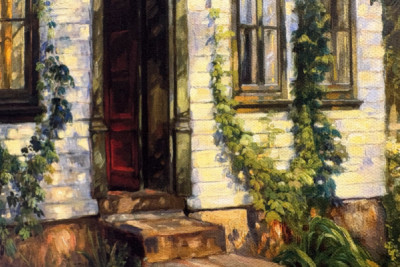
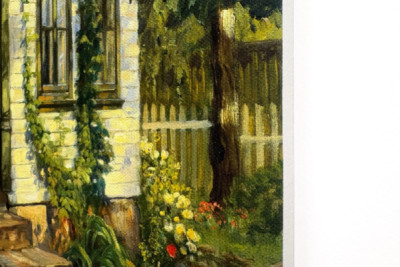
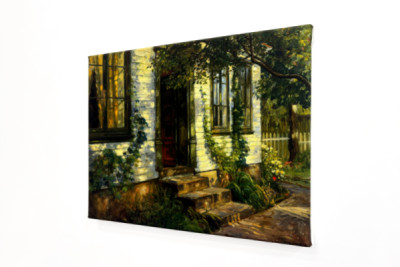
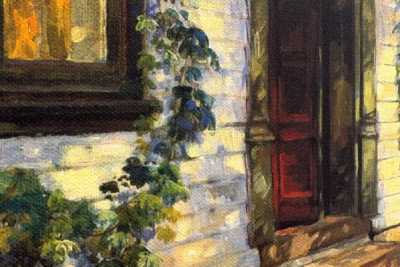
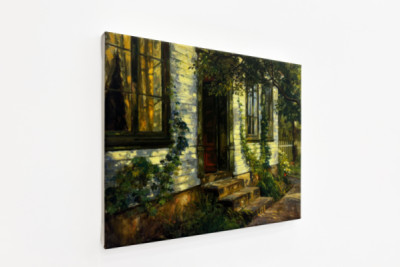
No one is waiting at the front door. Patches of sunlight dance across the white wooden wall and the steps leading up to the entrance. On the left stands a window in golden yellow and brown. On the right, vines climb up between the windows. A branch spans the top of the picture and casts a shadow over the façade. In the centre of it all sits the door, a dark red rectangle, and you almost have to look for its red. Yellow, olive green and bluish shadows dominate the view of this house in Fredriksvern. Flowers dot the fence with tiny red spots. In 1916, Thorolf Holmboe focused his painting on a place devoid of action. It is precisely this that carries the scene. Nothing calls for movement. The light alone transforms the wall and turns the house entrance into a picture of intimacy and summer tranquillity. Despite the deep shadows, the house does not appear closed off. The steps lead right up to the threshold - one could walk up them, but nobody feels like knocking at the moment.
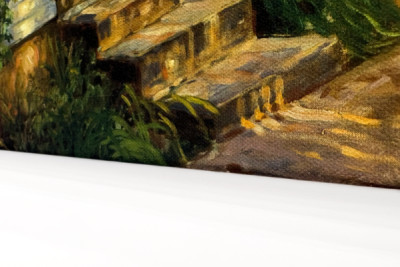
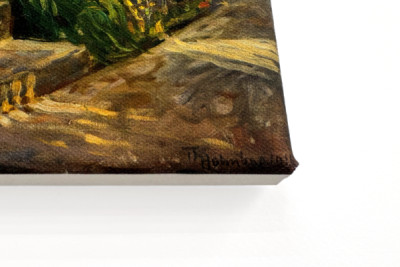
In this commission, the painting stands on its own on a matt Raphael canvas. There is no additional decorative frame. Consequently, there is no frame colour to describe here. The visible edge of the painting forms the border. This has an impact on the overall impression: neither gold nor dark wood claims its own space alongside the painting. There is also no passe-partout. Thus, the unassuming house entrance is not given a grand presentation. It remains a close-up detail from a garden, and it seems to me that this is exactly how it should be displayed.
This treatment allows the everyday motif to retain its natural simplicity and does not demand that it tell a grander story. In 1916, the year the painting was created, Holmboe devoted such attention to a sunlit house wall. Anyone who stands in front of it for a while will eventually find their gaze drawn to the patches of shadow on the steps - they are the essence of this picture, not the house.
 ×






 +43 4257 29415
 support@meisterdrucke.com
 Mo-Do: 7:00 - 16:00 | Fr: 7:00 - 13:00