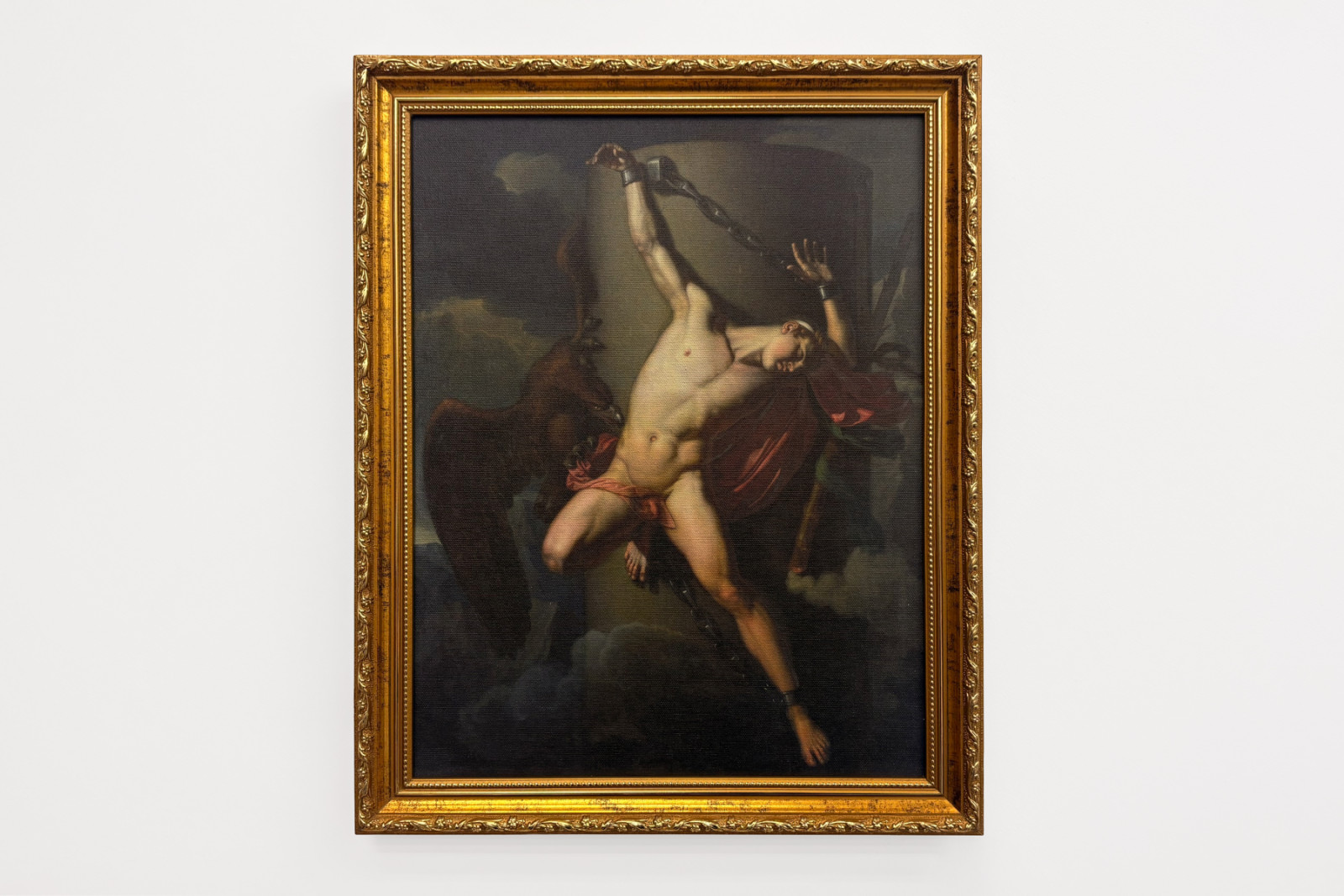
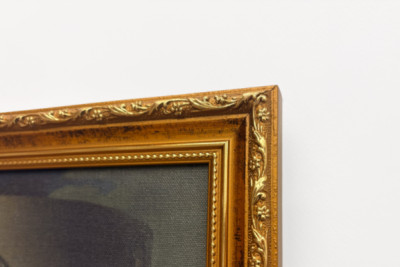
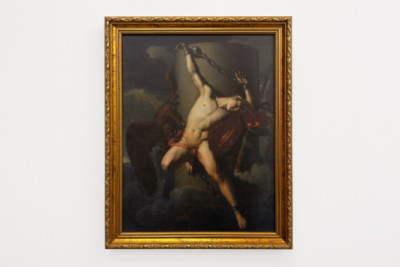
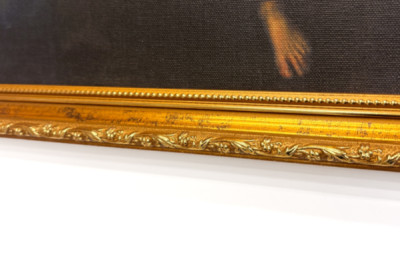
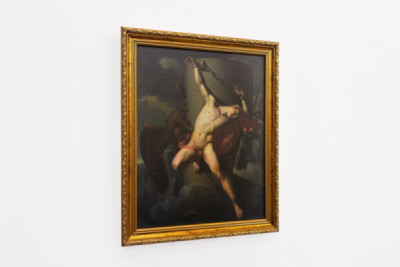
A delicate row of pearls runs along the inner gold edge, close to the picture, whilst dark scuff marks mark out the wide grove of the frame. From there, the eye is almost inevitably drawn to Prometheus, whose bound body stretches across the rock in a steep diagonal line. In 1819, Jean-Louis-César Lair depicted the Titan at the very moment of his punishment: because he brought fire to mankind, Zeus chained him to the rock and left him to the eagle. From the left, the bird presses in on his brightly lit body; chains bind his wrists and ankles. One arm reaches upwards, the other opens in a defensive gesture. A reddish-brown cloth, grey-green clouds and black rock surround the pale skin. The light pools on the chest, stomach and limbs, bringing the physical torment into sharp focus - one looks on, even if it is unpleasant.
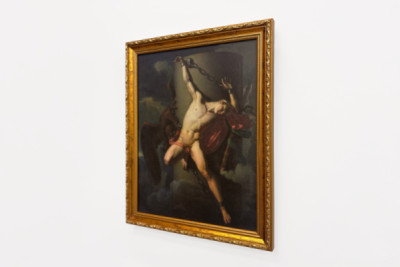
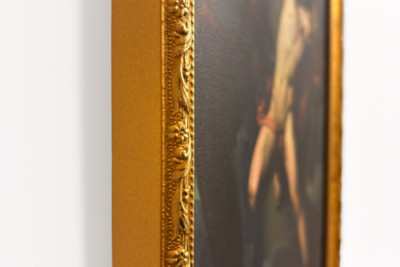
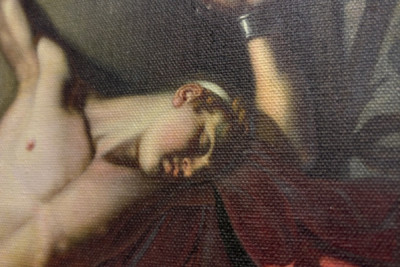
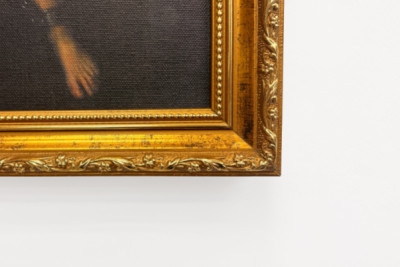
Zumera captures this scene with a tiered Baroque profile. On the outside, leaves and small flowers extend over the edge; their raised areas shine more brightly than the dotted background. Then a slanted groove with visible patina, narrow strips and, finally, the beaded inner edge. For a rather compact piece, that’s a lot of detail, we admit - but it is precisely this layering that brings out depth on the wall without constricting the pictorial space. The firm, almost architectural effect suits the taut posture and the weight of the myth: the frame does not merely adorn; it sets a clear boundary around the figure as it reaches out. Without a passe-partout or glass, the Leonardo canvas sits directly within the gold frame; its satin-finished surface is revealed only as a gentle sheen. When light falls on the piece from the side, bright reflections dance across the ornamentation, the moulding and the canvas, and the painting and frame interlock in such a way that we paused for a moment in the workshop. This doesn’t happen to us with every piece.
 ×





 +43 4257 29415
 support@meisterdrucke.com
 Mo-Do: 7:00 - 16:00 | Fr: 7:00 - 13:00