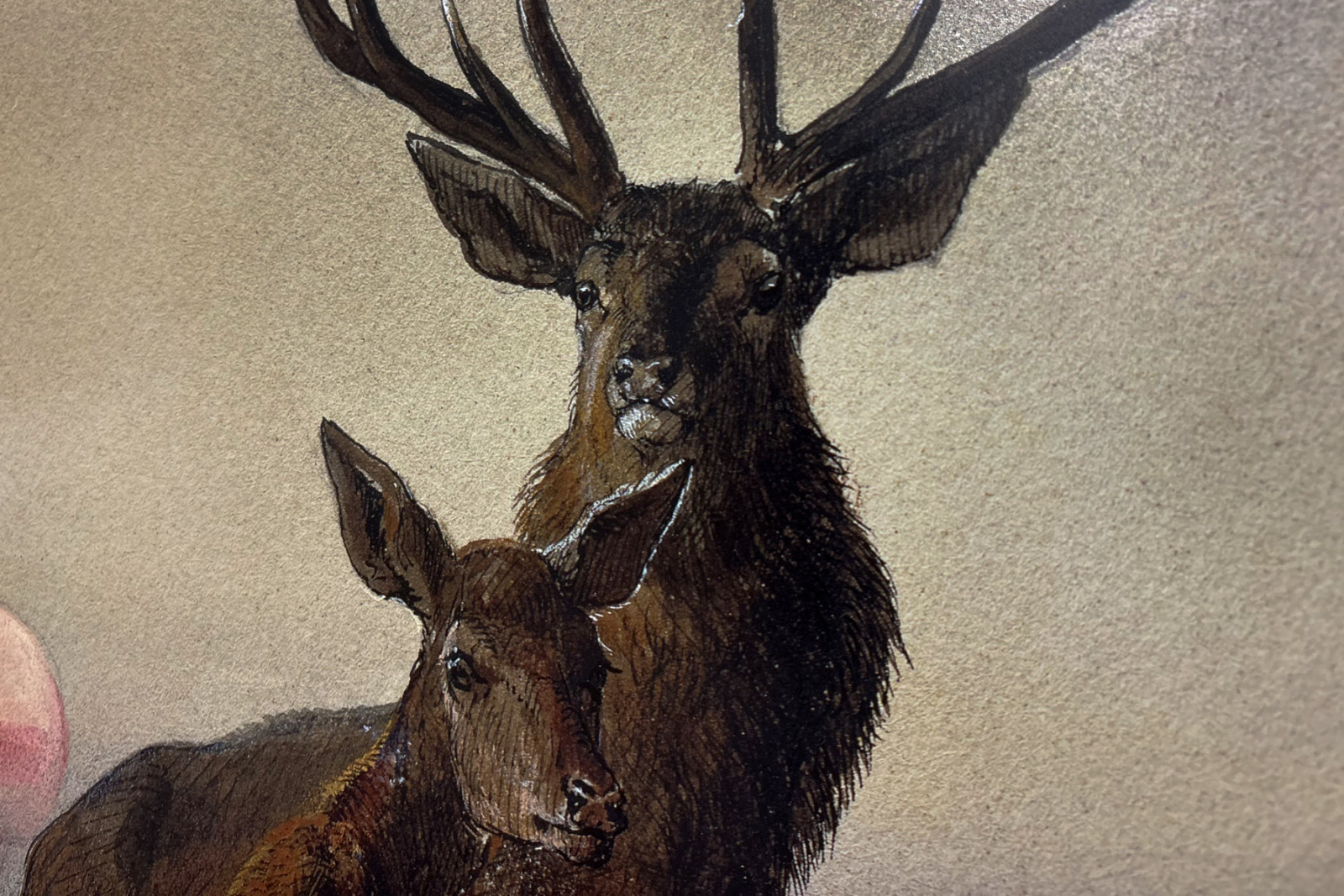
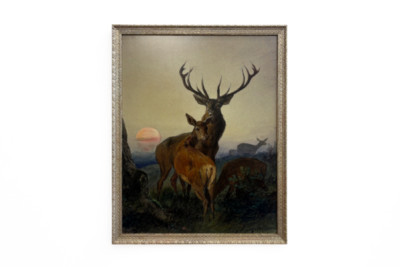
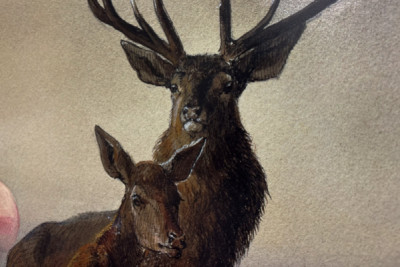
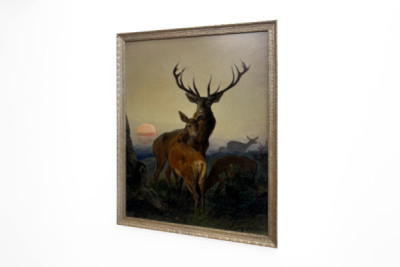
The composition’s axis rises past two animal heads, one above the other, towards the stag’s antlers, which stand out like a bare tree against the pale evening sky. In the foreground stands the roe deer, reddish-brown, its head turned towards the viewer; behind it, the stag, darker, with a thick mane and a steady gaze. On the left, a pale red sun sinks behind the ridge; on the right, another animal is visible on the horizon, appearing only as a shadow. There is no blue in this sky; it remains an olive-grey with a yellowish streak above the mountain range; at the bottom, dark undergrowth frames the scene. Carl Friedrich Deiker, a 19th-century German animal painter, drew his subjects from hunting experiences, and this is evident in their posture: the animals have noticed the viewer yet remain still. The painting is executed on tinted paper, with the highlights on the ears and nose applied as white overpaint.
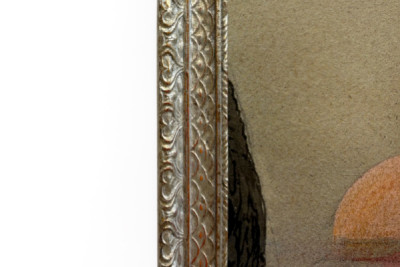
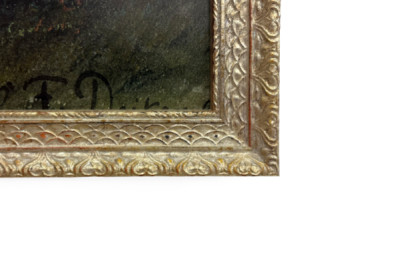
No canvas this time. The image is mounted on FineArt Foto Satin, a photographic paper with a matt finish, and the paper, in turn, is laminated over the entire surface onto a rigid backing board - not stretched over a stretcher frame, but lying flat behind the frame rebate, with no glass in front. This means the sheet cannot warp, and there is no reflection between the eye and the paper, which matters more than one might think with such a dark sky. As a result, the grain of the tinted paper remains visible from the original, right down to the hatching on the stag’s neck; the satin surface barely glistens; only the highlights in the white paint stand out slightly. Freja, a light antique silver with rust-red in the recesses, sits close to the picture: the red beneath the silver and the pink of the sun are only a few shades apart, and the silver itself has the same yellowish tinge as the sky above the mountains. Along the lower edge, next to the signature, the dark dots in the scale-like pattern stand out almost as black as the undergrowth behind them. From a distance, the frame seems lighter to me than the picture; up close, the opposite is true.
At 48 x 62 cm, the antlers extend to just below the upper edge, and the outer row of leaves in the profile remains, alongside them, about as wide as a single antler beam. Because the paper lies flat on the board, the edge of the image merges seamlessly into the fold without any shadow; whether the absence of a passe-partout feels too confined probably depends on how close one wishes to stand to the roe deer.
 ×



 +43 4257 29415
 support@meisterdrucke.com
 Mo-Do: 7:00 - 16:00 | Fr: 7:00 - 13:00