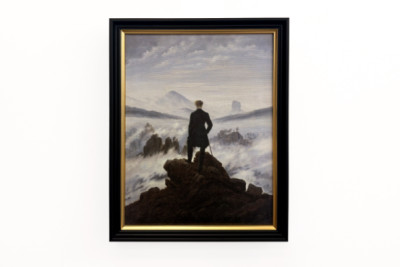
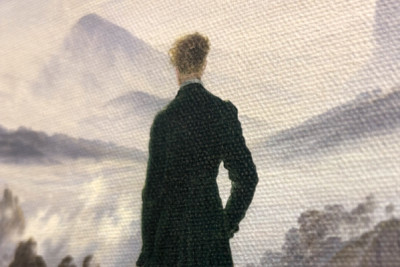
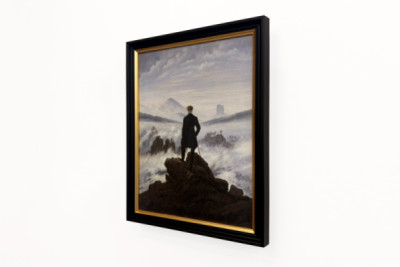
Hardly anyone notices the coat: the man on the rock is not wearing mountaineering gear, but a smart dark-green frock coat, the sort one would wear to church - not scuffed in the slightest, not a speck of dust on it. This garment alone reveals that he is not there to climb, but to look. We stand behind him and see what he sees: wisps of mist drifting between the jagged rocks, behind them the pale peaks, and to the left and right the mountain slopes converge on his figure like arrows, as if the landscape had been waiting just for him. To the right, a rock tower rises out of the mist - presumably the Zirkelstein in Saxon Switzerland - where Caspar David Friedrich gathered his motifs to combine them in his studio into this view, which he painted around 1817. A picture of tranquillity, and the viewer’s back leaves everything open.
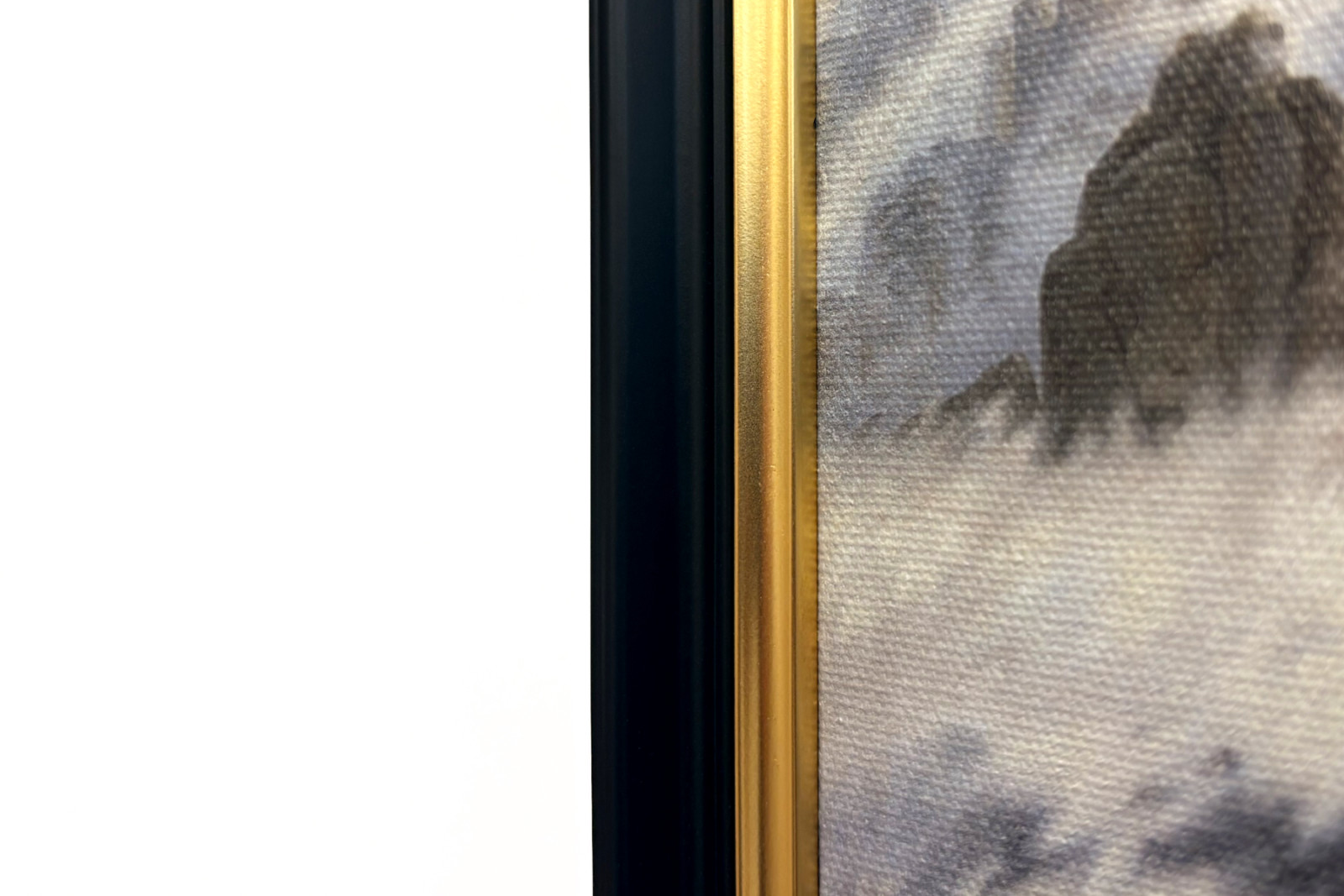
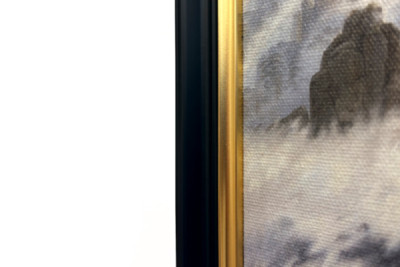
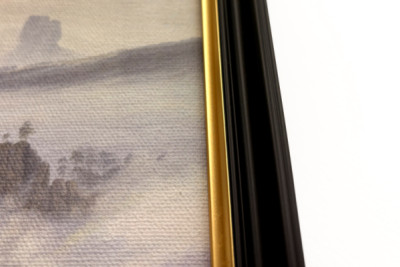
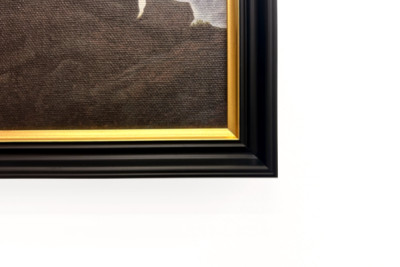
Against the white wall, the whole composition initially appears larger than the 20 x 26 cm dimensions of the picture area would suggest. ‘Effie’, a black frame with a narrow gold border, takes up almost as much space with its stepped width as the subject itself and condenses the small sea of mist into a compact block which, when viewed from the side, stands out clearly from the wall; at first glance, this seemed almost too much frame for such a small image, but on closer inspection the proportions do seem to work after all. ‘Leonardo’, a canvas with a satin finish, renders the mist not as a smooth surface but as soft grey-violet gradients, through which the texture of the fabric shines through everywhere. Where the wisps drift around the rock on the right, the outline of the treetops dissolves into the texture of the canvas, just as blurred as mist itself. Even the frock coat reveals this fine grid when viewed up close, and the gold of the inner edge runs all the way round as a thin, matt line.
From a distance of two paces, the figure almost vanishes into the light grey, and only as one approaches do the walking stick and the rocky ridges stretching into the mist come into view again. So one inevitably walks towards it, and that suits a picture which itself is about the act of looking.
 ×



 +43 4257 29415
 support@meisterdrucke.com
 Mo-Do: 7:00 - 16:00 | Fr: 7:00 - 13:00