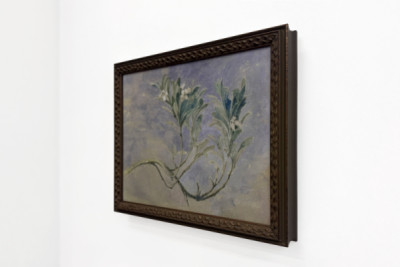
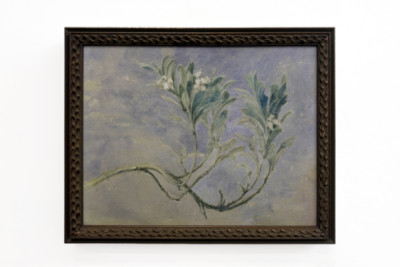
A single twig, nothing more: Starting from the bottom left, the branch stretches across the centre of the picture, forks twice and bears two clusters of narrow, grey-green leaves, between which a few whiteflowers are blooming. Behind it lies neither a garden nor a table, only a cloudy violet-grey that fades into a sandy hue towards the edge. Ruskin does not paint the myrtle as decoration, but as the subject of close observation - every leaf has its own angle, the stem its bends and knots, and where the paint thins, the light-coloured ground shows through. This is precisely how the critic, who defended Turner in *Modern Painters* and later taught drawing at Oxford, wanted his students to see: not the idea of a plant, but this very one. The myrtle itself carries with it ancient meanings: Venus, bridal wreaths, evergreen fidelity; on the page, all that remains is a single twig set against a sky that cannot quite decide whether it is evening or morning. And perhaps that is the charm: The study appears unfinished in the best sense of the word, as if the painter had just stood up to look at the flower once more.
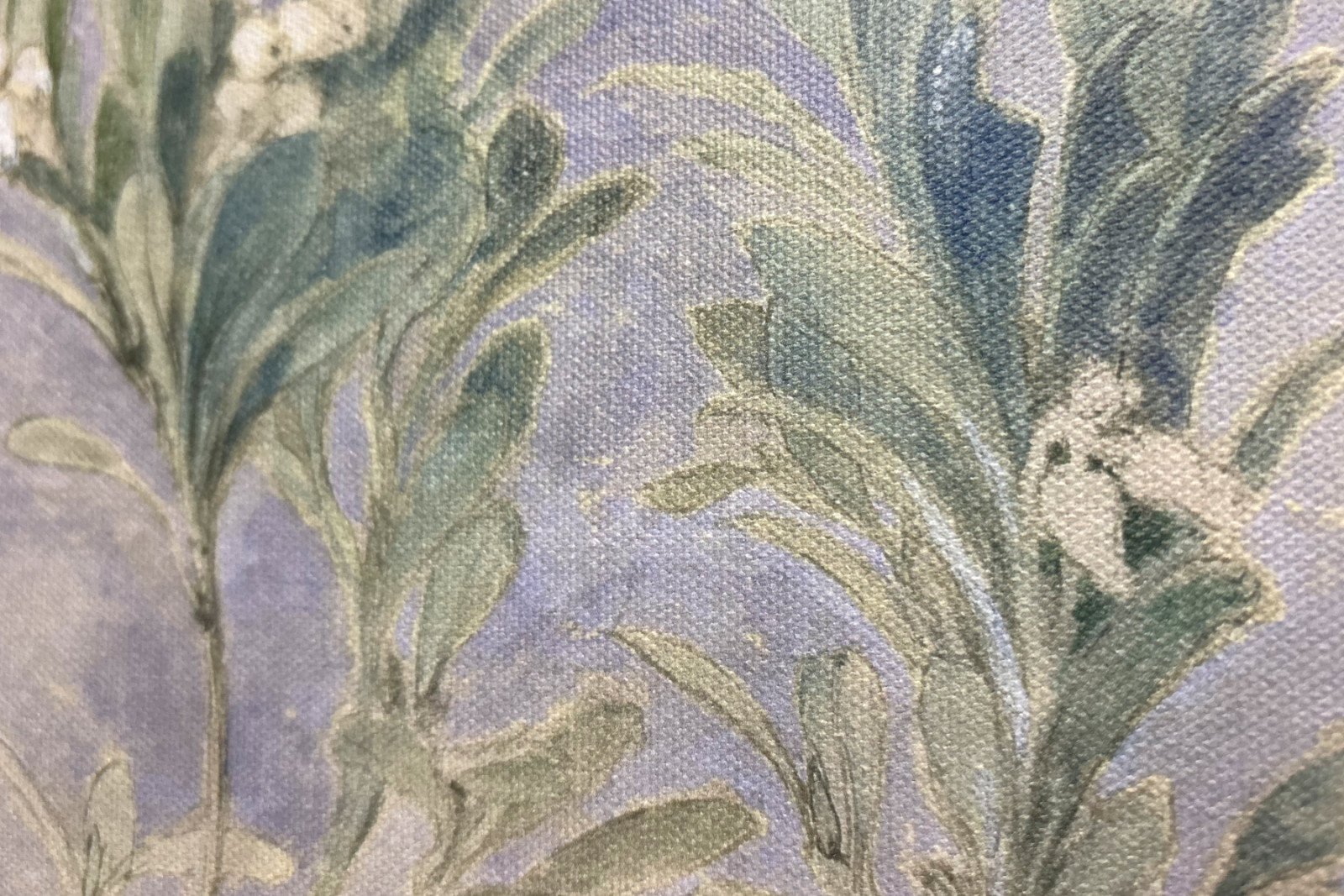
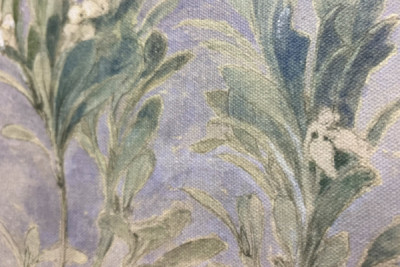
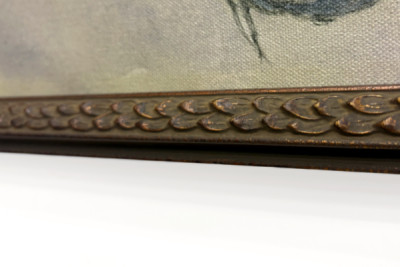
When hung, the first thing that becomes apparent is how the surface interacts with the light from the window. Leonardo, a canvas with a satin finish, absorbs the light rather than reflecting it; viewed at an angle, the violet in the top left-hand corner lightens slightly, yet retains its colour and never becomes a mirror. This suits Ruskin’s thin glazes, as the transitions from lilac to grey blur into the soft glow rather than disappearing into a reflection. If one steps close up, the weave remains visible beneath the leaves as a fine grid, just enough to make it look like a painted ground rather than a print. Ria responds to the same light quite differently. The leaf-stem ornament, which runs in two rows around the picture, has a small shiny spot in a bronze tone at each tip, and these edges glint, whilst the recesses in between remain dark - those who prefer a very calm effect might find this almost too much for such a subtle motif, but I particularly like the contrast. Measuring 32 x 25 cm, the piece is compact, but the profile protrudes a good four centimetres into the room, which is why the branch juts out from the wall like a little box. There is no glass in front of it; the whiteness of the blossoms interacts directly with the light in the room.
This juxtaposition - matt satin on the inside and gleaming bronze on the outside - neatly separates the artwork from its frame without confining it. In the end, it is the twig that makes the difference: it hangs slightly askew, as if someone had only just cut it and placed it there, and this casualness keeps the small picture more alive than many a large composition.
 ×





 +43 4257 29415
 support@meisterdrucke.com
 Mo-Do: 7:00 - 16:00 | Fr: 7:00 - 13:00