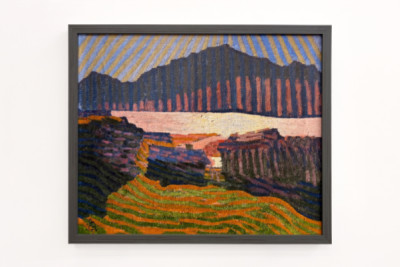
Blue-and-gold rays streak diagonally across the sky, and each one creates a visible relief in this- the colour appears as a texture on the surface, rather than a smooth plane. Beneath it lies Capolago near Maloja, the small village on Lake Sils in the Engadin, painted around 1907 by Giovanni Giacometti. Between dark mountain slopes, the bright ribbon of the lake opens up; in front of it, meadows and slopes are arranged in tiers of orange, green and violet stripes, whilst from the shore, reddish tree trunks stand like columns against the mountain massif. Giacometti - father of the sculptor Alberto - takes Divisionism in a radical direction here: instead of small dabs, he applies broad, rhythmic swathes of colour that do not merely depict the light of the high mountains, but literally break it down into stripes. The result is a landscape that is at once an ornament and yet remains topographically accurate. The original now hangs in the Musée d’Orsay in Paris; the fact that a Graubünden mountain village stands alongside the French Post-Impressionists there speaks volumes about the stature of this painting.
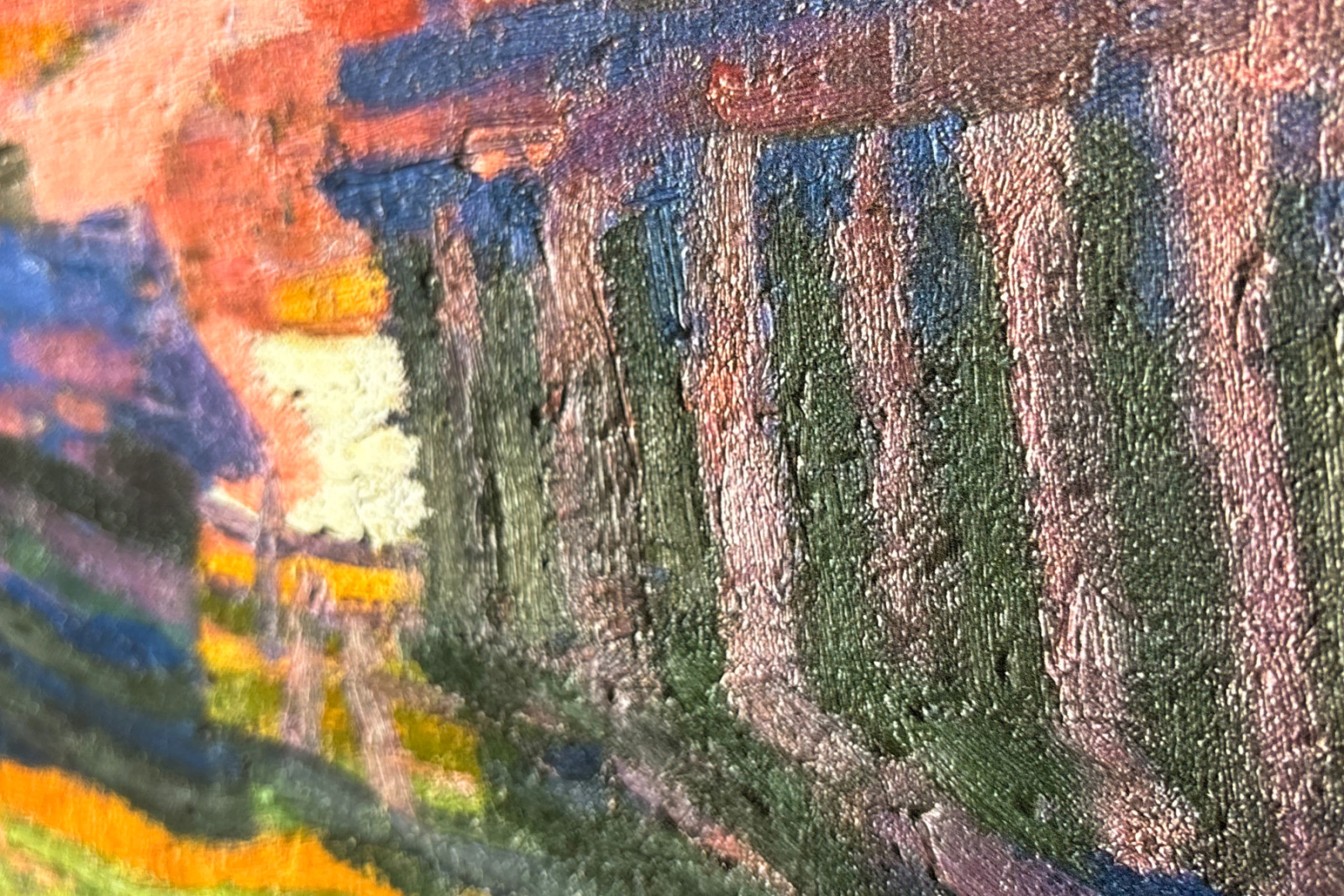
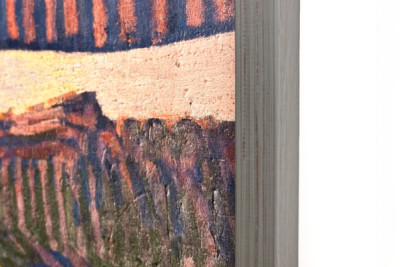
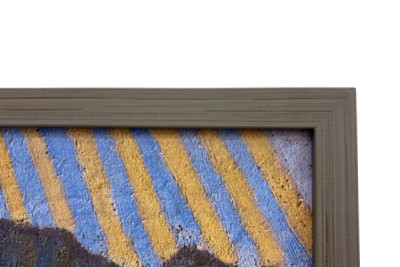
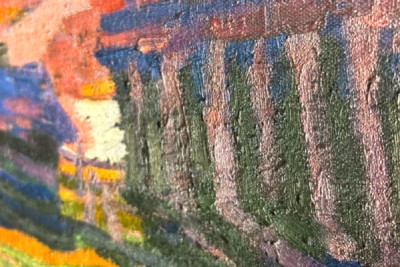
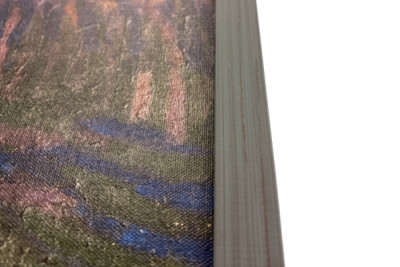
The work is printed on Leonardo, a satin-finished canvas, and it is precisely this combination that gives the print its appeal: the impasto application of paint in the original comes through as a tactile topography. In the green treetops, individual brushstrokes stand outas ridges, whilst on the bright areas of the lake, grainy accumulations of paint remain - one can almost sense just how heavily laden Giacometti’s brush must have been. It is only at the very edge, where the motif runs around the border, that the fabric reveals its own base. The piece is framed by ‘Salome’, a real-wood moulding whose bluish light grey appears as though applied with a broad brush over the warm brown of the wood - in places, the underlying tone shimmers through the glaze, lending the frame a pleasant, handcrafted quality. This is precisely what catches the eye: the painted frame echoes the gesture of the painting itself, without competing with its colours. Thus, the relief-like swathes of colour on the canvas and the glazed wooden surface speak the same language, each in its own tone - and the piece therefore appears to be a unified whole.
 ×
×






 +43 4257 29415
 support@meisterdrucke.com
 Mo-Do: 7:00 - 16:00 | Fr: 7:00 - 13:00