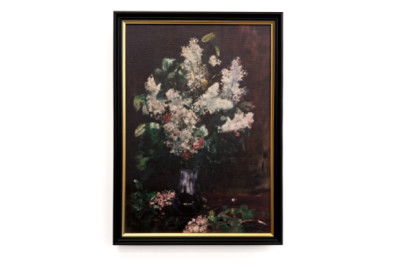
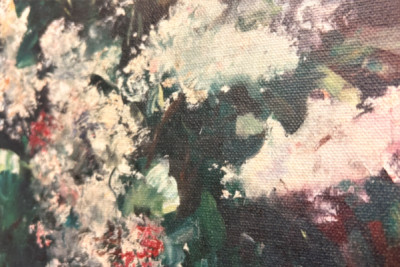
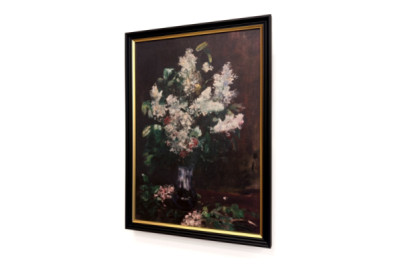
The original version of the painting, which is currently on display at the Alte Nationalgalerie of the Staatliche Museen zu Berlin, measures 101.5 × 70 cm, but despite this enormous reduction in size, the painting in its present form does not appear to be a mere miniature. The lilacs rise from the dark vase almost to the very top. Light-coloured clusters of flowers push over one another, then disperse again, emerging in places against the brownish-black background like small clouds of light. In between are heavy leaves, scattered red dots and those dark spaces that lend the bouquet its depth. At the bottom, order seems to be lost for a moment: Broken twigs and scattered blossoms lie on the tabletop, as if the bouquet had only just been arranged - the eye is drawn to this detail. Lesser Ury painted this still life in 1922, during his later creative period. The German Impressionist does not treat the flowers with botanical precision, but rather as a dynamic mass of colour and light. Some blossoms have clear contours, whilst others almost dissolve into short brushstrokes. Thus, the painting embodies both abundance and transience. A possible point of reference is Édouard Manet’s ‘Lilac Still Life’, which was in a Berlin collection at the time. Ury, however, develops this into a darker, more densely packed scene.
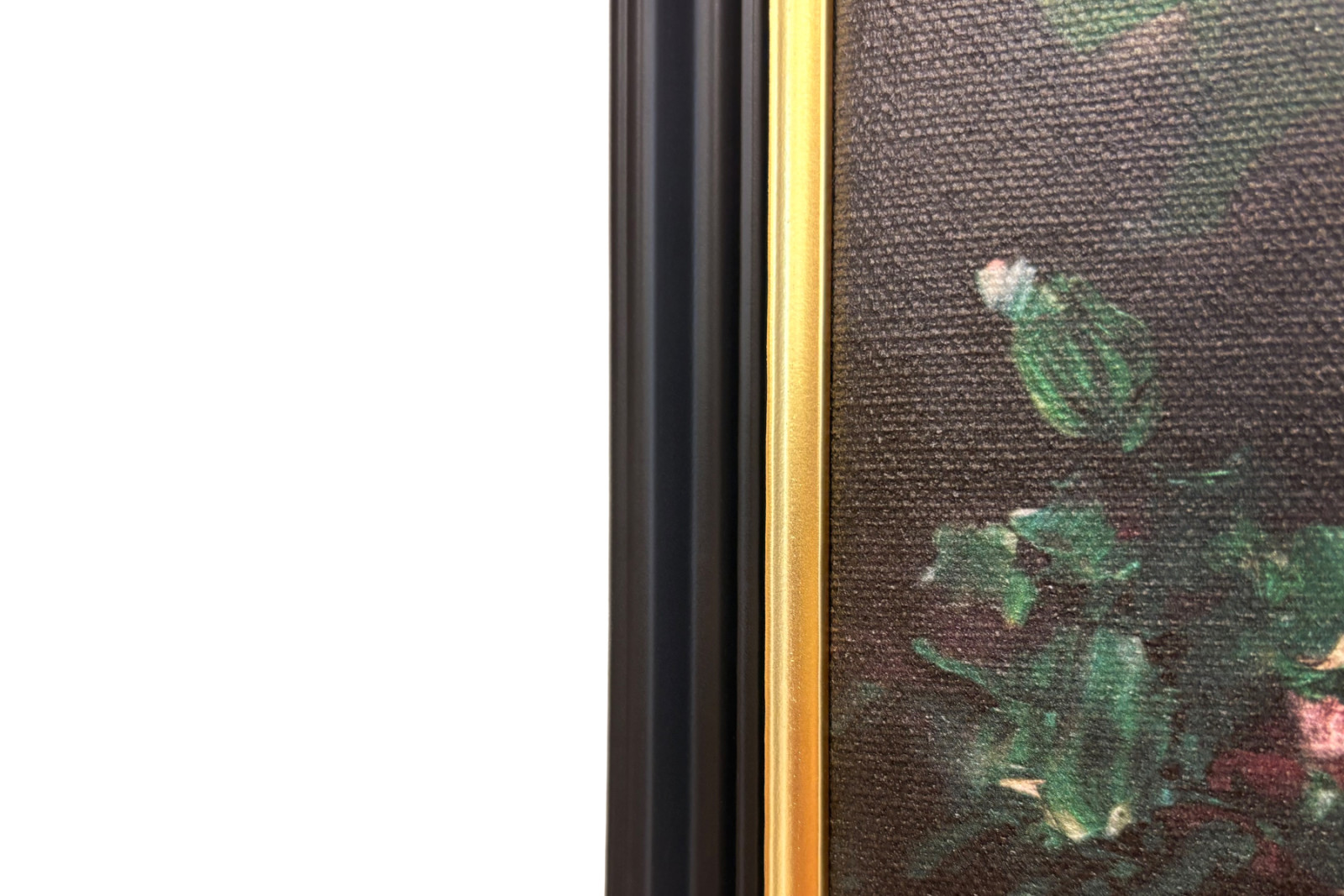
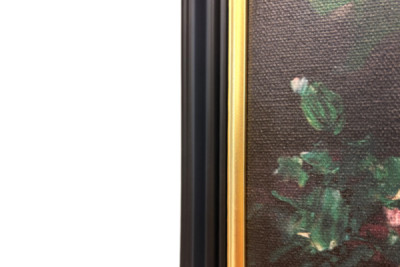
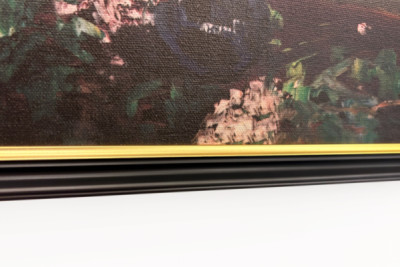
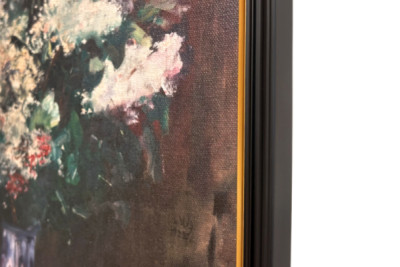
The work now hangs on the wall, measuring 25 × 36 cm, and it is precisely here that the extent of the reduction becomes apparent. Up close, the individual flowers and scattered twigs can be made out. Just a few steps away, everything merges once more into a bright bouquet. The Leonardo canvas, with its satin-finished surface, sits directly in the Effie frame without a passe-partout - so the motif loses no space to a wide border. The Effie frame extends the small picture outwards: the black profile gives it greater presence on the wall, whilst the gold edge clearly delineates the actual picture opening. Viewed from the front, the piece appears strictly portrait-oriented, almost like a window. Anyone walking past it from the side can see the depth of the frame without the frame itself protruding far into the room. The format does not require a large section of wall; at the same time, the bouquet does not disappear amongst other objects - a balance that suits the small format remarkably well. At eye level, the vase sits well below the centre, so that the lilac panicles take up most of the visible area. Above the topmost flower, only a narrow strip of the dark background remains, extending down to the gold rim.
 ×
×





 +43 4257 29415
 support@meisterdrucke.com
 Mo-Do: 7:00 - 16:00 | Fr: 7:00 - 13:00