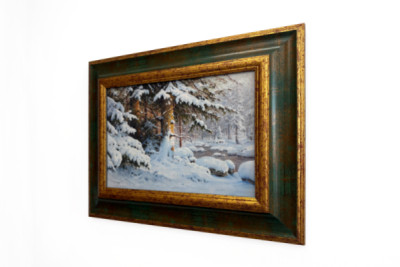
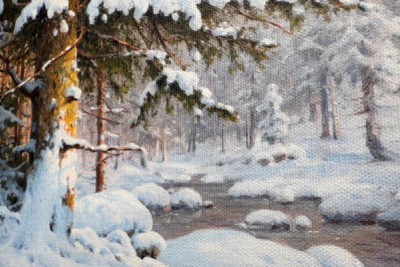
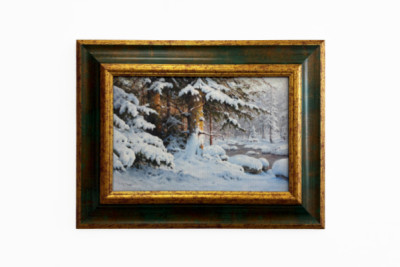
Snow lies on everything that can hold it: on the low-hanging branches of the two spruce trees in the left-hand foreground, on the round stones in the stream bed, on the fallen trunk by the bank. Between the white caps, the water flows as a narrow ribbon, dark brown, from the centre of the picture to the right and disappears amongst more stones. Behind them, the trunks stand in dense rows, reddish-brown and grey, until they become mere lines in the pale haze of the background. The sun is low and to the left, just outside the frame: it strikes the spruce trunk in the foreground and colours its bark ochre-yellow, whilst the shaded sides of the snow take on a cool blue-grey hue. The colour palette of the entire scene unfolds between the warm wood and the cold snow; the dark green of the needles stands out only where the weight of the snow has freed a branch. No people, no animals, no traces. The forest is depicted here in a state where every sound would be muffled and only the water still flows. At the bottom left, the signature appears in thin letters on the expanse of snow. Walter Moras painted this scene in 1925 under the title ‘Winter in the Forest’, and the view does indeed remain within the forest: no horizon opens up the scene; the rows of trees close it off at the back.
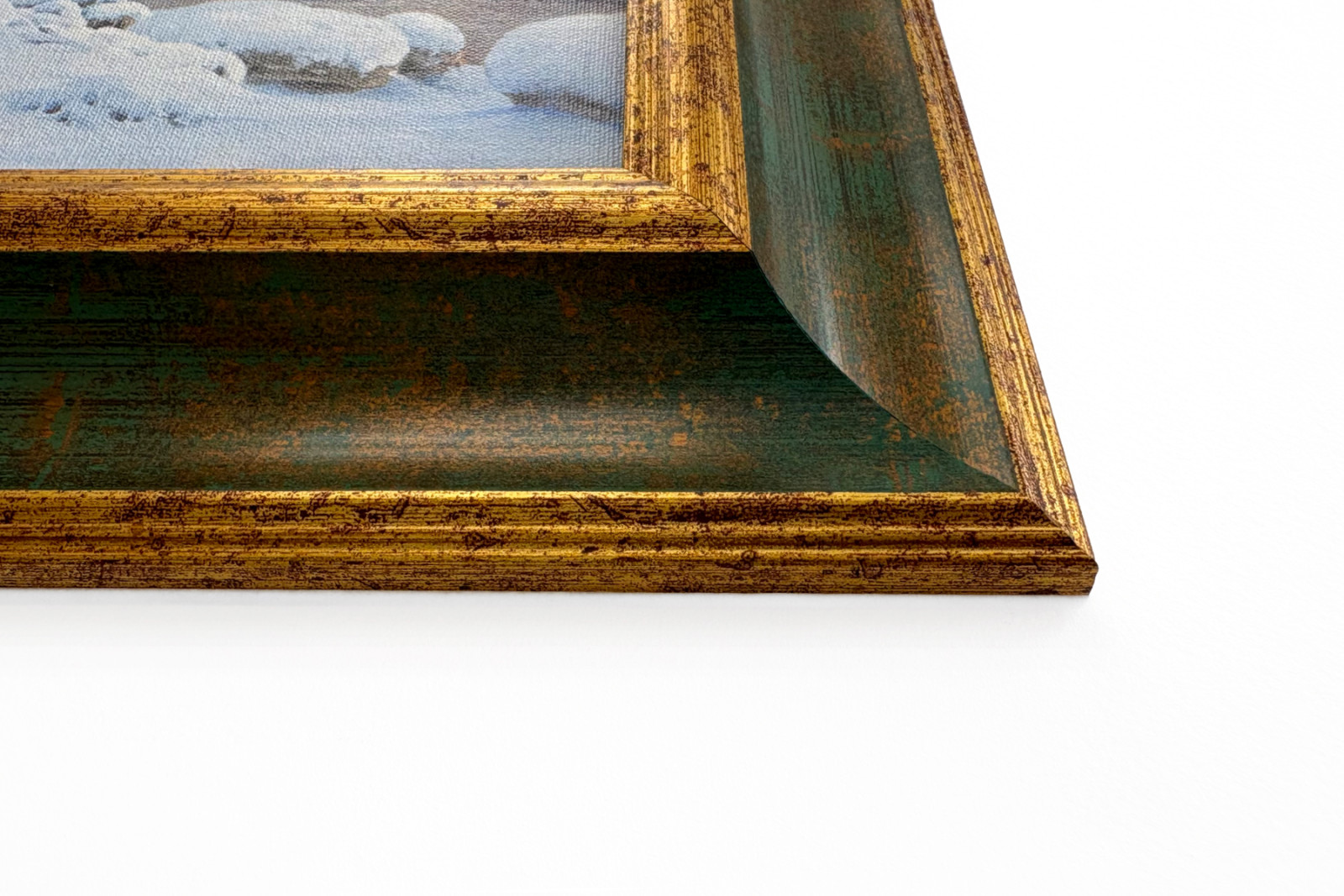
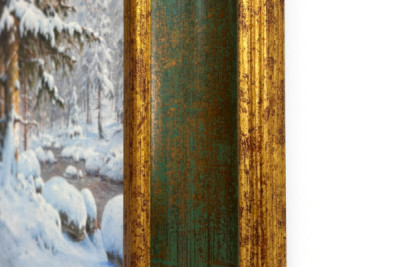
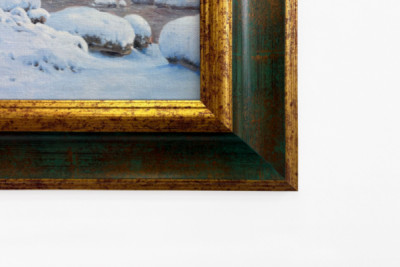
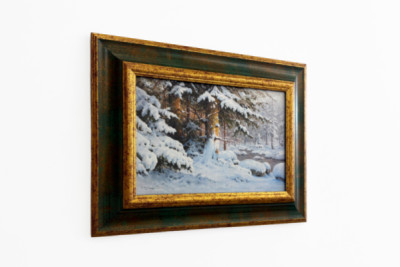
The Leonardo canvas bears this print, measuring a modest 30 x 20 cm, and its satin-finished surface alters the perception of the snow. Viewed up close, the fabric reveals a fine grid that shows through clearly beneath the light-coloured areas: This gives the snow caps on the stones a slightly grainy texture, as if hoarfrost were lying on them, and the white areas appear roughened rather than smooth. That doesn’t bother me; quite the opposite, in fact - the snow looks less like paper this way. Over this grid, the thin lines of the spruce twigs run as continuous strokes, without the canvas interrupting them; on the trunks on the right, the print layer renders the bark in angular light-and-dark contrasts. The silky sheen gathers more intensely on the dark patches of water than on the snow, making the stream bed look wetter than the banks. Beneath the fingers, the texture of the canvas remains perceptible through the paint. Surrounding the canvas is Lydia, a 66 mm wide wooden frame with a green groove, streaked with traces of gold, between two speckled gold edges in reddish-brown, without glass or a passe-partout, so that the texture of the canvas remains visible right up to the fold. For a painting of this size, it is a rather wide frame; one might find it excessive, but I think the green of the moulding keeps it in check. The snow-capped edges of the hanging branches stand out in sharp relief against the dark green of the needles, and the shadow relief on the snow caps in the foreground remains clearly visible. I wouldn’t necessarily have expected that from a print measuring 30 x 20 cm.
 ×






 +43 4257 29415
 support@meisterdrucke.com
 Mo-Do: 7:00 - 16:00 | Fr: 7:00 - 13:00