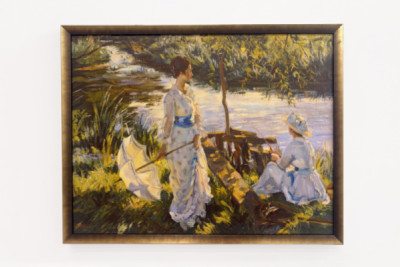
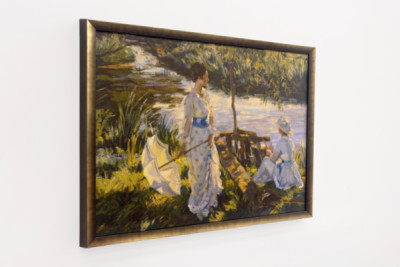
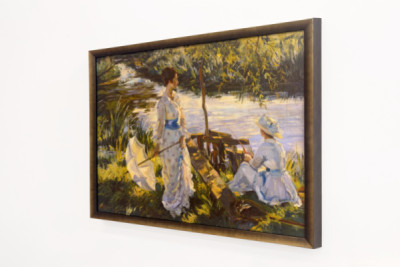
Two lines of sight frame the riverside scene: the standing woman gazes across the water, whilst the seated angler follows the movement of her delicate rod. Between them, the slender tree trunk forms a tranquil vertical line; the closed parasol draws the eye diagonally back towards the grass. Light-coloured dresses stand out against the dark green, and on the river, pale blue, violet and yellowish streaks of light intermingle. The foliage, which Wilfred Gabriel de Glehn scatters across the scene with short, fluid strokes, appears the most vibrant. Despite this painterly restlessness, the motif retains a sense of serenity: fishing is less an activity than an occasion to linger. De Glehn, a British artist, captured this moment in 1919. The fact that it is designated as a bookplate lends the image the character of an illustration, yet the bold painting style stands on its own without any narrative explanation.
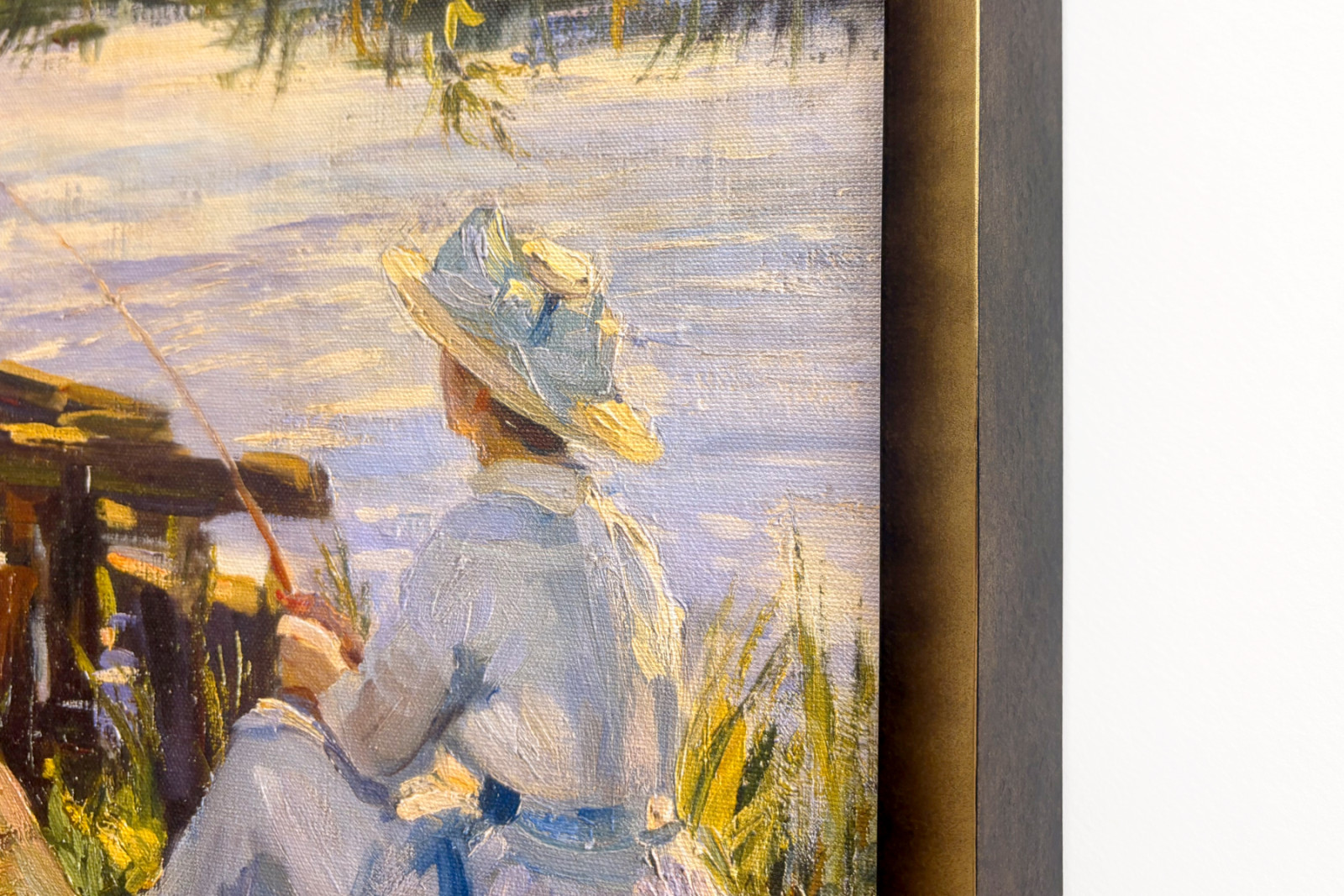
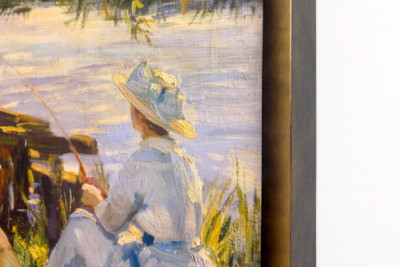
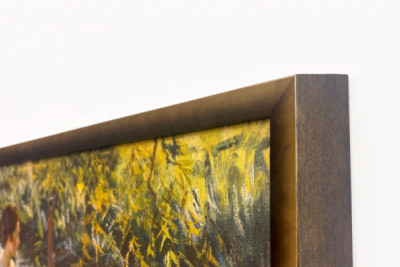
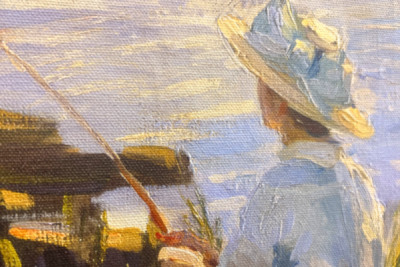
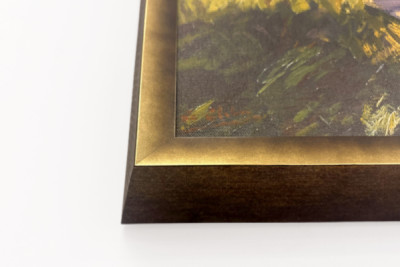
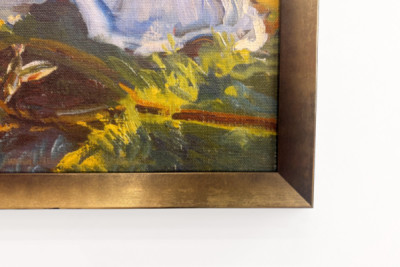
Viewed up close, this work takes on a second, almost tangible dimension. On the Leonardo canvas with its satin finish, the weave remains clearly visible: in the light-coloured water, the fine grid runs through the lavender-coloured panels, as well as through the sleeves, hat and bows of the seated woman. It is precisely where brief traces of pressure trace the brushstrokes that the image and the fabric intertwine - and it is exactly at these points that one’s gaze lingers. The light accents on the brim of the hat appear more compact, whilst the thin lines of the fishing rod cross the relief almost undeterred. Even in the dark areas at the bottom edge, the threads do not disappear; they lend the green and brown tones a grainy depth. As there is no glass in front of it, this surface lies exposed before the eye. Patricia, a gold-coloured wooden frame, frames the canvas sparingly, without obscuring its material quality.
This is how the work might well have hung at the time of its creation. From a distance, the framed scene radiates a sense of calm into the room; as one steps closer, one continually discovers something new in the visible texture - a combination that suits the subject well.
 ×





 +43 4257 29415
 support@meisterdrucke.com
 Mo-Do: 7:00 - 16:00 | Fr: 7:00 - 13:00