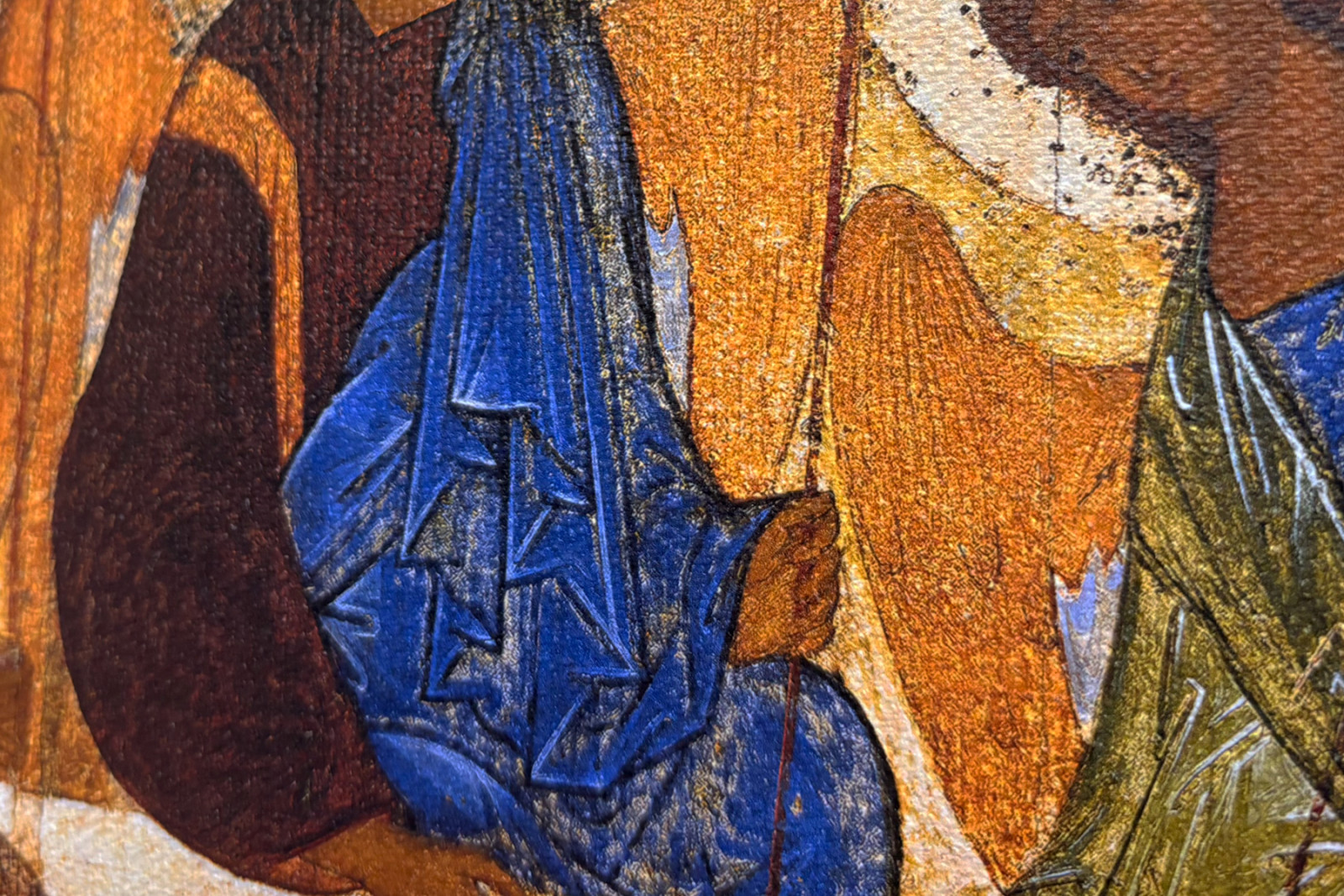
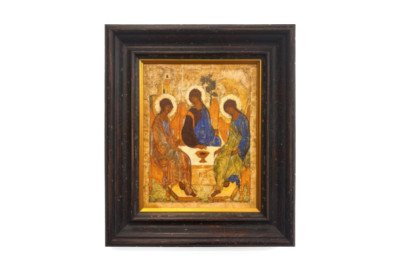
Three angels sit around a table laid with a white tablecloth, and their bowed heads and calm gestures form a circular composition. A vessel stands between them; behind the figures, a building appears on the left, a tree in the centre and a rock on the right. The gold background largely detaches the scene from everyday life and depth, making the figures’ postures all the more striking: the angel on the left leans towards the centre, the one in the middle responds with her head bowed, whilst the figure on the right directs the movement back towards the table. The vivid blue of the robes contrasts with the ochre, reddish-brown and the muted green of the angel on the right; it is this blue that catches my eye first every time. The result is not a narrated moment in the usual sense, but a silent encounter. The scene follows the biblical account of Abraham’s hospitality at the oaks of Mamre; the Christian interpretation interprets the three guests as the Trinity. Andrei Rublev, a Russian monk and icon painter, painted the work in the early 15th century in tempera on wood. He connects the figures not through physical contact, but through the directions of their gazes, their postures and the open space above the table; it is precisely this that makes the gathering appear composed and approachable.
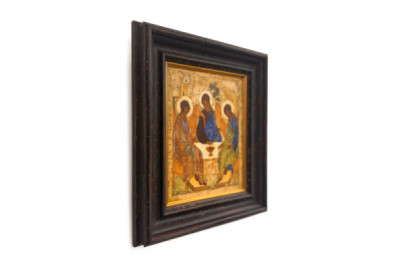
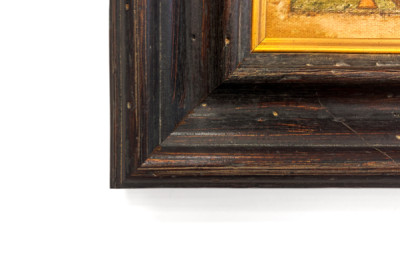
In this version, the large icon becomes a compact wall hanging. The image area, measuring 21 x 26 cm, is mounted on ‘Leonardo’ canvas with a satin finish, without a passe-partout or glass. Erika in brown surrounds the small area with a strikingly wide frame; Janae adds a narrow gold border directly around the motif. It is not so much the individual framing detail that matters here as the relationship between the sizes: viewed from the front, the dark border commands almost as much attention as the picture area itself, lending the small reproduction on the wall a sense of significance. I like the fact that this prevents it from appearing as a secondary format, even if it takes a moment to get used to the wide border. At the same time, the piece requires only a limited section of wall and fits into a quiet corner, against a narrow pillar or above a small piece of furniture. Viewed at an angle, it reveals its physical depth: the stepped profile protrudes noticeably from the wall, whilst the motif sits far inside and sheltered, almost as if in a small niche. Viewed from the front, the tall rectangular picture area, the golden inner line and the dark outer edge merge to form a compact surface that is a pleasure to view up close.
 ×





 +43 4257 29415
 support@meisterdrucke.com
 Mo-Do: 7:00 - 16:00 | Fr: 7:00 - 13:00