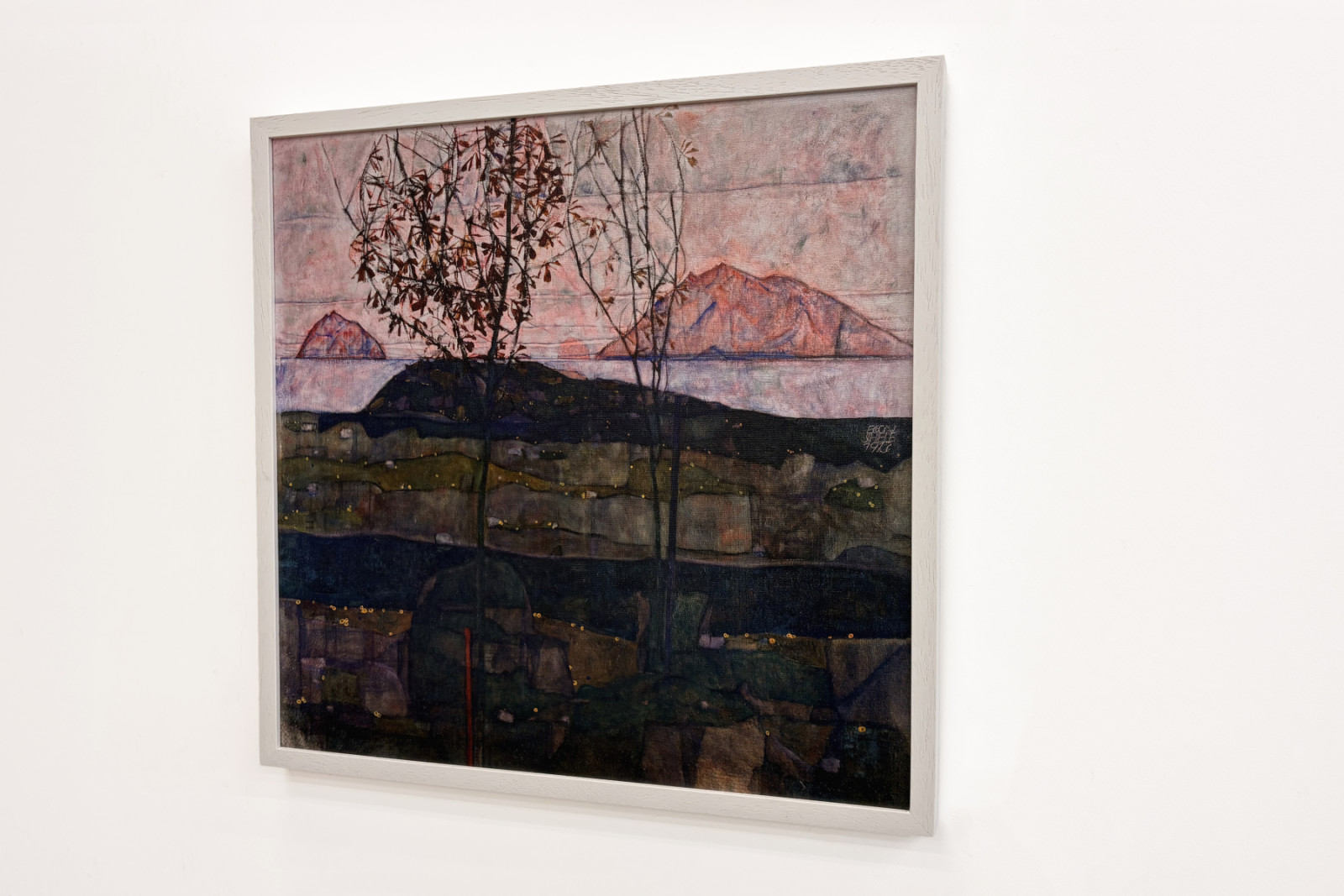
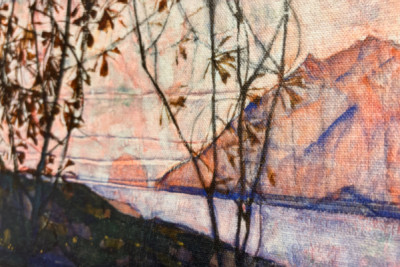
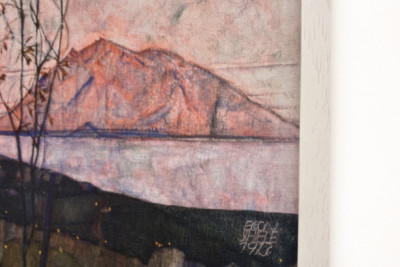
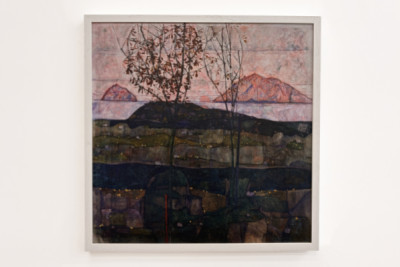
The evening sky glows pink above a dark strip of shoreline, whilst two bare trees stretch their slender branches towards the mountains. Egon Schiele painted this sunset in 1913, during the years between his early scandals and his later fame, and one immediately recognises that this is not the work of an Impressionist: the landscape is divided into horizontal zones, almost constructed, with hard contours around the hills and the expanse of water. Below, the land lies in deep greens and violets, interspersed with small yellow dots that resemble distant lights; above, everything dissolves into a shimmering pink, against which the mountain range stands outlined in blue. The painting strikes a strange balance between melancholy and delicacy - typical of Schiele, who never veers into the idyllic, even in his landscapes. To the right of centre, his characteristic block signature with the year is situated on the dark hill.
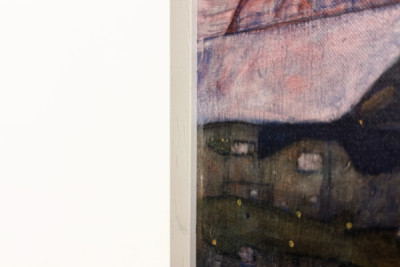
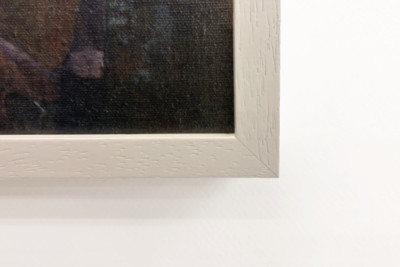
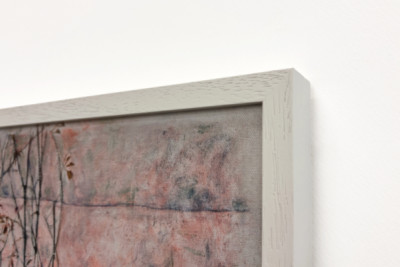
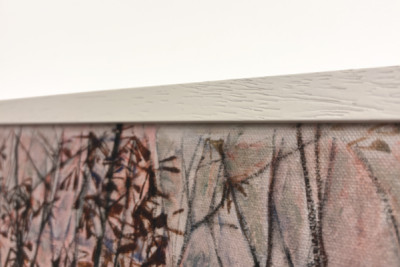
The square canvas, measuring 48 x 48 cm, is framed by ‘Levana’, a narrow wooden moulding in white on a natural finish - and it is precisely this combination that plays a significant role here. The white varnish does not cover the wood smoothly, but leaves the pore structure exposed; small, elongated indentations run across the front of the moulding like fine hatching. At the corners, the mitre joints meet so precisely that the grain of both sides aligns without any offset. The edges remain sharp, the profile flat and free of embellishments - Schiele’s austere compositional order requires nothing more; anything more playful would be a distraction here. The eye lingers longest on one detail of the surfaces: the light pauses briefly in the open pores of the strip, whilst it continues to travel evenly across the satin-finished canvas beside it - two materials that respond visibly differently to the same light.
 ×
×





 +43 4257 29415
 support@meisterdrucke.com
 Mo-Do: 7:00 - 16:00 | Fr: 7:00 - 13:00