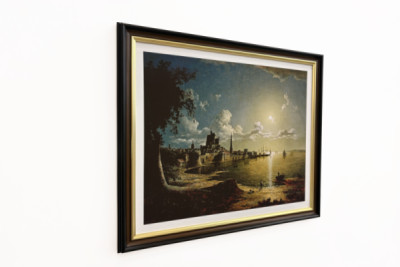
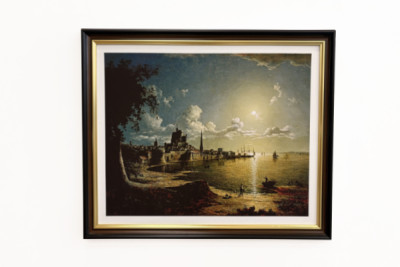
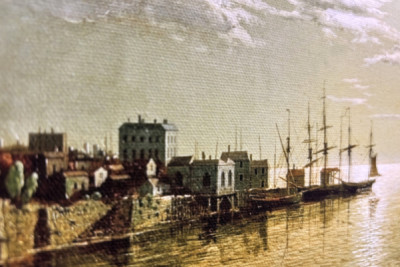
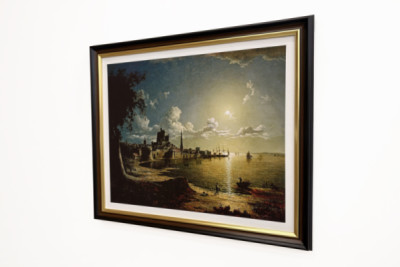
The moon is positioned to the right of the centre of the picture and casts a bright beam across the water right up to the beach. It is precisely there that the picture begins to glow. Sebastian Pether painted the harbour at Southampton by night in 1820. On the left, the town presses in close to the shore: fortress walls, church towers, small houses with red roofs. Sailing ships with tall masts lie at the quay; further out, boats cruise in the moonlight. At the front of the beach, a man stands beside his boat, whilst a second figure walks through the wet sand. Above it all, clouds tower, illuminated from behind by the moon’s silvery glow. Pether came from a family of English painters known for their moonlit scenes - his father was nicknamed ‘Moonlight Pether’, and the son carried on the tradition. The painting draws its life from the contrast between the almost black tree on the left-hand edge and the bright sky behind it. It is not a dramatic night. Rather, it is a quiet one, in which the town sleeps and work is still being carried out only by the water’s edge. If you look for a while, you’ll spot more and more little lights: lit windows, reflections on the waves, the glimmer on the grass by the bank.
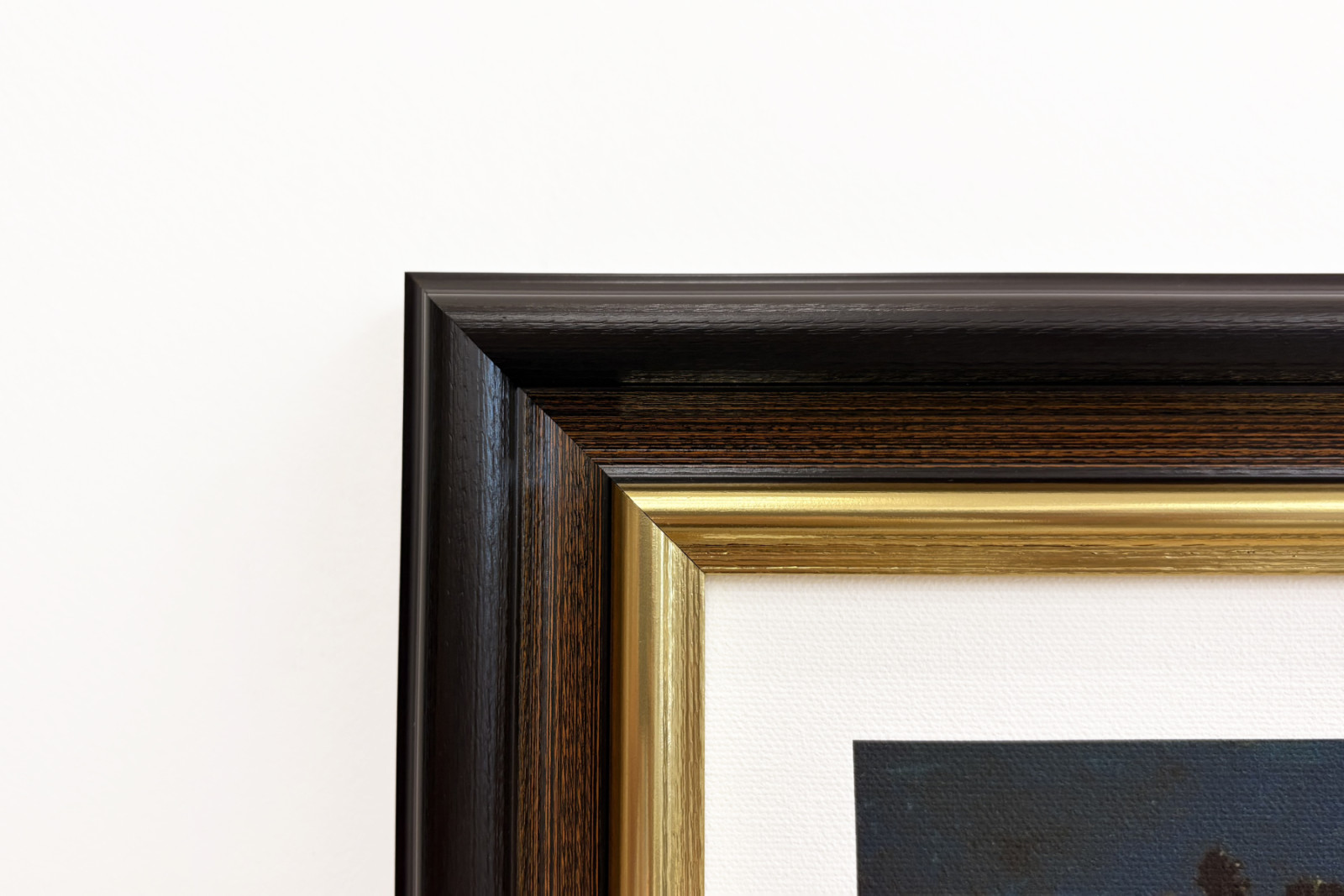
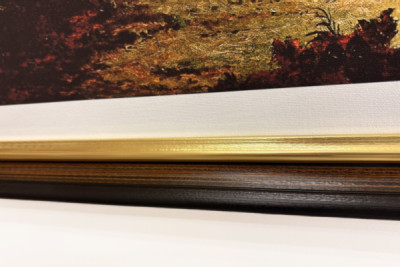
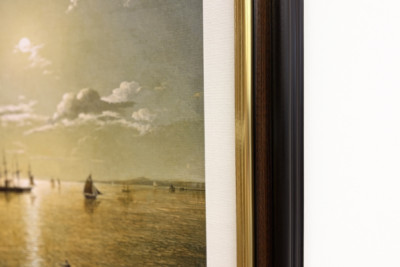
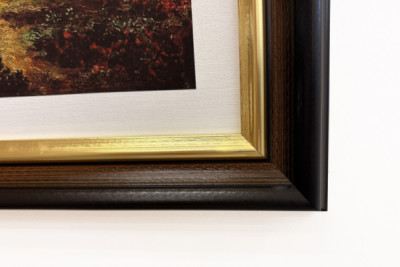
This nocturnal atmosphere is complemented here by a frame that, in terms of colour, shares a surprising amount with the painting itself. The profile is called ‘Lychorida’: black on the outside, with a moulding in a light brown wood tone on the inside, followed by a narrow gold edge right at the edge of the picture. These three shades all appear in the subject itself. The black of the outer moulding corresponds to the dark tree and the shadowed bank at the bottom left. The brown groove, with its visible grain, matches quite precisely the reddish-brown sections of the bank and the dry grass in the foreground. And the gold sits, colour-wise, between the moon’s path and the illuminated beach - as if someone had traced the brightest part of the picture once around the entire frame. Between the gold border and the picture surface, a narrow white strip of the matt Raphael canvas remains visible, briefly interrupting the dark tones and giving the eye a moment’s respite before the frame begins. Without this strip, the shadows in the picture and the black of the frame would merge. Thus, the two remain separate yet still appear as if cast from a single mould. At 60 x 48 cm, the bold profile does not overwhelm; it frames the composition neatly. It is only on second glance that one realises just how precise the balance is - the frame does not need explaining; it simply fits. In the end, what matters is what it frames: a harbour night in which a solitary man stands by the water and the moon bathes the entire bay in the same warm light. Pether often painted nights like this. This one is among the most tranquil.
 ×
×






 +43 4257 29415
 support@meisterdrucke.com
 Mo-Do: 7:00 - 16:00 | Fr: 7:00 - 13:00