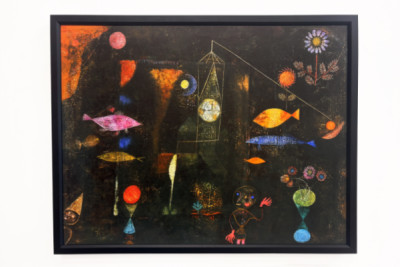
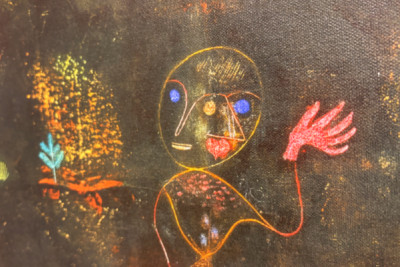
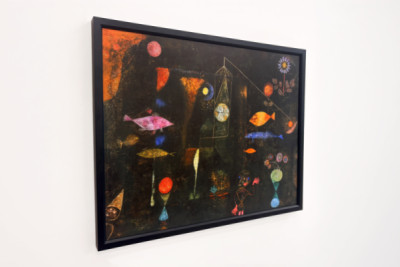
Two blue dots peer out from a face consisting solely of thin yellow lines - next to it, a red hand that looks as though it has been drawn in chalk on a blackboard, its grainy texture reproduced in the print right down to the individual fingers. This small figure at the bottom of the picture is part of ‘Fischzauber’, which Paul Klee painted in 1925: a nocturnal scene in which fish in shades of pink, orange and blue float through a deep black, amidst flowers resembling sea anemones, a tower with a clock, and what appear to be both moons and suns. Whether an underwater world, a night sky or a stage - Klee leaves it open to interpretation, and it is precisely this ambiguity that gives the painting its appeal. Everything seems to be drifting and standing still at the same time. Klee, born in Switzerland in 1879, was teaching at the Bauhaus at the time; his visual worlds oscillate between childlike drawing and precisely constructed composition, and ‘Fish Magic’ brings both together: the scrawled figures and a finely balanced network of diagonals and dots of colour that holds the dark background together.
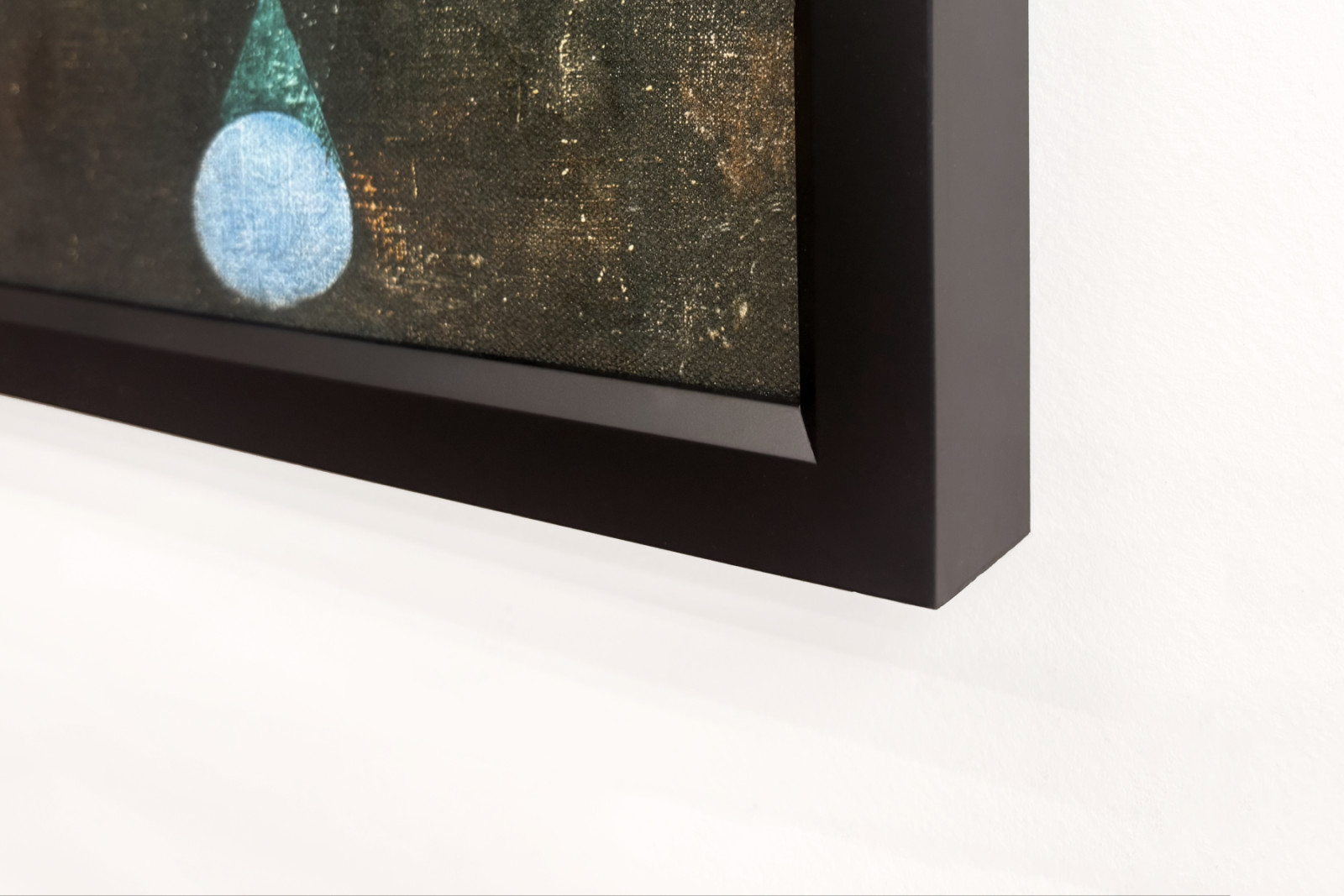
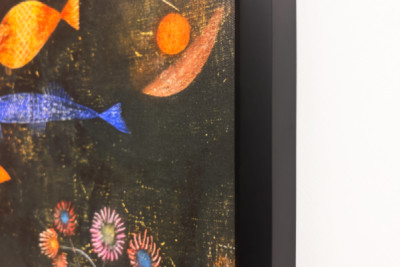
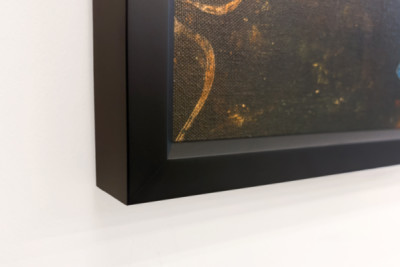
The motif is executed in the format 70 x 55 cm on Leonardo, a canvas with a satin-finished surface - and this pays off particularly well in this painting. The deep black remains opaque and free of reflections even when light falls on it from the side, whilst the light areas - the orange crescent on the right-hand edge, the yellow speckles across the background - exhibit a subtle shimmer that lifts them slightly from the surface. Reflections do not settle over the subject as a distracting film of glare, but rather drift softly across the surface; the darkness absorbs them, whilst the patches of colour take them in. A black decorative frame, Trina, with a narrow moulding 20 mm wide and 35 mm high, encloses the canvas; its matt profile extends the black of the picture’s background right up to the wall. A narrow shadow gap remains visible between the edge of the canvas and the frame moulding, lending the flat picture a tangible sense of depth. I wouldn’t necessarily have guessed before hanging it that such an unobtrusive frame of all things would best complement this multi-layered motif - but against the white wall, it works perfectly.
 ×
×





 +43 4257 29415
 support@meisterdrucke.com
 Mo-Do: 7:00 - 16:00 | Fr: 7:00 - 13:00