A pomegranate, plump and burst open, its ruby-red seeds glowing like tiny gemstones - this image appears again and again in Georgian art. The pomegranate not only symbolises life and fertility, but also the complexity of the Georgian soul, which is reflected in the country's painting, graphic art and photography. Georgian artists have been exploring the major themes for centuries: Identity, homeland, the interplay between East and West, the beauty and harshness of nature, the coexistence of tradition and modernity. Their works are often imbued with a quiet melancholy, but also with an irrepressible joie de vivre that breaks through in bright colours, expressive lines and surprising compositions.
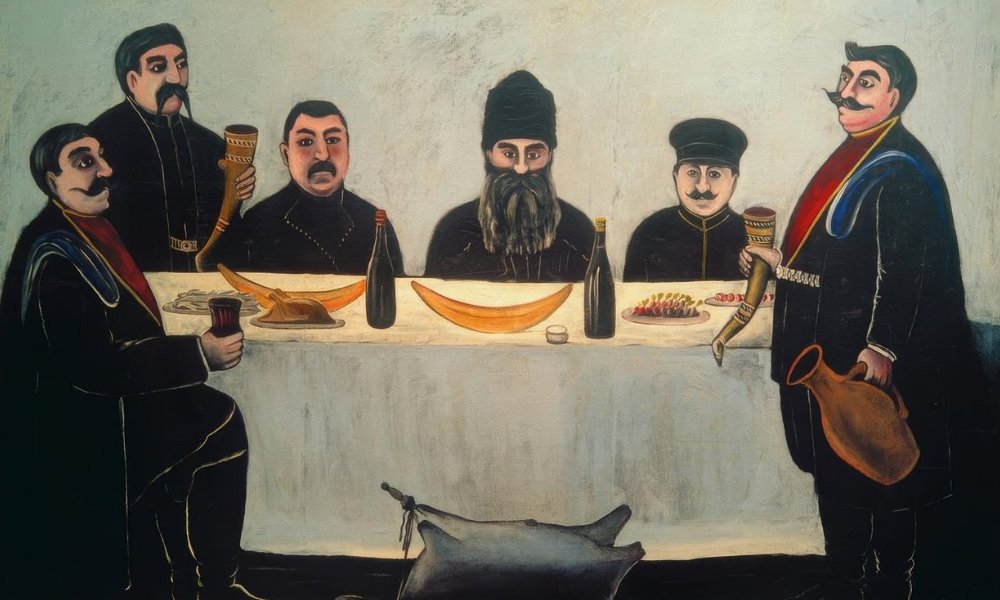
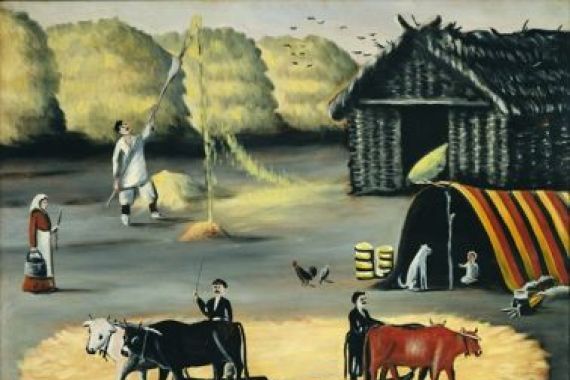
Those who follow the trail of Georgian art will discover a world in which Orient and Occident meet without ever completely mixing. In Elene Akhvlediani's watercolours, for example, the light flickers across the rooftops of Tbilisi as if the city itself were breathing. Her cityscapes are not mere images, but poetic condensations of atmosphere and memory. Georgian painting loves the narrative, the fragmentary, the play with symbols: Niko Pirosmani, probably the country's most famous painter, used the simplest of means to create pictures of animals, festivals and everyday scenes that have an almost childlike directness and yet are full of secrets. His works, often painted on a black oil ground, seem like windows into another time - and are icons of Georgian identity today.
But Georgia's art history is anything but backward-looking. In the 1920s, when Tbilisi became a magnet for avant-garde artists from all over Eastern Europe, artists such as Lado Gudiashvili experimented with new forms of expression, mixing cubist and surrealist elements with Georgian motifs. Printmaking flourished and photography became a medium of self-assertion and resistance. Even in the dark decades of Soviet censorship, Georgian artists found ways to preserve their individuality: In the sketchbooks of Otar Chkhartishvili, for example, the humour and irony of a people who never allowed themselves to be completely appropriated lives on. Today, young artists such as Mariam Natroshvili and David Meskhi take up these traditions and bring them into the present - with digital collages, experimental photography and bold mixed media that show how lively and versatile Georgian art has remained.
When you look at an art print from Georgia, you are holding more than just a beautiful picture in your hands: It is a piece of lived history, an echo of the mountains and valleys, the festivals and tragedies, the longing and hope of a country that has always seen its art as both a mirror and a window. Georgian art invites us to take a closer look - and to be moved by the power of its colours, the depth of its stories and the poetry of its forms.
A pomegranate, plump and burst open, its ruby-red seeds glowing like tiny gemstones - this image appears again and again in Georgian art. The pomegranate not only symbolises life and fertility, but also the complexity of the Georgian soul, which is reflected in the country's painting, graphic art and photography. Georgian artists have been exploring the major themes for centuries: Identity, homeland, the interplay between East and West, the beauty and harshness of nature, the coexistence of tradition and modernity. Their works are often imbued with a quiet melancholy, but also with an irrepressible joie de vivre that breaks through in bright colours, expressive lines and surprising compositions.
Those who follow the trail of Georgian art will discover a world in which Orient and Occident meet without ever completely mixing. In Elene Akhvlediani's watercolours, for example, the light flickers across the rooftops of Tbilisi as if the city itself were breathing. Her cityscapes are not mere images, but poetic condensations of atmosphere and memory. Georgian painting loves the narrative, the fragmentary, the play with symbols: Niko Pirosmani, probably the country's most famous painter, used the simplest of means to create pictures of animals, festivals and everyday scenes that have an almost childlike directness and yet are full of secrets. His works, often painted on a black oil ground, seem like windows into another time - and are icons of Georgian identity today.
But Georgia's art history is anything but backward-looking. In the 1920s, when Tbilisi became a magnet for avant-garde artists from all over Eastern Europe, artists such as Lado Gudiashvili experimented with new forms of expression, mixing cubist and surrealist elements with Georgian motifs. Printmaking flourished and photography became a medium of self-assertion and resistance. Even in the dark decades of Soviet censorship, Georgian artists found ways to preserve their individuality: In the sketchbooks of Otar Chkhartishvili, for example, the humour and irony of a people who never allowed themselves to be completely appropriated lives on. Today, young artists such as Mariam Natroshvili and David Meskhi take up these traditions and bring them into the present - with digital collages, experimental photography and bold mixed media that show how lively and versatile Georgian art has remained.
When you look at an art print from Georgia, you are holding more than just a beautiful picture in your hands: It is a piece of lived history, an echo of the mountains and valleys, the festivals and tragedies, the longing and hope of a country that has always seen its art as both a mirror and a window. Georgian art invites us to take a closer look - and to be moved by the power of its colours, the depth of its stories and the poetry of its forms.
 ×
×







 Passionate Customer Service

 +43 4257 29415
 support@meisterdrucke.com
 Mo-Do: 7:00 - 16:00 | Fr: 7:00 - 13:00