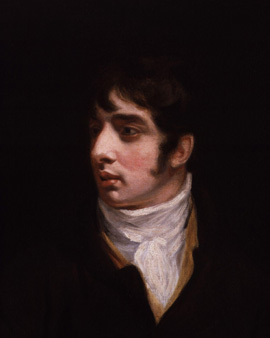
Thomas Girtin grew up in London as the son of a wealthy family of craftsmen. When his biological father died, his mother married a pattern draughtsman, who trained young Thomas with a watercolour painter, where he coloured prints with watercolours. It is to Girtin's credit that watercolour was able to establish itself as a respected art form alongside oil painting. He is one of the most famous landscape watercolourists in England.
Already as a young man Girtin got to know his long-time friend, the painter J. M. W. Turner, with whom he attended an evening academy under the direction of his patron Thomas Monro. There they made prints of landscapes and topographic sketches. Turner and Girtin quickly recognized the manifold possibilities of watercolors. Girtin traveled through England North and Wales and made romantic landscape paintings. During this time she created impressive drawings such as "Findlater Castle, Banff", "Lichfield Cathedral", "Interior of Tintern Abbey" or "Stonehenge during a thunderstorm".
Between 1801 and 1802 Girtin spent five months in Paris and made several pencil sketches there, which he reworked into engravings on his return to London. Shortly before his untimely death at the age of 27 from asthma, Girtin completed the large-format panoramic painting Eidometropolis of the city of London, of which only preliminary sketches in the British Museum in London remain today.
 ×
× 





 Passionate Customer Service

.jpg "St. Paul's Cathedral, from St. Martin's-le-Grand, London by Thomas Girtin")
.jpg)
.jpg "Ouse Bridge, York by Thomas Girtin")
.jpg)
 - (MeisterDrucke-101701).jpg "Rievaulx Abbey, Yorkshire, 1798 by Thomas Girtin")
 - (MeisterDrucke-101701).jpg)
.jpg "In the Farnese Gardens, Rome by Thomas Girtin")
.jpg)
 - (MeisterDrucke-592778).jpg "St. Pauls from St. Martins le Grand by Thomas Girtin")
 - (MeisterDrucke-592778).jpg)
.jpg "Tintern Abbey by Thomas Girtin")
.jpg)
.jpg "The Ruins of the Chapel in the Savoy Palace, London, c. 1795-96 by Thomas Girtin")
.jpg)
.jpg "A Selection of Twenty of the Most Picturesque Views in Paris: View of Belle Vue and Pont de Sèvres by Thomas Girtin")
.jpg)
 - (MeisterDrucke-145979).jpg "Stonehenge during a thunderstorm, c. 1794 by Thomas Girtin")
 - (MeisterDrucke-145979).jpg)
_-_(MeisterDrucke-114072).jpg "St. Alban's Cathedral, Hertfordshire, c.1797 by Thomas Girtin")
_-_(MeisterDrucke-114072).jpg)
.jpg "Warkworth Castle, Northumberland by Thomas Girtin")
.jpg)
.jpg "Turvers Farm, Wimbish, Essex by Thomas Girtin")
.jpg)
 - (MeisterDrucke-207590).jpg "Durham Castle and Cathedral by Thomas Girtin")
 - (MeisterDrucke-207590).jpg)
.jpg "Guisborough Priory by Thomas Girtin")
.jpg)
 - (MeisterDrucke-94773).jpg "Lindisfarne Abbey by Thomas Girtin")
 - (MeisterDrucke-94773).jpg)
.jpg "The White House, Chelsea by Thomas Girtin")
.jpg)
.jpg "Peterborough Cathedral, Huntingdonshire, c.1794 by Thomas Girtin")
.jpg)
.jpg "Interior of Tintern Abbey by Thomas Girtin")
.jpg)
.jpg "A Selection of Twenty of the Most Picturesque Views in Paris: The Watermill above the Bridge at Charenton by Thomas Girtin")
.jpg)
.jpg "St. Paul's Cathedral from St. Martin's-le-Grand, circa 1795 by Thomas Girtin")
.jpg)
 - (MeisterDrucke-297210).jpg "Guisborough Priory by Thomas Girtin")
 - (MeisterDrucke-297210).jpg)
_-_(MeisterDrucke-1315839).jpg "All Saints Pavement, York by Thomas Girtin")
_-_(MeisterDrucke-1315839).jpg)
_-_(MeisterDrucke-1484744).jpg "Morpeth Bridge, Northumberland, c.1801 by Thomas Girtin")
_-_(MeisterDrucke-1484744).jpg)
.jpg "A Selection of Twenty of the Most Picturesque Views in Paris: View of Pont St. Michel, taken from Pont Neuf by Thomas Girtin")
.jpg)
.jpg "Dunstanburgh Castle from a Distance by Thomas Girtin")
.jpg)
.jpg "Crowland Abbey, Lincolnshire, 1793-94 by Thomas Girtin")
.jpg)
.jpg "View from the Palace Terrace at St. Germain, the Aqueduct of Marly Seen in the Distance by Thomas Girtin")
.jpg)
.jpg "A Selection of Twenty of the Most Picturesque Views in Paris: View of Belle Vue & Pont de Sèvres by Thomas Girtin")
.jpg)
.jpg "Findlater Castle, Banff by Thomas Girtin")
.jpg)
.jpg "Lyme Regis, Dorset by Thomas Girtin")
.jpg)
.jpg "St. Paul's Cathedral, from St. Martin's-le-Grand, London, c.1795 by Thomas Girtin")
.jpg)
.jpg "Caesar's Tower, Warwick Castle by Thomas Girtin")
.jpg)
.jpg "St Agatha's Abbey, Richmond, Yorkshire, c.1797 by Thomas Girtin")
.jpg)
.jpg "Distant View of Jedburgh by Thomas Girtin")
.jpg)
.jpg "View of Belle Vue and Pont du Sève, taken from the terrace near Pont de Saint-Cloud by Thomas Girtin")
.jpg)
.jpg "The Tithe Barn at Abbotsbury with the Abbey on the Hill, c.1795 by Thomas Girtin")
.jpg)
_-_(MeisterDrucke-899689).jpg "The New Walk, York by Thomas Girtin")
_-_(MeisterDrucke-899689).jpg)
.jpg "Byland Abbey, Yorkshire by Thomas Girtin")
.jpg)
.jpg "Byland Abbey, Yorkshire by Thomas Girtin")
.jpg)
.jpg "A Selection of Twenty of the Most Picturesque Views in Paris: View of the Louvre & Bridge by Thomas Girtin")
.jpg)
.jpg "Kingswear Seen from Dartmouth, Devon by Thomas Girtin")
.jpg)
.jpg "Sketch for the Eidometropolis- Panorama, Great Surrey Street and Christchurch, Southwark by Thomas Girtin")
.jpg)
.jpg "A Selection of Twenty of the Most Picturesque Views in Paris: View of the Palace and Village of Choisi on the Banks of the Seine by Thomas Girtin")
.jpg)
_-_(MeisterDrucke-899633).jpg "Guisborough Priory by Thomas Girtin")
_-_(MeisterDrucke-899633).jpg)
.jpg "Durham Cathedral by Thomas Girtin")
.jpg)
.jpg "The New Walk, York by Thomas Girtin")
.jpg)
.jpg "View of the Pont de la Tournelle and Notre-Dame Taken from the Arsenal by Thomas Girtin")
.jpg)
.jpg "Kirkstall Abbey, Yorkshire, c1790-1802 by Thomas Girtin")
.jpg)
.jpg "View of the City with the Louvre etc., taken from Pont-Marie by Thomas Girtin")
.jpg)
.jpg "Tolleshunt-Beckingham, Essex by Thomas Girtin")
.jpg)
 - (MeisterDrucke-52533).jpg "Rochester, from the North by Thomas Girtin")
 - (MeisterDrucke-52533).jpg)
.jpg "Ouse Bridge, York by Thomas Girtin")
.jpg)
.jpg "Rye, Sussex by Thomas Girtin")
.jpg)
.jpg "The Ancient Charnel House, Holy Trinity Church, Stratford-upon-Avon by Thomas Girtin")
.jpg)
 - (MeisterDrucke-592780).jpg "Conway Castle, North Wales by Thomas Girtin")
 - (MeisterDrucke-592780).jpg)
.jpg "View of the Tuileries and bridge taken from the Quai d'Orsay by Thomas Girtin")
.jpg)
.jpg "Bolton Abbey, Lancashire by Thomas Girtin")
.jpg)
.jpg "Sandsend, Yorkshire by Thomas Girtin")
.jpg)
.jpg "Moorland View, c. 1800 by Thomas Girtin")
.jpg)
.jpg "Conway Castle, c1793 by Thomas Girtin")
.jpg)
.jpg "La Porte St Denis, Paris by Thomas Girtin")
.jpg)
.jpg "Conway Castle by Thomas Girtin")
.jpg)
.jpg "Figure Costume Study: Noble Virgin of Bologna by Thomas Girtin")
.jpg)
_-_(MeisterDrucke-898529).jpg "Estuary of the River Taw, Devon, c.1801 by Thomas Girtin")
_-_(MeisterDrucke-898529).jpg)
 - (MeisterDrucke-59911).jpg "Warkworth Castle, Northumberland, c.1798 by Thomas Girtin")
 - (MeisterDrucke-59911).jpg)
_-_(MeisterDrucke-57193).jpg "Country House by Thomas Girtin")
_-_(MeisterDrucke-57193).jpg)
.jpg "A Selection of Twenty of the Most Picturesque Views in Paris, 1802 by Thomas Girtin")
.jpg)
.jpg "View of the Pantheon Taken from the Arsenal, 1802 by Thomas Girtin")
.jpg)
.jpg "The Guildhall, Exeter by Thomas Girtin")
.jpg)
 - (MeisterDrucke-39787).jpg "The Guildhall, Exeter by Thomas Girtin")
 - (MeisterDrucke-39787).jpg)
.jpg "Thetford, Norfolk by Thomas Girtin")
.jpg)
 - (MeisterDrucke-171056).jpg "Kirkstall Abbey, Yorkshire, 18th century by Thomas Girtin")
 - (MeisterDrucke-171056).jpg)
.jpg "An Overshot Mill, Devon, 1797 by Thomas Girtin")
.jpg)
.jpg "Figure Costume Study of Edward VI in 1550 by Thomas Girtin")
.jpg)
.jpg "A Selection of Twenty of the Most Picturesque Views in Paris by Thomas Girtin")
.jpg)
.jpg "The Gorge of Wathenlath with the Falls of Lodore, Derwentwater by Thomas Girtin")
.jpg)
 - (MeisterDrucke-70022).jpg "Tynemouth Priory, Northumberland by Thomas Girtin")
 - (MeisterDrucke-70022).jpg)
.jpg "A Selection of Twenty of the Most Picturesque Views in Paris: View of the Village of Chaillot by Thomas Girtin")
.jpg)
.jpg "View of the Village of Chaillot etc., taken from the Pont de la Concorde by Thomas Girtin")
.jpg)
_-_(MeisterDrucke-898801).jpg "Sketch for the Eidometropolis by Thomas Girtin")
_-_(MeisterDrucke-898801).jpg)
 - (MeisterDrucke-125923).jpg "Eton College from Datchet Road, c.1790 by Thomas Girtin")
 - (MeisterDrucke-125923).jpg)
.jpg "Devonshire Farm, c1798 by Thomas Girtin")
.jpg)
.jpg "View of Pont au Change, the City Theatre, Pont Neuf, Conciergerie Prison, etc., taken from Pont Notre-Dame by Thomas Girtin")
.jpg)
_-_(MeisterDrucke-1126143).jpg "Mynnydd Mawr, North Wales by Thomas Girtin")
_-_(MeisterDrucke-1126143).jpg)
.jpg "A Selection of Twenty of the Most Picturesque Views in Paris: View of Pont Neuf, part of the Louvre, Notre Dame, and the College of Four Nations by Thomas Girtin")
.jpg)
.jpg "Glasgow Cathedral by Thomas Girtin")
.jpg)
.jpg "View of the Louvre and Tuileries Bridge Taken from Pont-Neuf by Thomas Girtin")
.jpg)
 - (MeisterDrucke-183269).jpg "Moorland View, c.1800 by Thomas Girtin")
 - (MeisterDrucke-183269).jpg)
 - (MeisterDrucke-105557).jpg "View of the Louvre and the Pont des Tuileries from the Pont Neuf, c.1801 by Thomas Girtin")
 - (MeisterDrucke-105557).jpg)
.jpg "Valle Crucis Abbey, Denbighshire, North Wales by Thomas Girtin")
.jpg)
.jpg "Trees in Hyde Park, London by Thomas Girtin")
.jpg)
 - (MeisterDrucke-51608).jpg "Arch of Janus, c. 1798-99 by Thomas Girtin")
 - (MeisterDrucke-51608).jpg)
.jpg "The Ancient Charnel House, Holy Trinity Church, Stratford-upon-Avon by Thomas Girtin")
.jpg)
 - (MeisterDrucke-549377).jpg "Louth Church, Lincs by Thomas Girtin")
 - (MeisterDrucke-549377).jpg)
.jpg "Chalfont House, Buckinghamshire by Thomas Girtin")
.jpg)
 - (MeisterDrucke-45281).jpg "Writtle Church, Essex by Thomas Girtin")
 - (MeisterDrucke-45281).jpg)
.jpg "Estuary on the River Taw, Devon by Thomas Girtin")
.jpg)
.jpg "A Selection of Twenty of the Most Picturesque Views in Paris: View of St. Cloud & Mount Calvary by Thomas Girtin")
.jpg)
.jpg "View from Palace Terrace at Saint Germain on Laye, from Twenty Views in Paris and its Environs by Thomas Girtin")
.jpg)
.jpg "Headland on the Coast of South Devon, Possibly Shaldon by Thomas Girtin")
.jpg)

 +43 4257 29415
 support@meisterdrucke.com
 Mo-Do: 7:00 - 16:00 | Fr: 7:00 - 13:00