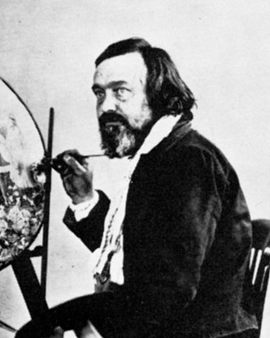
In the 19th century, fairy, gnome and elf motifs developed into an independent genre. The mythical creatures appeared more and more often, both in the paintings of many artists and as motif in many exhibitions. A well-known representative of this genre was Richard Dadd, an English painter whose story began with the successful career of an artist and ended with schizophrenia.
His genres were: History, portraits and landscapes - but also elfin motifs. The latter already gained the interest of the public in his youth and were praised by many critics, which encouraged the development of this motif into an independent genre. It is speculated that the artist had already gained a special interest in the elf theme at the Royal Academy School, where he studied and thus had contact with professors who were familiar with such motifs. In 1838 Richard Dadd founded "The Clique", a group of painters whose main subject was academic painting. In this circle were artists like Augustus Egg, Alfred Elmore, John Phillip and others.
The development of his paintings goes hand in hand with the painter's mental state; while the earlier works are perceived as lighter, the later ones seem to have fallen into confusion (cf. "Tobsucht" with "Kommen Sie zu diesen gelben Sanden"), although there are different opinions as to how far the outbreak of the disease influenced Dadd's paintings. However, one thing is certain: the details in the paintings are painted in detail and thoughtfully.
Remarkable is the effect the paintings have. While earlier depictions of elves appear to be part of a fantasy world, Dadd's works "experiment" with the viewer's consciousness. The consciousness had to be separated from the real world and put into a kind of trance. Although the artist still painted during his stay in hospital, he gradually withdrew from the art world. Nevertheless, his works did not lose their importance and enjoyed attention at numerous exhibitions.
 ×
× 






 Passionate Customer Service

.jpg "The Fairy Fellers Master-Stroke by Richard Dadd")
.jpg)
.jpg "Portrait of Maria Elizabeth Dadd, the Artist")
.jpg)
.jpg "Portrait of Sir Thomas Philips in Eastern Costume, Reclining with a Hookah by Richard Dadd")
.jpg)
.jpg "Titania Sleeping by Richard Dadd")
.jpg)
.jpg "Come unto These Yellow Sands, 1842 by Richard Dadd")
.jpg)
.jpg "Portrait of a Mad Lady by Richard Dadd")
.jpg)
_-_(MeisterDrucke-1425341).jpg "The Attack of the Spider by Richard Dadd")
_-_(MeisterDrucke-1425341).jpg)
_-_(MeisterDrucke-1632053).jpg "Landscape, c.1837 by Richard Dadd")
_-_(MeisterDrucke-1632053).jpg)
.jpg "Reminiscence of Venice from a Sketch Made on the Spot in 1842 by Richard Dadd")
.jpg)
.jpg "Contradiction: Oberon and Titania by Richard Dadd")
.jpg)
.jpg "Sketch to Illustrate Jealousy, 1853 by Richard Dadd")
.jpg)
_-_(MeisterDrucke-69465).jpg "Sketch of Robin Hood, 1852 by Richard Dadd")
_-_(MeisterDrucke-69465).jpg)
.jpg "Portrait of Mr. George Bailey by Richard Dadd")
.jpg)
.jpg "Portrait of a Monk by Richard Dadd")
.jpg)
 - (MeisterDrucke-42081).jpg "Sketch for the Passions: Love by Richard Dadd")
 - (MeisterDrucke-42081).jpg)
_-_(MeisterDrucke-908531).jpg "Fish Market by the Sea by Richard Dadd")
_-_(MeisterDrucke-908531).jpg)
_-_(MeisterDrucke-291016).jpg "Puck and the Fairies, engraved by William Home Lizars (1788-1859) by Richard Dadd")
_-_(MeisterDrucke-291016).jpg)
.jpg "Landscape Composition: Study for a Drop-Scene for the Theatre at Broadmoor Asylum by Richard Dadd")
.jpg)
.jpg "Caravanserai at Mylasa, Turkey, 1845 by Richard Dadd")
.jpg)
.jpg "Fish Market by the Sea by Richard Dadd")
.jpg)
.jpg "Gaming, Sketch Illustrating the Passions, 1853 by Richard Dadd")
.jpg)
.jpg "Caravanserai at Mylasa in Asia Minor by Richard Dadd")
.jpg)
.jpg "Puck by Richard Dadd")
.jpg)
.jpg "The Death of Richard II by Richard Dadd")
.jpg)
.jpg "Sketch of Robin Hood by Richard Dadd")
.jpg)
.jpg "The Flight out of Egypt by Richard Dadd")
.jpg)
 - (MeisterDrucke-549148).jpg "Tombs of the Khalifs, Cairo by Richard Dadd")
 - (MeisterDrucke-549148).jpg)
.jpg "Hamlet and His Mother; The Closet Scene by Richard Dadd")
.jpg)
.jpg "Sketch to Illustrate the Passions: Treachery by Richard Dadd")
.jpg)
_-_(MeisterDrucke-1129724).jpg "Portrait of Sir Thomas Phillips in Arab Dress by Richard Dadd")
_-_(MeisterDrucke-1129724).jpg)
.jpg "Invicta by Richard Dadd")
.jpg)
.jpg "Sketch to Illustrate the Passions - Drunkenness by Richard Dadd")
.jpg)
.jpg "Landscape with Cottages, Broadmoor by Richard Dadd")
.jpg)
.jpg "The Rabbit Hutch by Richard Dadd")
.jpg)
.jpg "Family Portraits by Richard Dadd")
.jpg)
.jpg "A Hermit by Richard Dadd")
.jpg)
.jpg "Puck by Richard Dadd")
.jpg)
.jpg "Splendour and Wealth, 1853 by Richard Dadd")
.jpg)
.jpg "Portrait of a Girl by Richard Dadd")
.jpg)
.jpg "Negation by Richard Dadd")
.jpg)
.jpg "Caravanserai at Mylasa in Asia Minor by Richard Dadd")
.jpg)
.jpg "A View of the Ancient City of Tlos in Lycia, 1883 by Richard Dadd")
.jpg)
.jpg "Still Life with Gooseberries, Raspberries, Red Currants, Spring Onions, a Gherkin and Foliage by Richard Dadd")
.jpg)
.jpg "The Packet Delayed by Richard Dadd")
.jpg)
.jpg "Augustus Egg by Richard Dadd")
.jpg)
.jpg "Mercy: David Spares Saul")
.jpg)
.jpg "Fantaisie de l")
.jpg)
.jpg "David Spareth Saul")
.jpg)
 - (MeisterDrucke-72746).jpg "Sketch to Illustrate the Passions: Pride, c.1853-55 by Richard Dadd")
 - (MeisterDrucke-72746).jpg)
.jpg "Sketch for the Passions: Jealousy by Richard Dadd")
.jpg)
.jpg "Sketch for the Passions: Pride by Richard Dadd")
.jpg)
.jpg "Juvenile Members of the Yacht Club by Richard Dadd")
.jpg)
.jpg "Mercy: David Spares Saul")
.jpg)
.jpg "Negation by Richard Dadd")
.jpg)
.jpg "Reminiscence of Mountain Scenery in Caria, near Mylasa, Asia Minor by Richard Dadd")
.jpg)
.jpg "Egyptian Fantasy by Richard Dadd")
.jpg)
.jpg "Augustus Egg by Richard Dadd")
.jpg)
.jpg "Negation by Richard Dadd")
.jpg)
 - (MeisterDrucke-67296).jpg "Sketch to Illustrate the Passions: Suspense or Expectation by Richard Dadd")
 - (MeisterDrucke-67296).jpg)
.jpg "Sailing Ship by Richard Dadd")
.jpg)
 - (MeisterDrucke-97558).jpg "Juvenile Members of the Yacht Club, 1853 by Richard Dadd")
 - (MeisterDrucke-97558).jpg)
.jpg "Sketch to Illustrate the Passions - Avarice, 1854 by Richard Dadd")
.jpg)
_-_(MeisterDrucke-998320).jpg "View of the Island of Rhodes by Richard Dadd")
_-_(MeisterDrucke-998320).jpg)
.jpg "Greek Woman of Asia Minor by Richard Dadd")
.jpg)
.jpg "Sailing Ships by Richard Dadd")
.jpg)
.jpg "Gaming, mid 19th Century by Richard Dadd")
.jpg)
.jpg "Sketch of Christ Walking on Water by Richard Dadd")
.jpg)
.jpg "Mother and Child, 1860 by Richard Dadd")
.jpg)
.jpg "Hunting Scene by Richard Dadd")
.jpg)
.jpg "Fantasy in an Egyptian Harem, 1865 by Richard Dadd")
.jpg)
.jpg "Mercy - David Spares Saul")
.jpg)
.jpg "Puck by Richard Dadd")
.jpg)
.jpg "Sketch to Illustrate the Passions: Suspense or Expectation by Richard Dadd")
.jpg)
.jpg "Sketch for the Passions: Love by Richard Dadd")
.jpg)
.jpg "Patriotism by Richard Dadd")
.jpg)
.jpg "Death of Abimelech at Thebez by Richard Dadd")
.jpg)
.jpg "Settling the Disputed Point by Richard Dadd")
.jpg)
.jpg "Caravanserai at Mylasa in Asia Minor by Richard Dadd")
.jpg)
.jpg "View on the Island of Rhodes by Richard Dadd")
.jpg)
.jpg "Fish Market by the Sea by Richard Dadd")
.jpg)
.jpg "Death of Abimelech at Thebez by Richard Dadd")
.jpg)
.jpg "Portrait of John McDonald by Richard Dadd")
.jpg)
.jpg "Wandering Musicians by Richard Dadd")
.jpg)
.jpg "Patriotism by Richard Dadd")
.jpg)
 - (MeisterDrucke-97218).jpg "No.3713")
 - (MeisterDrucke-97218).jpg)
.jpg "Italian Rustic Musicians by Richard Dadd")
.jpg)
.jpg "Hamlet and his Mother; The Closet Scene by Richard Dadd")
.jpg)

 +43 4257 29415
 support@meisterdrucke.com
 Mo-Do: 7:00 - 16:00 | Fr: 7:00 - 13:00