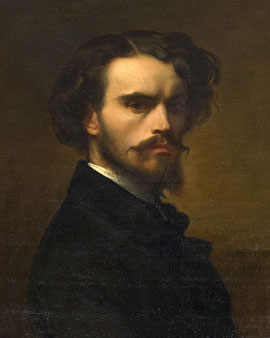
Alexandre Cabanel (1823 - 1889) was a French painter who achieved his great importance by not following the new styles of his time. With his history paintings, portraits and mythologies, he remained true to the style of academic painting and strove more towards the art of a Michelangelo or Raffael, while his contemporaries already turned to Realism and Impressionism. The son of a carpenter, he had begun studying painting at an early age and by 1864, at the age of only forty, he had become professor at the École des Beaux-Arts and jury member of the Paris Salon.
The artist created his most famous work "The Birth of Venus" in 1863, which earned the enthusiasm of the public and the Emperor Napoleon III, who bought the painting for a record sum. Later he made copies of it himself, most of them as commissioned works. The delicate colours and balanced proportions of Venus were not celebrated by everyone and also led to criticism. However, this did not harm Cabanel's fame and reputation, he remained a respected artist for many years and exerted a great influence as a professor. Among his students was Gustave Courbet, who was at least temporarily inspired by Cabanel.
 ×
×






 Passionate Customer Service

.jpg "Fallen Angel, 1847. by Alexandre Cabanel")
.jpg)
.jpg "Birth of Venus by Alexandre Cabanel")
.jpg)
.jpg "Nymph Abducted by a Faun, 1860 by Alexandre Cabanel")
.jpg)
.jpg "Cleopatra Testing Poison on Condemned Slaves, 1887 by Alexandre Cabanel")
.jpg)
.jpg "Ophelia, 1883 by Alexandre Cabanel")
.jpg)
.jpg "The Countess de Keller by Alexandre Cabanel")
.jpg)
.jpg "Self-portrait by Alexandre Cabanel")
.jpg)
.jpg "The Birth of Venus, 1875 by Alexandre Cabanel")
.jpg)
 preparatory study for Cleopatra Testing Poisons on the Condemned Prisoners - (MeisterDrucke-58180).jpg "Cleopatra (69-30 BC), preparatory study for “Cleopatra Testing Poisons on the Condemned Prisoners” by Alexandre Cabanel")
 preparatory study for Cleopatra Testing Poisons on the Condemned Prisoners - (MeisterDrucke-58180).jpg)
.jpg "Study of Adam for Paradise Lost, c. 1863 by Alexandre Cabanel")
.jpg)
_1863_Sun_13x225_m_P_-_(MeisterDrucke-970813).jpg "The Birth of Venus. Painting by Alexandre Cabanel (1823-1889), 1863. Height 1.3 x 2.25 m. Paris, Musée d")
_1863_Sun_13x225_m_P_-_(MeisterDrucke-970813).jpg)
.jpg "Phaedra. Phaedra, in love with her stepson Hippolytus, is in despair. by Alexandre Cabanel")
.jpg)
.jpg "Portrait of Countess E.A. Vorontova-Dashkova, 1873 by Alexandre Cabanel")
.jpg)
.jpg "Echo, 1874 by Alexandre Cabanel")
.jpg)
.jpg "Phaedra, c. 1880 by Alexandre Cabanel")
.jpg)
.jpg "Study for")
.jpg)
.jpg "La Comtesse de Keller, 1873 by Alexandre Cabanel")
.jpg)
.jpg "The Glorification of St. Louis by Alexandre Cabanel")
.jpg)
.jpg "Phaedra by Alexandre Cabanel")
.jpg)
.jpg "Paradise Lost, 1867 by Alexandre Cabanel")
.jpg)
_-_(MeisterDrucke-583876).jpg "The Death of Moses, 1851 by Alexandre Cabanel")
_-_(MeisterDrucke-583876).jpg)
.jpg "Death of Francesca da Rimini and Paolo Malatesta, 1870 by Alexandre Cabanel")
.jpg)
_-_(MeisterDrucke-1564154).jpg "Portrait of Arabella Worsham (later Arabella Huntington) by Alexandre Cabanel")
_-_(MeisterDrucke-1564154).jpg)
.jpg "The Sutton Sisters, 1871 by Alexandre Cabanel")
.jpg)
.jpg "Birth of Venus, 1863 by Alexandre Cabanel")
.jpg)
.jpg "Psyche with the Casket of Proserpina, 1881 by Alexandre Cabanel")
.jpg)
.jpg "Portrait of Prince K. A. Gorchakov, 1868 by Alexandre Cabanel")
.jpg)
_(1214-1270)_in_Jerusalem_Painting_by_-_(MeisterDrucke-984090).jpg "Seventh Crusade: King Louis IX (Saint Louis) (1214-1270) in Jerusalem. Painting by Alexandre Cabanel (1823-1889), 19th century. Paris, Panthéon by Alexandre Cabanel")
_(1214-1270)_in_Jerusalem_Painting_by_-_(MeisterDrucke-984090).jpg)
.jpg "St. Louis in Jerusalem, illustration from the illustrated supplement of Le Petit Journal, 11th September, 1898 by Alexandre Cabanel")
.jpg)
.jpg "The White Queen of Castile Gives a Lesson to the Future King Louis IX (Saint Louis) (1214-1270) as a Child, painting by Alexandre Cabanel (1823-1889), 19th century, Paris, Panthéon by Alexandre Cabanel")
.jpg)
 - (MeisterDrucke-60156).jpg "The Life of St. Louis (detail) by Alexandre Cabanel")
 - (MeisterDrucke-60156).jpg)
_-_(MeisterDrucke-632241).jpg "The Death of Moses, 1851 (detail of 225068) by Alexandre Cabanel")
_-_(MeisterDrucke-632241).jpg)
_rendering_justice_Painting_by_Alexand_-_(MeisterDrucke-1000521).jpg "King Louis IX Rendering Justice by Alexandre Cabanel")
_rendering_justice_Painting_by_Alexand_-_(MeisterDrucke-1000521).jpg)
_-_(MeisterDrucke-1662638).jpg "Algae and Boniface, c.1857 by Alexandre Cabanel")
_-_(MeisterDrucke-1662638).jpg)
.jpg "Samson and Delilah by Alexandre Cabanel")
.jpg)
_(1214-1270)_rendering_justice_Painting_by_Alexandre_-_(MeisterDrucke-1021789).jpg "King Louis IX rendering justice by Alexandre Cabanel")
_(1214-1270)_rendering_justice_Painting_by_Alexandre_-_(MeisterDrucke-1021789).jpg)
_Painting_by_Alexandre_Ca_-_(MeisterDrucke-951052).jpg "Death of Francesca de Rimini and Paolo Malatesta (1284) by Alexandre Cabanel")
_Painting_by_Alexandre_Ca_-_(MeisterDrucke-951052).jpg)
.jpg "Portrait of the Countess of Keller by Alexandre Cabanel")
.jpg)
.jpg "The Birth of Venus by Alexandre Cabanel")
.jpg)
.jpg "Echo by Alexandre Cabanel")
.jpg)
.jpg "Pandora, 1873 by Alexandre Cabanel")
.jpg)
.jpg "The Birth of Venus, 1863 by Alexandre Cabanel")
.jpg)
.jpg "Portrait of Princess Elizabeth Vorontsova-Dashkova by Alexandre Cabanel")
.jpg)
_(s_-_(MeisterDrucke-583877).jpg "Study for The Death of Moses by Alexandre Cabanel")
_(s_-_(MeisterDrucke-583877).jpg)
.jpg "Drapery study for An Angel Attending God the Father, in Paradise Lost by Alexandre Cabanel")
.jpg)
.jpg "Death of Moses by Alexandre Cabanel")
.jpg)
.jpg "The Birth of Venus by Alexandre Cabanel")
.jpg)
_-_(MeisterDrucke-1663216).jpg "Pharaoh Cleopatra VII by Alexandre Cabanel")
_-_(MeisterDrucke-1663216).jpg)
.jpg "Study for \"The Florentine Poet\" by Alexandre Cabanel")
.jpg)
.jpg "Samson and Delilah by Alexandre Cabanel")
.jpg)
.jpg "Georgina Schuyler, 1883 by Alexandre Cabanel")
.jpg)
.jpg "Florentine Poet, 1861 by Alexandre Cabanel")
.jpg)
.jpg "Catharine Lorillard Wolfe by Alexandre Cabanel")
.jpg)
.jpg "The Birth of Venus by Alexandre Cabanel")
.jpg)
_as_Ophelia_by_Caban_-_(MeisterDrucke-1011179).jpg "Christina Nilsson as Ophelia by Alexandre Cabanel")
_as_Ophelia_by_Caban_-_(MeisterDrucke-1011179).jpg)
.jpg "A Druidess, 1868 by Alexandre Cabanel")
.jpg)
_at_the_Ecole_des_Beaux_-_(MeisterDrucke-1427659).jpg "The workshop of the painter Alexandre Cabanel at the Ecole des Beaux Arts by Alexandre Cabanel")
_at_the_Ecole_des_Beaux_-_(MeisterDrucke-1427659).jpg)
.jpg "The Birth of Venus by Alexandre Cabanel")
.jpg)
_-_(MeisterDrucke-1517462).jpg "Phaedra, in 1880 by Alexandre Cabanel")
_-_(MeisterDrucke-1517462).jpg)
.jpg "Albayde by Alexandre Cabanel")
.jpg)
.jpg "Olivia Peyton Murray Cutting by Alexandre Cabanel")
.jpg)
.jpg "Rebecca and Eliezer by Alexandre Cabanel")
.jpg)
.jpg "The Birth of Venus by Alexandre Cabanel")
.jpg)
.jpg "Portrait of Miss Fanny Clapp by Alexandre Cabanel")
.jpg)
.jpg "Algae and Boniface by Alexandre Cabanel")
.jpg)
.jpg "Medieval Lady by Alexandre Cabanel")
.jpg)
.jpg "The Studio by Alexandre Cabanel")
.jpg)
.jpg "Cleopatra by Alexandre Cabanel")
.jpg)
.jpg "Painting in the left transept of the Pantheon, Paris, c1880-1882 by Alexandre Cabanel")
.jpg)
_-_(MeisterDrucke-1491662).jpg "Rocky Landscape by Alexandre Cabanel")
_-_(MeisterDrucke-1491662).jpg)
.jpg "The Birth of Venus by Alexandre Cabanel")
.jpg)
.jpg "The Druidess by Alexandre Cabanel")
.jpg)
.jpg "Albayde by Alexandre Cabanel")
.jpg)
.jpg "Ruth Returning from the Fields by Alexandre Cabanel")
.jpg)
.jpg "Academic Nude by Alexandre Cabanel")
.jpg)
.jpg "Napoleon III by Alexandre Cabanel")
.jpg)
.jpg "A Young Lady by Alexandre Cabanel")
.jpg)
.jpg "Mary Frick Garrett by Alexandre Cabanel")
.jpg)
.jpg "Catharine Lorillard Wolfe by Alexandre Cabanel")
.jpg)
.jpg "A Self-Portrait, bust length, 1847 by Alexandre Cabanel")
.jpg)
.jpg "Venetian Patrician by Alexandre Cabanel")
.jpg)
.jpg "Woman Reaching Over a Wall, study for The Life of Saint Louis, King of France by Alexandre Cabanel")
.jpg)
.jpg "St. Louis during Justice by Alexandre Cabanel")
.jpg)
.jpg "Self-Portrait by Alexandre Cabanel")
.jpg)
.jpg "The Life of St. Louis by Alexandre Cabanel")
.jpg)
.jpg "Central Figure, study for The Life of Saint Louis, King of France by Alexandre Cabanel")
.jpg)
.jpg "Study for a Saracen, for The Captivity of St Louis by Alexandre Cabanel")
.jpg)
.jpg "Self Portrait by Alexandre Cabanel")
.jpg)
.jpg "Napoleon III by Alexandre Cabanel")
.jpg)
.jpg "St. Louis pendant la Justice, c. 1875 by Alexandre Cabanel")
.jpg)
.jpg "La Chiaruccia by Alexandre Cabanel")
.jpg)
.jpg "Study for The Triumph of Flora, c1880-1882 by Alexandre Cabanel")
.jpg)
.jpg "Study of Man")
.jpg)
.jpg "Algae and Boniface by Alexandre Cabanel")
.jpg)
.jpg "Study for The Education of St Louis Pantheon by Alexandre Cabanel")
.jpg)
.jpg "The choirmaster")
.jpg)
.jpg "Napoleon III by Alexandre Cabanel")
.jpg)
.jpg "The Roman Monk by Alexandre Cabanel")
.jpg)

 +43 4257 29415
 support@meisterdrucke.com
 Mo-Do: 7:00 - 16:00 | Fr: 7:00 - 13:00