-
 ×
× - Home
- Art Prints ▸
- Artists ▸
- Categories ▸
- Art Styles ▸
- Picture Frame ▸
- All decorative frames
- Baroque decorative frames
- Simple decorative frames
- Rustic decorative frames
- Floating frames
- Golden decorative frames
- Silver decorative frames
- White decorative frames
- Black decorative frames
- Wood-look decorative frames
- Shabby chic decorative frames
- Thin decorative frames
- Thick decorative frames
- Print Media ▸
- All print media
- Canvas Leonardo (satin)
- Canvas Salvador (matte)
- Canvas Raphael (matte)
- FineArt Photo Matte
- FineArt Photo Satin
- FineArt Photo Baryte
- FineArt Photo Glossy
- Watercolor Paper Munch
- Watercolor Paper Renoir
- Watercolor Paper Turner
- Watercolor Paper Dürer
- Natural Line Hemp
- Natural Line Rice
- Kozo White, 110g
- Kozo Natural, 110g
- Inbe White, 125g
- Unryu, 55g
- Bamboo, 110g
- Premio Unryu, 165g
- Murakumo Natural, 42g
- Bizan Natural, 300g
- Bizan White, 300g
- Aluminum composite 3mm
- Acrylic glass 5mm
- Order Sample Set
- Which print medium is right for you?
Canvas
Photo Paper
Watercolor Board
Natural Line
Japanese Paper
Special Media
More information
- Help & Service ▸
- Contact us
- Sell your art
- Frequently Asked Questions
- Job Openings
- Complaint
- Order Samples
- Order Vouchers
- Shipping costs
- Production time
- Sustainability
- Image research
- Special requests
- Who are we?
- Pricing policy
- Company policy
- Quality promise
- Awards
- Stretcher frame
- Mats
- Decorative frames
- Glazing
- Fillets
- Mounting systems
- Print media
- Care tips
- Legal Notice
- Terms & Conditions
- Privacy Policy
- Right of Cancellation
Info & Service
More information
Good to know
Legal information
- Shop ▸
- Contact







 Passionate Customer Service
.jpg "Map of the Battle of Trafalgar, published by William Blackwood and Sons, Edinburgh and London, 1848 by Alexander Keith Johnston")
.jpg)
.jpg "Reproduction of Map of Routes of St. James of Compostela, originally engraved by D. Serveaux 1648 by French School")
.jpg)
.jpg "Double Hemisphere World Map, 1587 by Gerardus Mercator")
.jpg)
_and_Frans_-_(MeisterDrucke-304105).jpg "Map of London, from 'Civitates Orbis Terrarum', by Georg Braun (1542-1622) and Frans Hogenberg (1635-90), c. 1572 by Joris Hoefnagel")
_and_Frans_-_(MeisterDrucke-304105).jpg)
.jpg "Map of Atlantis, from 'Mundus Subterraneus', 1665-68 by Athanasius Kircher")
.jpg)
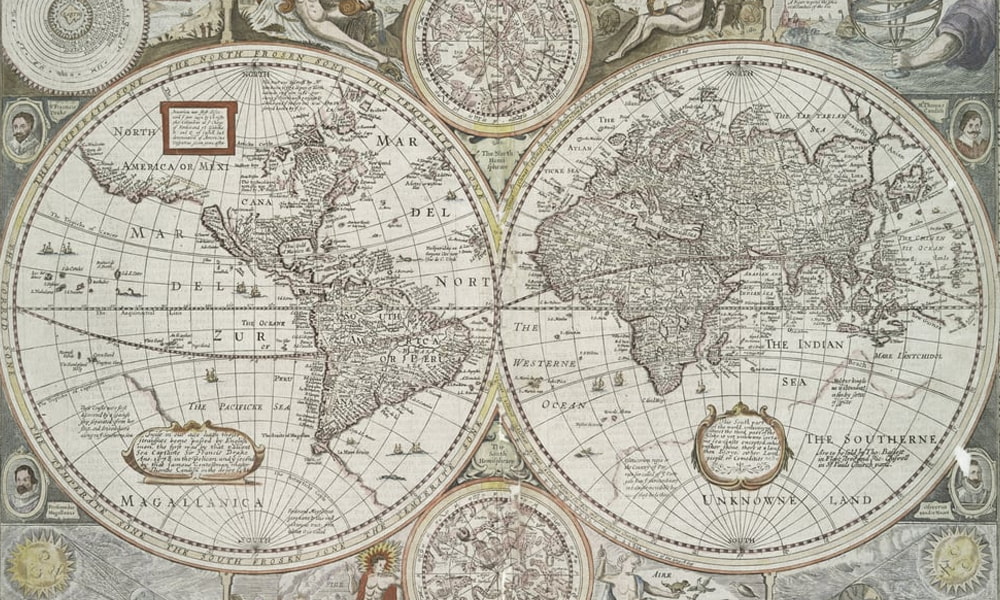
 - (MeisterDrucke-123182).jpg "A new and accurate map of the world, 1676 by John Speed")
 - (MeisterDrucke-123182).jpg)
 - (MeisterDrucke-97158).jpg "Zodiac Calendar, from an Atlas of the World in 33 Maps, Venice, 1st September 1553 by Battista Agnese")
 - (MeisterDrucke-97158).jpg)
.jpg "Map of Berlin and Cölln, 1652 by Johann Gregor Memhardt")
.jpg)
.jpg "World Map, from 'Le Theatre du Monde' or 'Nouvel Atlas', 1645 by Willem Janszoon Blaeu")
.jpg)
.jpg "Map of Tenochtitlan and the Gulf of Mexico, from Praeclara Ferdinadi Cortesii de Nova maris Oceani Hyspania Narratio by Hernando Cortés (1485-1547), 1524 by Spanish School")
.jpg)
.jpg "Detail of Italy from the Peutinger map copy by Unbekannt Unbekannt")
.jpg)
.jpg "Map of Paris depicting the city's famous monuments, 1882 by French School")
.jpg)
 (for detail see 84597) - (MeisterDrucke-170581).jpg "Map of the Pacific, China and America, 1589, by Abrahamus Ortelius (1527-98) by Abraham Ortelius")
 (for detail see 84597) - (MeisterDrucke-170581).jpg)
.jpg "Map of Ancient Egypt, 1584 by Abraham Ortelius")
.jpg)
 pub by Joannes Janssonius Amsterdam 1660-61 (hand coloured eng - (MeisterDrucke-160707).jpg "Map of the Southern Hemisphere, from “The Celestial Atlas, or The Harmony of the Universe” (Atlas coelestis seu harmonia macrocosmica), published by Joannes Janssonius, Amsterdam, 1660-61, hand-coloured engraving by Andreas Cellarius")
 pub by Joannes Janssonius Amsterdam 1660-61 (hand coloured eng - (MeisterDrucke-160707).jpg)
.jpg "Double Hemisphere World Map, 1587 by Gerardus Mercator")
.jpg)
.jpg "Map of the World, Based on Descriptions and Co-ordinates Given in 'Geographia', First Published in Ulm, Germany, 1482 by Ptolemy")
.jpg)
.jpg "A New Land and Water Map of the Entire Earth, 1630 by Henricus Hondius II")
.jpg)
.jpg "Map of Florence, 1584 by Stefano Bonsignori")
.jpg)
 published Geneva 1780 - (MeisterDrucke-65565).jpg "Map of the World using the Mercator Projection, from 'Atlas de Toutes les Parties Connues du Globe Terrestre' by Guillaume Raynal (1713-96), published Geneva, 1780 by Charles Marie Rigobert Bonne")
 published Geneva 1780 - (MeisterDrucke-65565).jpg)
.jpg "Historical Map of Berlin, published by Verlag von Gebrüder Rocca, Berlin 1838 by W.v. Moellendorf")
.jpg)
.jpg "Ms. Arabe 2221, fol. 203 and 204, Map of the Mediterranean, Europe and Africa, 1300 by Abu Muhammad Al-Idrisi or Edrisi")
.jpg)
 - (MeisterDrucke-112095).jpg "Mappa Mundi, 1502 by Juan de la Cosa")
 - (MeisterDrucke-112095).jpg)
_and_Frans_H_-_(MeisterDrucke-207892).jpg "Map of Rome, from 'Civitates Orbis Terrarum' by Georg Braun (1541-1622) and Frans Hogenberg (1535-90), c.1572 by Joris Hoefnagel")
_and_Frans_H_-_(MeisterDrucke-207892).jpg)
_and_Frans_-_(MeisterDrucke-216713).jpg "Map of Lisbon, from 'Civitates Orbis Terrarum' by Georg Braun (1541-1622) and Frans Hogenberg (1535-90), c. 1572 by Joris Hoefnagel")
_and_Frans_-_(MeisterDrucke-216713).jpg)
_and_Fr_-_(MeisterDrucke-230633).jpg "Map of Cambridge, from 'Civitates Orbis Terrarum' by Georg Braun (1541-1622) and Frans Hogenberg (1535-90), c.1572 by Joris Hoefnagel")
_and_Fr_-_(MeisterDrucke-230633).jpg)
 (c90-168 AD) - (MeisterDrucke-65091).jpg "Map of the World, Based on Descriptions and Coordinates Given in “Geographia”, by Ptolemy (Claudius Ptolemaeus of Alexandria) (c. 90-168 AD) by Unbekannt Unbekannt")
 (c90-168 AD) - (MeisterDrucke-65091).jpg)
.jpg "Map of the Voyage of the Argonauts, from the “Theatrum Orbis Terrarum”, 1603 by Abraham Ortelius")
.jpg)
_and_Fran_-_(MeisterDrucke-219549).jpg "Map of Leipzig, from „Civitates Orbis Terrarum“ by Georg Braun (1541-1622) and Frans Hogenberg (1535-90), c. 1572 by Joris Hoefnagel")
_and_Fran_-_(MeisterDrucke-219549).jpg)
_and_F_-_(MeisterDrucke-156983).jpg "Map of Regensburg, from 'Civitates Orbis Terrarum' by Georg Braun (1541-1622) and Frans Hogenberg (1535-90), 1594 by Joris Hoefnagel")
_and_F_-_(MeisterDrucke-156983).jpg)
.jpg "Map of Paris at the Outbreak of the French Revolution, 1789, published by William Blackwood and Sons, Edinburgh and London, 1848 by Alexander Keith Johnston")
.jpg)
.jpg "Detailed Map of Gallipoli Peninsula and the Dardanelles, Turkey, 1915, from 'The War Illustrated Album deLuxe', Published in London, 1916 by English School")
.jpg)
 - (MeisterDrucke-56912).jpg "Typus Orbis Terrarum, map of the world, from Ortelius's 'Theatrum Orbis Terrarum', Antwerp, 1570 by Abraham Ortelius")
 - (MeisterDrucke-56912).jpg)
.jpg "Map of the world with possessions of the British Empire coloured red, c. 1870 by English School")
.jpg)
.jpg "Maps of Holy Island and Farne Island, Northumberland, from 'The Theatre of the Empire of Great Britaine' by John Speed, 1676 by John Speed")
.jpg)
 detail from a Map showing th - (MeisterDrucke-222916).jpg "Nicolaus Copernicus (1473-1543), detail from a map showing the Copernican system of planetary orbits, Planisphaerium Copernicanum, from The Celestial Atlas, or The Harmony of the Universe (Atlas c by Andreas Cellarius")
 detail from a Map showing th - (MeisterDrucke-222916).jpg)
.jpg "Map of Padua, from \"Les Villes de Venétie\", 1704, published by Pierre Mortier in Amsterdam by Pierre Mortier")
.jpg)
.jpg "Map of the Known World, from „Geographia“ by Ptolemy")
.jpg)
 (see also 330956) - (MeisterDrucke-54987).jpg "The Indian Ocean, from an Atlas of the World in 33 Maps, Venice, 1st September 1553 by Battista Agnese")
 (see also 330956) - (MeisterDrucke-54987).jpg)
.jpg "Map of the Battle of Jena, published by William Blackwood and Sons, Edinburgh and London, 1848 by Alexander Keith Johnston")
.jpg)
.jpg "Ms Ital 550.0.3.15 fol.2r Map of Europe, from 'Carte Geografiche' by Jacopo Russo")
.jpg)
.jpg "Map of Europe, from a facsimile of the ‘Miller Atlas’ by Pedro and Jorge Reinel, and Lopo Homem, made in 1519 by Unbekannt Unbekannt")
.jpg)
.jpg "Detail of Copy of a Catalan Map of Europe and North Africa, presented to Charles V of France in 1381 by Abraham Cresques")
.jpg)
.jpg "The New World, from an Atlas of the World in 33 Maps, Venice, 1st September 1553 by Battista Agnese")
.jpg)
 - (MeisterDrucke-90593).jpg "Map tracing Magellan's world voyage, once owned by Charles V, 1545 by Battista Agnese")
 - (MeisterDrucke-90593).jpg)
 - (MeisterDrucke-99297).jpg "Improved Map of India, published in London 1820 by English School")
 - (MeisterDrucke-99297).jpg)
 - (MeisterDrucke-38790).jpg "Ms. Ital. 550.0.3.15, fol. 4v-5r. Map of the Eastern Mediterranean Coast and Islands, from the „Carte Geografiche“ by Jacopo Russo")
 - (MeisterDrucke-38790).jpg)
 (see also 330950) - (MeisterDrucke-87632).jpg "The Continent of Europe, from an Atlas of the World in 33 Maps, Venice, 1st September 1553 by Battista Agnese")
 (see also 330950) - (MeisterDrucke-87632).jpg)
.jpg "Battle of Waterloo, Map of the Battlefield, engraved by Jacowick, 1816 by Willem Benjamin Craan")
.jpg)
.jpg "Map of the Old and New Worlds, c. 1500 by Juan de la Cosa")
.jpg)
 - (MeisterDrucke-198293).jpg "Map of the Battle of Trafalgar, published by William Blackwood and Sons, Edinburgh and London, 1848 by Alexander Keith Johnston")
 - (MeisterDrucke-198293).jpg)
.jpg "Map of Silesia, from an Atlas by Georg Matthäus Seutter")
.jpg)
 - (MeisterDrucke-135768).jpg "A New and Correct Map of the World Laid Down According to the Newest Discoveries and from the Most Exact Observations, 1736 by Hermann Moll")
 - (MeisterDrucke-135768).jpg)
.jpg "Map of Rovigo, from “Les Villes de Venetie”, 1704, published by Pierre Mortier in Amsterdam by Pierre Mortier")
.jpg)
 - (MeisterDrucke-170625).jpg "Map of Madras at the time of the capture of the town and Fort of St. George in 1746 by the French under the command of Mahé de la Bourdonnais, 1750 by Maurille Antoine Moithey")
 - (MeisterDrucke-170625).jpg)
 - (MeisterDrucke-37902).jpg "Map of Canada, from 'Carte de l'Amerique Septentrionale' by Jean Baptiste Louis Franquelin")
 - (MeisterDrucke-37902).jpg)
.jpg "Map of the Battle of the Nile, published by William Blackwood and Sons, Edinburgh and London, 1848 by Alexander Keith Johnston")
.jpg)
.jpg "Map of Rome, from the “Speculum Romanae Magnificentiae” published in 1562 by Antonio Lafreri")
.jpg)
.jpg "Map of Berlin, printed by C.L. Keller, Berlin, 1890 by Jul. Straube")
.jpg)
 - (MeisterDrucke-151586).jpg "Map of Berlin, published by D. Reimer Verlag, Berlin, 1871 by Leopold Kraatz")
 - (MeisterDrucke-151586).jpg)
.jpg "Map of South America showing its political divisions from Mitchell's New General Atlas, 1863 by Samuel Augustus Mitchell")
.jpg)
.jpg "Ms.255171 Estate map of Belchamp St. Paul, 1576 (detail) by Israel Amyce")
.jpg)
 - (MeisterDrucke-86163).jpg "Fol. 99 Map of Saint-Savinien on the Charente River in 1713, from 'Recueil des Plans de Saintonge' by Claude Masse")
 - (MeisterDrucke-86163).jpg)
 - (MeisterDrucke-61569).jpg "A Map of the North Pole by John Seller")
 - (MeisterDrucke-61569).jpg)
.jpg "Ms 255171 fol. 88 Map of the Village of Belchamp St. Paul, 1576 by Israel Amyce")
.jpg)
.jpg "Map representing the approximate tonnage of wines and spirits in circulation in France in 1857 by water and by railway, 1860 by Charles Joseph Minard")
.jpg)
.jpg "Map of Tenochtitlan from „Praeclara Ferdinandi Cortesii de Nova Maris Oceani Hispania Narrati“ by German School")
.jpg)
.jpg "An inciting map of the Turbid Amazon, illustration from 'Just So Stories for Little Children' by Rudyard Kipling, published in London, 1951 by Joseph Rudyard Kipling")
.jpg)
.jpg "Map of Hamburg and the surrounding area, published in Nuremberg by German School")
.jpg)
 - (MeisterDrucke-97255).jpg "Map of the Central Mediterranean by Grazioso Benincasa")
 - (MeisterDrucke-97255).jpg)
.jpg "Detail of Constantinople and the Middle East from the Peutinger map copy by Unbekannt Unbekannt")
.jpg)
.jpg "Copy of an 8th-century Beatus mappa mundi by Unbekannt Unbekannt")
.jpg)
.jpg "Mappa Mundi, c. 1290 by Richard of Haldingham")
.jpg)
.jpg "Detail of Italy from the Peutinger map copy by Unbekannt Unbekannt")
.jpg)
.jpg "Map of Europe, illustration from Le Magasin Pittoresque, 1849 by French School")
.jpg)
.jpg "Map of Egypt, 1348 by Abu Muhammad Al-Idrisi or Edrisi")
.jpg)
.jpg "Map, from The Navigation of King James V, Round Scotland, the Orkney Isles, and the Hebrids or Western Isles: Under the Conduct of That Excellent Pilot Alexander Lindsay by Nicolas de Nicolay")
.jpg)
_-_(MeisterDrucke-310284).jpg "Map of animals in Europe by Janos Balint")
_-_(MeisterDrucke-310284).jpg)
 - (MeisterDrucke-36081).jpg "Map of Charles V, map by Mecia de Viladestes, a portolan of Europe and North Africa, 1413 by Spanish School")
 - (MeisterDrucke-36081).jpg)
 - (MeisterDrucke-225587).jpg "Map of Africa, published in 1700, Paris by Guillaume Delisle")
 - (MeisterDrucke-225587).jpg)
_-_(MeisterDrucke-434394).jpg "Map of Greece, Hungary and their surrounding countries by Dutch School")
_-_(MeisterDrucke-434394).jpg)
_during_the_conquest_of_-_(MeisterDrucke-36067).jpg "Map of the route followed by Hernando Cortés (1485-1547) during the conquest of Mexico by Mexican School")
_during_the_conquest_of_-_(MeisterDrucke-36067).jpg)
.jpg "Map showing the localities of the Indian tribes of the US in 1833, illustration from 'The Indian Tribes of North America, Vol. 3', by Thomas L. McKenney and James Hall, published by John Grant by George Catlin")
.jpg)
 - (MeisterDrucke-103966).jpg "Map of the Magellan Straits, Patagonia by Dutch School")
 - (MeisterDrucke-103966).jpg)
.jpg "Septentrionalium terrarum descriptio, map of the Arctic, 1595 by Gerardus Mercator")
.jpg)
 - (MeisterDrucke-287342).jpg "Map of Europe, published in 1700, Paris by Guillaume Delisle")
 - (MeisterDrucke-287342).jpg)
.jpg "Map of Civil War England and a View of Prague, 1632 by Wenceslaus Hollar")
.jpg)
.jpg "Map of Southern Italy, Corsica, and Sardinia known in Ancient Times as Great Greece or Magna Graecia, early 18th century by Guillaume Delisle")
.jpg)
 from - (MeisterDrucke-259626).jpg "Map of the travels of Alexander the Great (356-323 BC) from 'Le Théâtre du Monde' or 'Nouvel Atlas', 1645 by Joan Blaeu")
 from - (MeisterDrucke-259626).jpg)
 - (MeisterDrucke-234356).jpg "Map of Persia, 1638 by Gerardus Mercator")
 - (MeisterDrucke-234356).jpg)
 - (MeisterDrucke-219723).jpg "Map of Asia, published in 1700, Paris by Guillaume Delisle")
 - (MeisterDrucke-219723).jpg)
.jpg "Map of England and Wales, 1644 by Wenceslaus Hollar")
.jpg)
.jpg "Map of Africa, from Nova Africa Descriptio, published in Amsterdam in the 1660s by Dutch cartographer Frederik de Wit by Dutch School")
.jpg)
 pub by Joannes Janssonius A - (MeisterDrucke-52996).jpg "Map of the Christian Constellations as depicted by Julius Schiller, from “The Celestial Atlas, or The Harmony of the Universe” (Atlas coelestis seu harmonia macrocosmica), published by Joannes Janssonius, A by Andreas Cellarius")
 pub by Joannes Janssonius A - (MeisterDrucke-52996).jpg)
_drawn_and_engraved_by_Sydney_Hall_c1826_-_(MeisterDrucke-59372).jpg "Map of Aegyptus Antiqua (Ancient Egypt), drawn and engraved by Sydney Hall, c. 1826 by Sydney Prior Hall")
_drawn_and_engraved_by_Sydney_Hall_c1826_-_(MeisterDrucke-59372).jpg)
.jpg "Geographic Map of the Azores, 1587 by Portuguese School")
.jpg)
.jpg "A Map of St Paul's and Bankside, London, 1746 by John Rocque")
.jpg)
.jpg "A New Map of the Roman Empire, from \"A Prospect of the Most Famous Parts of the World\", published by Bassett and Chiswell, 1676 by John Speed")
.jpg)
 - (MeisterDrucke-115884).jpg "Map of the North Sea, c.1675 by Frederick de Wit")
 - (MeisterDrucke-115884).jpg)
.jpg "A Map of Bloomsbury and Holborn, London, 1746 by John Rocque")
.jpg)

 +43 4257 29415
 support@meisterdrucke.com
 Mo-Do: 7:00 - 16:00 | Fr: 7:00 - 13:00