-
 ×
×
- Home
- Art Prints ▸
- Artists ▸
- Categories ▸
- Art Styles ▸
-
Picture Frame ▸
- All decorative frames
- Baroque decorative frames
- Simple decorative frames
- Rustic decorative frames
- Floating frames
- Golden decorative frames
- Silver decorative frames
- White decorative frames
- Black decorative frames
- Wood-look decorative frames
- Shabby chic decorative frames
- Thin decorative frames
- Thick decorative frames
-
Print Media ▸
- All print media
- Canvas Leonardo (satin)
- Canvas Salvador (matte)
- Canvas Raphael (matte)
- FineArt Photo Matte
- FineArt Photo Satin
- FineArt Photo Baryte
- FineArt Photo Glossy
- Watercolor Paper Munch
- Watercolor Paper Renoir
- Watercolor Paper Turner
- Watercolor Paper Dürer
- Natural Line Hemp
- Natural Line Rice
- Kozo White, 110g
- Kozo Natural, 110g
- Inbe White, 125g
- Unryu, 55g
- Bamboo, 110g
- Premio Unryu, 165g
- Murakumo Natural, 42g
- Bizan Natural, 300g
- Bizan White, 300g
- Aluminum composite 3mm
- Acrylic glass 5mm
- Order Sample Set
- Which print medium is right for you?
Canvas
Photo Paper
Watercolor Board
Natural Line
Japanese Paper
Special Media
More information
-
Help & Service ▸
- Contact us
- Sell your art
- Frequently Asked Questions
- Job Openings
- Complaint
- Order Samples
- Order Vouchers
- Shipping costs
- Production time
- Sustainability
- Image research
- Special requests
- Who are we?
- Pricing policy
- Company policy
- Quality promise
- Stretcher frame
- Mats
- Decorative frames
- Glazing
- Fillets
- Mounting systems
- Print media
- Care tips
- Legal Notice
- Terms & Conditions
- Privacy Policy
- Right of Cancellation
Info & Service
More information
Good to know
Legal information
- Shop ▸
- Contact







 Passionate Customer Service
.jpg "The Mill by Rembrandt van Rijn")
.jpg)
.jpg "Church and Cottage with Lighted Windows by English School")
.jpg)
.jpg "American Gothic by Grant Wood")
.jpg)
.jpg "The Sheepfold, Moonlight by Jean-Francois Millet")
.jpg)
.jpg "Two Watermills and an Open Sluice by Jacob van Ruisdael")
.jpg)
.jpg "September by Erik Theodor Werenskiold")
.jpg)
.jpg "A Cottage in Winter, 19th century by William Oliver Stone")
.jpg)
.jpg "An Evening Gossip by Joshua Fisher")
.jpg)
.jpg "Wooded landscape with a watermill by Meindert Hobbema")
.jpg)
.jpg "Old Cottage, Bignor, Sussex, from The Cottages and the Village Life of Rural England, published by Dent & Sons Limited, 1912 by Alfred Robert Quinton")
.jpg)
.jpg "By a Lane at Houghton, Suffolk, from The Cottages and the Village Life of Rural England, Published by Dent & Sons Limited, 1912 by Alfred Robert Quinton")
.jpg)
.jpg "Cottages by a stream, c.1824 by Richard Parkes Bonington")
.jpg)
.jpg "Glenmire Bridge, near Cork, engraved by E. Finden, 1832 by Richard Westall")
.jpg)
.jpg "Landscape Study - a haystack near a church by Peter de Wint")
.jpg)
.jpg "West Hagbourne, Berkshire, from The Cottages and the Village Life of Rural England, published by Dent & Sons Limited, 1912 by Alfred Robert Quinton")
.jpg)
.jpg "Anglers by a Cottage on a River Bank by James Holland")
.jpg)
.jpg "Turvers Farm, Wimbish, Essex by Thomas Girtin")
.jpg)
.jpg "A Cottage by a Duck Pond by Arthur Claude Strachan")
.jpg)
 - (MeisterDrucke-37530).jpg "Village near Dachau, 1859 by Christian Ernst Bernhard Morgenstern")
 - (MeisterDrucke-37530).jpg)
.jpg "Woodland scene with cottage by John Berney Ladbrooke")
.jpg)
.jpg "Norton, near Evesham, Worcester, from The Cottages and the Village Life of Rural England, published by Dent & Sons Limited, 1912 by Alfred Robert Quinton")
.jpg)
.jpg "Cowdrays Cottage, Midhurst, Sussex, from The Cottages and the Village Life of Rural England, published by Dent & Sons Limited, 1912 by Alfred Robert Quinton")
.jpg)
.jpg "Farmhouse, Brent Eleigh, Suffolk, from The Cottages and the Village Life of Rural England published by Dent & Sons Limited, 1912 by Alfred Robert Quinton")
.jpg)
.jpg "Lilac and Apple Blossoms, Harvington, Worcester, from The Cottages and the Village Life of Rural England published by Dent & Sons Limited, 1912 by Alfred Robert Quinton")
.jpg)
.jpg "Normandy Shore by Camille Flers")
.jpg)
 - (MeisterDrucke-21349).jpg "Mill by the Mountain Stream (1861) by Andreas Achenbach")
 - (MeisterDrucke-21349).jpg)
.jpg "Cottages at Lake, near Salisbury, Wiltshire, from The Cottages and the Village Life of Rural England, published by Dent & Sons Limited, 1912 by Alfred Robert Quinton")
.jpg)
.jpg "Dove Cottage, Grasmere, from The Cottages and the Village Life of Rural England published by Dent & Sons Limited, 1912 by Alfred Robert Quinton")
.jpg)
.jpg "A Cottage Garden in Cholstry by Ernest Arthur Rowe")
.jpg)
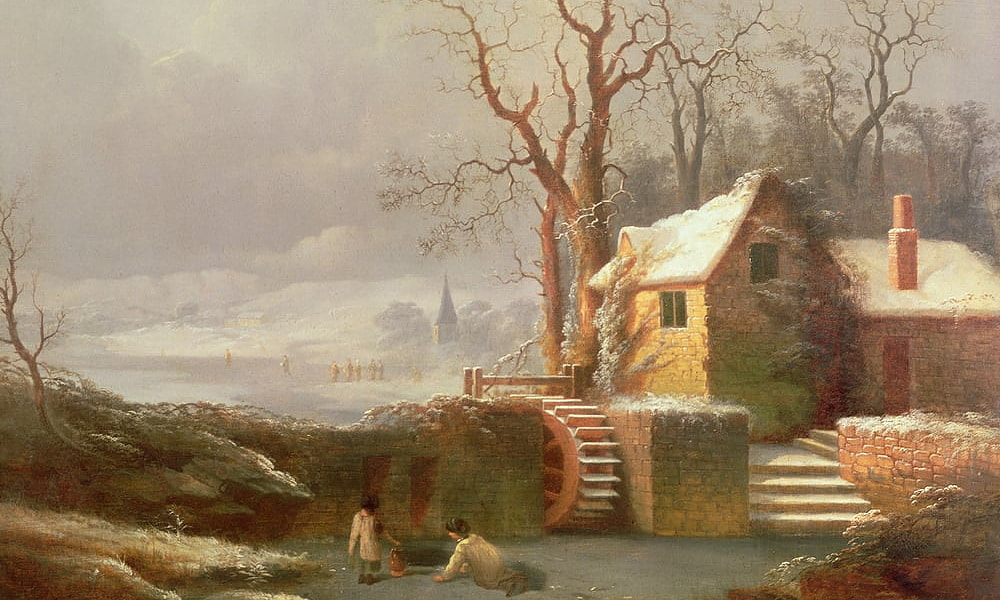
.jpg "Snow Scene with Mill and Cottages by George Smith")
.jpg)
 - (MeisterDrucke-20382).jpg "Landscape (European Farm) by Prilidiano Pueyrredon")
 - (MeisterDrucke-20382).jpg)
 - (MeisterDrucke-90127).jpg "Ukrainian cottages, 1906 by Petr Levchenko")
 - (MeisterDrucke-90127).jpg)
.jpg "Thatched Cottage in Normandy, 1894 by Alfred Sisley")
.jpg)
.jpg "Mrs Snookes house at Ringmer, Sussex, England, 1733 by English School")
.jpg)
.jpg "Thatched Cottage in Picardy by Jean-Baptiste-Camille Corot")
.jpg)
.jpg "Ivy Cottage, Shoreham by Samuel Palmer")
.jpg)
.jpg "The Brook, Steventon, from The Cottages and the Village Life of Rural England, published by Dent & Sons Limited, 1912 by Alfred Robert Quinton")
.jpg)
.jpg "Farmyard, Porlock, Somerset by Leghe Suthers")
.jpg)
_-_(MeisterDrucke-134676).jpg "The Arch of Titus in Rome, 1839 by Carl-Christian-Constantin Hansen")
_-_(MeisterDrucke-134676).jpg)
.jpg "A View of Asheville, North Carolina by Robert Scott Duncanson")
.jpg)
.jpg "Woman in Front of a Cottage by Egbert van der Poel")
.jpg)
.jpg "Landscape at Pont-Aven, 1888 by Paul Gauguin")
.jpg)
.jpg "At the Farm, Ulvin by Gerhard Peter Frantz Vilhelm Munthe")
.jpg)
.jpg "Landscape with Windmills by Thomas Shotter Boys")
.jpg)
.jpg "Landscape near Arles by Paul Gauguin")
.jpg)
.jpg "A Farm in Normandy by Nicolas Louis Cabat")
.jpg)
.jpg "Old Barn by Lionel Constable")
.jpg)
.jpg "Golden Autumn. Slobodka by Isaak Ilyich Levitan")
.jpg)
.jpg "Long Wittenham, Berkshire, from The Cottages and the Village Life of Rural England published by Dent & Sons Limited, 1912 by Alfred Robert Quinton")
.jpg)
.jpg "Landscape with Farmhouse by François Boucher")
.jpg)
.jpg "Landscape, Trinidad by James Wilson Morrice")
.jpg)
.jpg "Tillington, Nr Petworth, Sussex, from The Cottages and the Village Life of Rural England published by Dent & Sons Limited, 1912 by Alfred Robert Quinton")
.jpg)
.jpg "Village Street Scene by Charles James Fox")
.jpg)
.jpg "Tree and Barn by Allen Tucker")
.jpg)
.jpg "Small House by Alfred Henry Maurer")
.jpg)
.jpg "Orakei Korako on the Waikato by Charles Blomfield")
.jpg)
.jpg "Limonaia and garden, Villa di Celle by Italian School")
.jpg)
.jpg "Villagers Struggling to Put Out a Cottage Fire by Adriaen Lievensz van der Poel")
.jpg)
.jpg "Winter Landscape by George Smith")
.jpg)
.jpg "Native Huts by Winslow Homer")
.jpg)
.jpg "Unknown Image by Unbekannt Unbekannt")
.jpg)
.jpg "Winter in the Country by George Henry Durrie")
.jpg)
.jpg "House in Woodbridge, Suffolk by Thomas Churchyard")
.jpg)
.jpg "The Gunpowder Magazine, Hyde Park by Paul Sandby")
.jpg)

 +43 4257 29415
 support@meisterdrucke.com
 Mo-Do: 7:00 - 16:00 | Fr: 7:00 - 13:00